
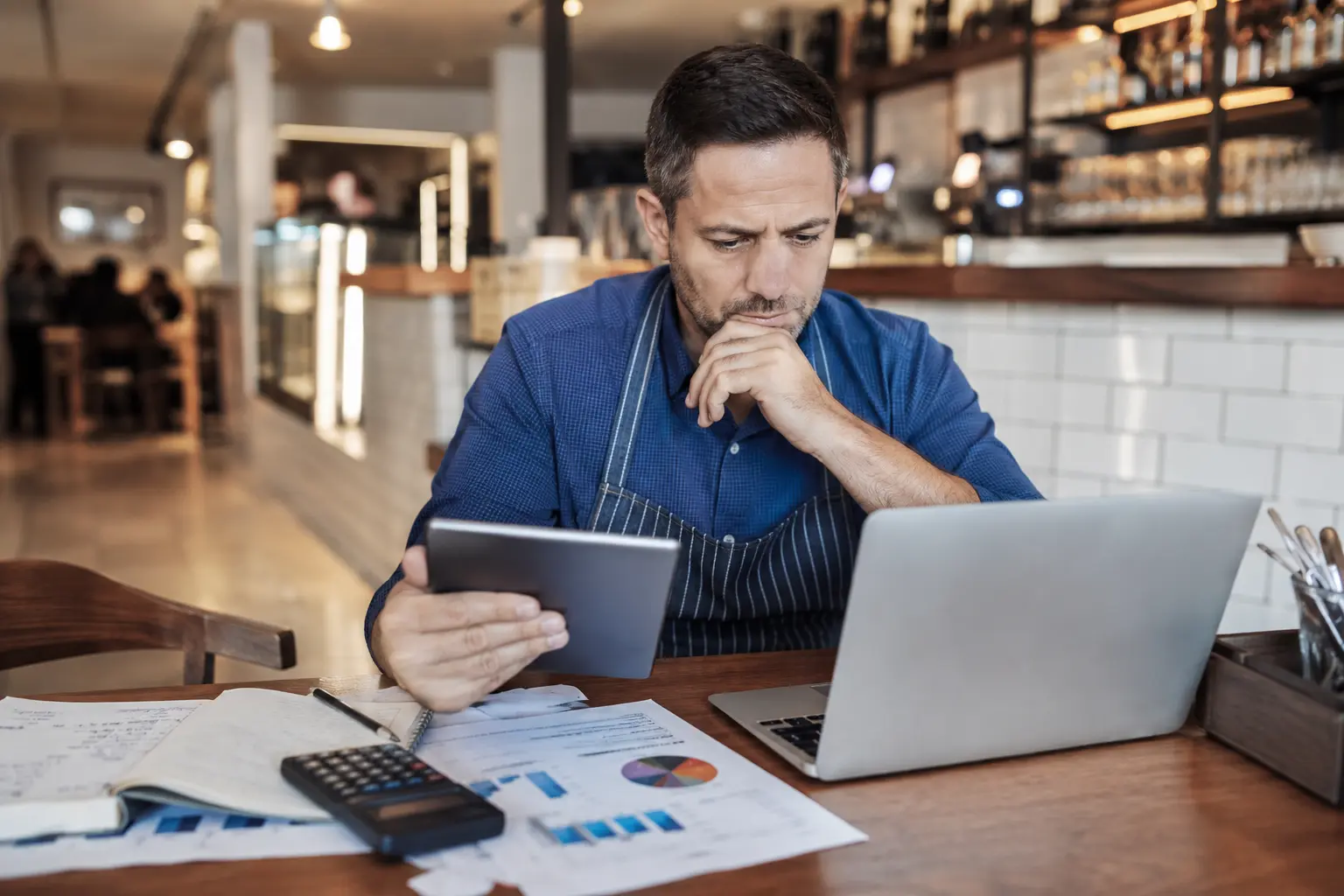
Not every restaurant is at the same stage of digitalization, and that is fine. A small bistro with a single service a day has different needs from a restaurant with its own delivery fleet, online orders, and three simultaneous sales channels. The question is not whether you are fully digitalized, but whether the tools you are currently using are still keeping pace with the volume and complexity of your business.
The most common signs that your restaurant needs digitalization do not arrive as a sudden crisis. They come as a gradual accumulation of small things: hours lost daily to manual tasks, errors that repeat week after week, decisions made on intuition rather than data. These signals appear before they become serious problems, if you know what to look for.
This article presents seven concrete signs that show you have outgrown your current processes, and that digitalization is no longer a future option but a present-day necessity.
The First Sign: Phone Orders Are Taking Up Too Much Time
If a staff member spends 30 to 60 minutes a day taking orders over the phone, writing down addresses, repeating dishes, and confirming everything verbally, this is the first and probably clearest sign that your restaurant needs a digital ordering channel. Not because the phone is bad, but because it is the least efficient way to handle a high volume of orders.
Every phone order requires the presence of an available staff member and a minimum processing time, regardless of how busy the rest of the shift is. The customer reads out an address and the staff member writes it down wrong. The customer asks for a modification and the staff member forgets to pass it on to the kitchen. The customer calls back to ask about the order and the staff member has to check and respond.
A digital ordering channel, whether a mobile app or a website with online ordering, automatically captures the order with all its details, sends it directly into the system, and eliminates the need for a human intermediary for this task entirely. Staff get their time back for what matters more.
The Second Sign: Order Errors Are Frequent and Generating Complaints
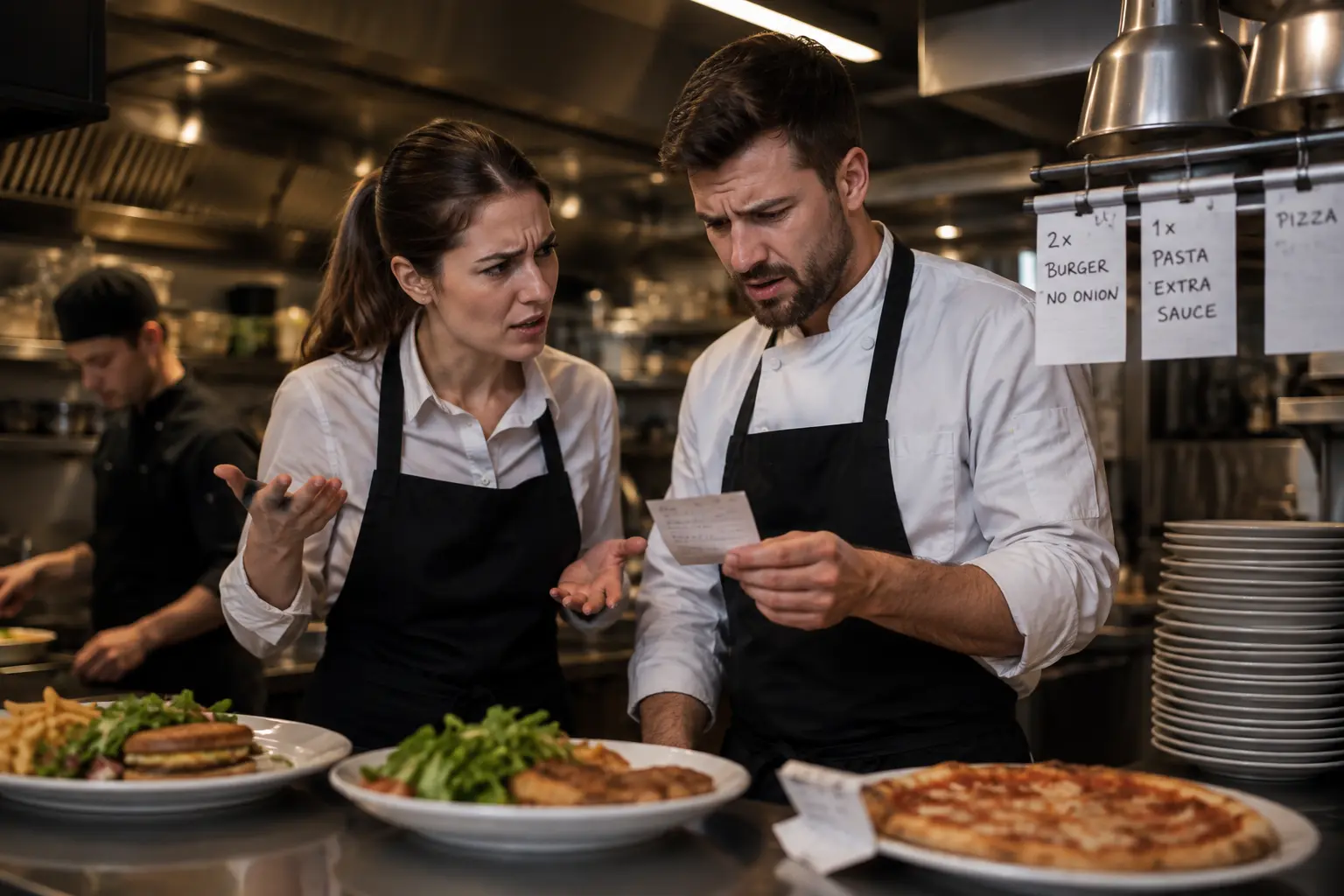
If you receive weekly complaints about wrong orders, missing items, or modifications that never reached the kitchen, this is not primarily a problem of staff attention. It is a problem with how information is transmitted. Orders passed on verbally or via paper tickets go through too many manual steps, and every manual step is a potential point of failure.
Order errors carry a triple cost: the ingredients, the work of preparing a new dish, and the negative experience of the customer, which significantly reduces the likelihood of them returning. A customer who receives the wrong order more than once will often stop coming back, even if the food itself is good.
A KDS screen (Kitchen Display System) connected to the POS eliminates verbal order transmission. The cook sees exactly what needs to be prepared, with what specifications and in what order, directly on the screen. Last-minute modifications arrive automatically, without depending on anyone's memory.
The Third Sign: You Don't Know What Each Dish Really Costs
If menu prices were set at launch and have not been recalculated since, or if you cannot say precisely what the food cost of each dish is right now, your restaurant is operating on outdated data. Ingredient costs change. Supplier prices go up. Portioning varies. The menu stays the same.
Without a system that connects recipes with the real prices of ingredients and with actual sales, you cannot know whether a popular dish is also profitable, or whether you are selling it at a loss. Menu engineering, the practice of systematically analysing which dishes deserve to be promoted and which need to be adjusted, is impossible to apply without connected data.
This is one of the areas where an inventory management system connected to the POS and all other sales channels makes an immediately visible difference: the real cost per dish can be calculated from actual ingredient consumption, not estimated from memory. You can read more about how the absence of this data affects profitability in our article on how restaurants lose money without realising it.
The Fourth Sign: Stock Takes Are Done Manually and Always Have Discrepancies
A stock take at the end of the day or week, done manually with pen and paper or in Excel, is one of the clearest signs that your restaurant needs digitalization. Not because the process itself is wrong, but because it is slow, prone to error, and does not provide real-time visibility.
If you discover during a stock take that an ingredient has run out when it should not have, that the discrepancy between theoretical and actual stock is a recurring pattern, or that the manager is spending several hours a week on this task alone, you have already reached the point where the cost of the manual process exceeds the cost of a digital tool.
Digital inventory management updates stock automatically with every order sold, based on the configured recipes. You know at any moment what you have and what you are running low on, without counting anything physically. Low-stock alerts tell you when to order, not after you have run out.
The Fifth Sign: You're Managing Orders from Multiple Sources on Separate Devices
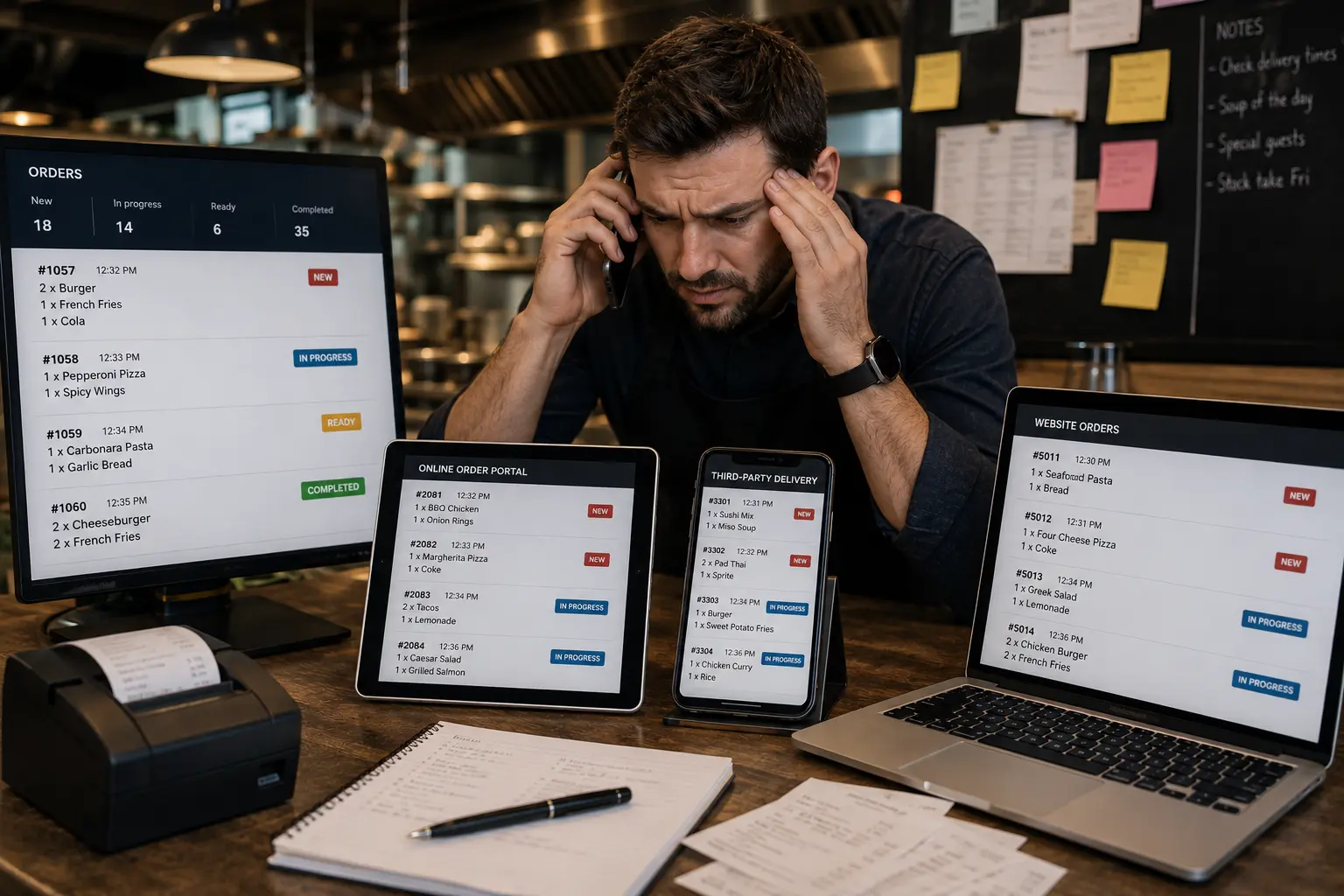
One tablet for Glovo, one for Bolt Food, one for Wolt, possibly one for orders from your own app. Each makes a different sound, displays information in different formats, and demands separate attention at the same time. The counter staff perform mental gymnastics during peak hours to avoid missing a single notification.
This is a major warning sign — not that you have too many channels, but that they are not integrated. Integrating all orders into a single POS eliminates this fragmentation. All orders, regardless of source, appear on the same screen, are sent to the same KDS, and are managed from the same dashboard. The counter staff member has one task instead of four.
According to AedanRose, one of the most common mistakes in adopting restaurant technology is adopting multiple disconnected systems, which creates workflow inefficiencies and training challenges. The solution is not fewer channels, but better integration between them — or, better still, a restaurant ecosystem where modules communicate natively with each other.
The Sixth Sign: You Compile Sales Reports Manually or Not at All
If at the end of the week or month you do not have a clear picture of sales by time slot, by dish, by channel, or by server, you are working without the data you need to make good decisions. If these reports exist but you compile them manually from multiple sources, you are losing time and producing data that carries a real risk of error.
A modern POS system automatically generates the relevant reports: which hours are the busiest, which dishes contribute most to profit, which servers have the highest average order value, how sales have evolved compared to the previous week — all available in real time, with no manual work.
Without this data, decisions about staffing schedules, menu changes, or price adjustments are made on instinct. And instinct, even that of the most experienced manager, systematically misses the trends that appear in data. According to EHL Insights, the common thread among restaurants that reported real efficiency improvements after adopting technology was not how sophisticated any individual tool was, but how well their tools shared data with each other.
The Seventh Sign: You Don't Know Your Customers and Don't Know Why They Leave
If you know your return rate is low but cannot identify which customers have been lost, when they last ordered, or what might bring them back, the problem is not a lack of interest in your customers. It is the absence of the data that makes them visible. Every customer who orders through Glovo or Bolt remains anonymous to your restaurant, regardless of how many times they have ordered. You do not know who orders most often, what they prefer, whether new customers become returning ones, or whether the people who visit in person are the same as those who order online.
Without customer data, any marketing strategy is expensive and inefficient. You spend on advertising without knowing who it reaches, you run promotions that go to everyone instead of those who would react, and you cannot measure the impact of any campaign.
Digitalization in this respect does not necessarily mean a complex loyalty programme. It means having your own ordering channel, whether a mobile app or a website, through which customers create an account and become identifiable. Every order placed with an account automatically builds a profile: order history, frequency, average value, preferences. From there, you can see who has not ordered in 30 days and send a reactivation message through the TapTasty targeted marketing module. You can read more about how a customer database works and what it contains in the dedicated article on the TapTasty blog.
Conclusion: Where to Start
If you recognise yourself in three or more of the signs above, it does not mean your restaurant is struggling. It means there are clear areas where your current processes are costing you more than they should, and where a concrete change can make a visible difference quickly.
The order in which you start matters more than the speed. If order errors are the most pressing problem, you start with a POS connected to a KDS. If the absence of data is the most urgent issue, you first build your own ordering channel. If the chaos between channels is what exhausts you most, you prioritise integration.
TapTasty is a modular platform for restaurants that brings together orders, operations, and marketing in a single digital ecosystem. You can start with one module and add others as the restaurant grows. If you want to understand the right order to start in and which tools best fit your situation, the complete restaurant digitalization guide is a solid starting point, and you can explore TapTasty's modules based on your restaurant's actual needs.