
Every restaurant has customers it does not know. Not because they are unimportant, but because no system exists to record them. You know someone orders regularly, but you do not know their name. You notice order volume has dropped compared to last month, but you cannot identify which customers have gone or why. You want to send an offer to your most loyal customers, but you do not know who they are.
The problem is not a lack of interest in customers. It is the absence of the infrastructure that makes them visible. The restaurant customer database is precisely that infrastructure: a collection of individual profiles that forms automatically the moment a customer creates an account and places an order through your restaurant's own channels. Not a manually filled register, not an Excel spreadsheet updated sporadically, but a database that grows and is enriched with every interaction.
This article explains what this database contains, why it does not get built if you sell exclusively through aggregators, how to use it for concrete decisions, and how to grow it over time.
What a Restaurant Customer Database Actually Is
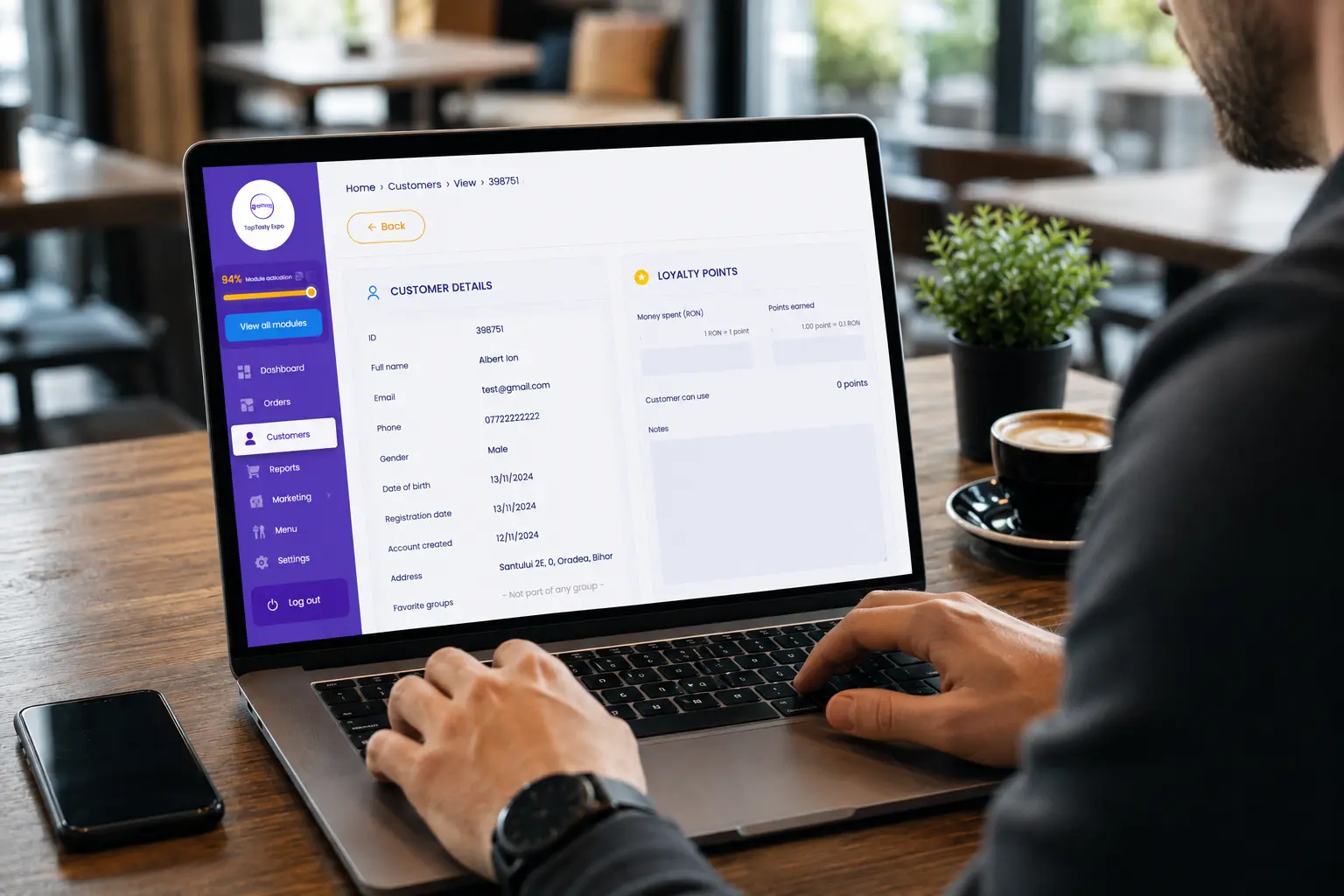
A restaurant's customer database is the collection of individual profiles of customers who have interacted with the restaurant through its own online channels: a mobile app or website. Every customer who creates an account and places an order automatically generates a profile in this database.
The profile contains the information the customer provided at sign-up (name, email address, phone number, gender) and all subsequent interactions recorded by the system: what they ordered, when, how much they spent, how often they order, whether they used a coupon or a referral code, and how many loyalty points they have accumulated. This is not a manually maintained register, but a database updated automatically with every order.
This collection of data is what sets apart a restaurant that can make informed decisions from one that operates on instinct. And it is what makes any direct marketing, loyalty, or customer reactivation strategy possible.
Why You Do Not Have It If You Sell Exclusively Through Aggregators
The most important thing to understand about the restaurant customer database is that it does not build itself automatically if you sell exclusively through third-party platforms. A customer who orders through Glovo, Bolt, or Wolt enters the platform's database, not the restaurant's. You know you received an order and who placed it, but after that, that data is not saved anywhere in your restaurant.
This has concrete practical consequences. You cannot send a reactivation message to a customer who has not ordered in 30 days, because you do not know who that customer is. You cannot analyse what your most loyal customers prefer, because you have no way of identifying returning customers unless you track them manually. You cannot personalise an offer for a specific customer segment, because there is no segment, only individual anonymous orders.
According to Evokad research, restaurants with their own customer databases grow five to ten times faster than those relying exclusively on third-party platforms, precisely because they can run remarketing, segmentation, and retention without paying an intermediary every time they want to reach their own customers.
A customer relationship built through your own channels is a business asset. One mediated by an aggregator is a recurring cost.
How the Customer Database Is Built Automatically
Your restaurant's customer database is built through any ordering channel that requires account creation: the restaurant's mobile app or the online ordering website. The moment a customer creates an account and places their first order, a new profile is automatically generated in the system. With every subsequent order, the profile is enriched with new information.
The process requires no manual intervention from the team. The customer fills in the fields at sign-up, accepts the terms and conditions, and from that point every interaction they have with your restaurant is recorded and linked to their profile. When they order a new dish, it appears in their history. When they use a coupon, it is noted. When they stop ordering for a month, the system shows you this information and you can build a reactivation campaign.
TapTasty brings all of this data together in one place. Even if a profile is created through the app or the website, the customer can subsequently order through any TapTasty ordering channel and still be identified. Whether a customer first ordered through the app and returns via the website, or places their order in-venue through the kiosk or at the POS, the system does not create a new profile but continues to enrich the existing one. The customer database thus reflects a genuine picture of each person's behaviour, not a collection of isolated orders.
What a Customer Profile Contains
A customer profile in the restaurant database contains several layers of information, each useful in a different way.
Identification data: name, email address, phone number, gender, age, and delivery address. These allow direct contact with the customer and their identification in any context.
Order history: every order placed, with the dishes chosen, amount spent, date, and channel used. From the order history you can see what the customer prefers, whether they have tried new dishes or always order the same things, and how the average value of their orders has evolved over time.
Frequency: how many times per month they order and when they last placed an order. This is the information that makes reactivation campaigns possible. A regular customer who suddenly disappears is a signal for action, not for waiting.
Loyalty points and rewards: how many points they have accumulated, how many they have used, and which rewards they have received. This data shows the customer's level of engagement with the restaurant's loyalty programme.
Acquisition source: where the customer came from, whether they were referred by someone through the referral programme or discovered the restaurant another way.
Chowly notes that the top 5% of a restaurant's customers generate, on average, 28% of total sales. Without your own database, you do not know who that 5% is, you cannot reward them differently, and you cannot do anything concrete to retain them.
What to Do With Your Customer Database
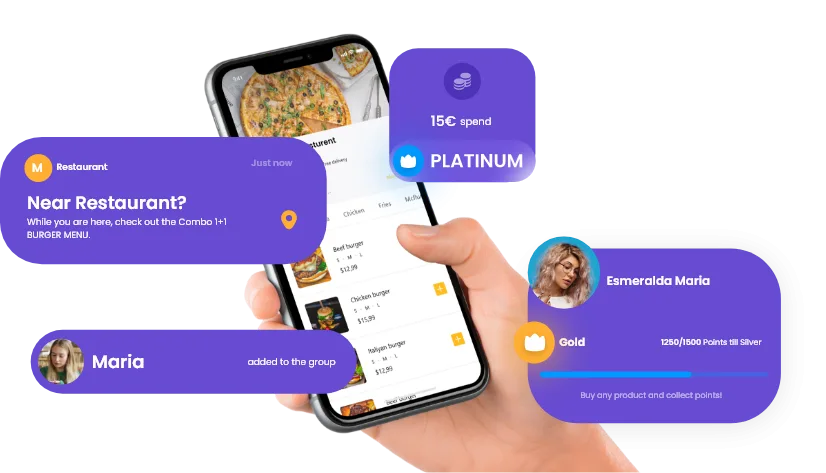
With all that said, a restaurant customer database without a strategy for using it is just a data warehouse. Its real value appears when it is actively used for marketing, loyalty, and communication decisions. Here are some ways to put it to work with the help of the TapTasty restaurant ecosystem:
Customer segmentation. Using data from the customer database, you can define thresholds based on the number of orders placed or the total amount spent. As a customer reaches a threshold, they automatically unlock an exclusive reward: a free item, a discount, or access to an offer available only at that loyalty level. The system works in the background with no manual intervention. The customer orders, accumulates, and is rewarded automatically when they reach the set threshold. The TapTasty segmentation module lets you configure these thresholds and associate them with the right rewards for your type of restaurant.
Reactivation campaigns. A customer who has ordered several times and suddenly disappeared is far more valuable to reactivate than a new customer, both in terms of cost and probability of success. The TapTasty targeted marketing module allows you to send a personalised message to customers who have been inactive for more than X days, with an offer that gives them a reason to come back.
Personalised offers. If you know a customer regularly orders a particular type of dish, an offer for that category has a far higher conversion rate than a generic promotion. Personalising communications does not require a complex system — it simply requires the data from your customer database.
Consumer behaviour analysis. The database answers questions you would otherwise have no way of addressing: what is the average value of a customer over a year? How many new customers from this month will return next month? Which dishes are most often associated with orders from your most loyal customers? These answers guide decisions about the menu, pricing, and marketing.
How to Grow Your Customer Database
A customer database does not grow passively. Launching an app or a website and waiting is not enough. It grows as more customers choose to order with an account through your restaurant's own channels rather than third-party platforms, and that happens when you have active mechanisms to attract and register them. A few concrete methods that work:
Registration at first order. The account creation process must be as simple and quick as possible, accompanied by a clear reason to complete it: a benefit on the first order, automatic enrolment in the points programme, or access to offers available only in the app. The more concrete the reason, the more customers will complete registration rather than ordering as anonymous guests.
Gift cards. A gift card purchased by an existing customer and given to a friend is, in practice, an invitation into your database. The friend downloads the restaurant's app to activate and use the card, creates an account, and becomes a new profile in the system. TapTasty allows you to configure gift cards that can be purchased directly from the app and given as gifts, bringing new customers into the database without additional marketing costs.
The referral programme. Every customer in your database can bring in new customers through personalised recommendation links. The new customer who comes through a referral enters the database with an activated profile, not as an anonymous visitor. The TapTasty loyalty and referral programme allows you to set rewards for both the ambassador and the invited customer after the new member places their first order. Furthermore, ambassadors can receive recurring monthly rewards based on a percentage or fixed amount from the orders placed by the customers they have referred — a mechanism that keeps motivation active in the long run, not just at the first recommendation.
Conclusion
A restaurant's customer database is not a marketing concept — it is infrastructure. It is the collection of profiles that makes everything else possible: segmentation, personalised communication, reactivating inactive customers, loyalty programmes. Without it, all of these strategies are abstract. With it, they become concrete actions based on real data.
Every customer who orders with an account through your app or website adds a row to this database. Every subsequent order enriches it. The sooner you start building this infrastructure, the sooner it becomes a genuine competitive advantage.
TapTasty can help you configure a customer database and gives you all the tools you need to get maximum value from it. Request a personalised quote!