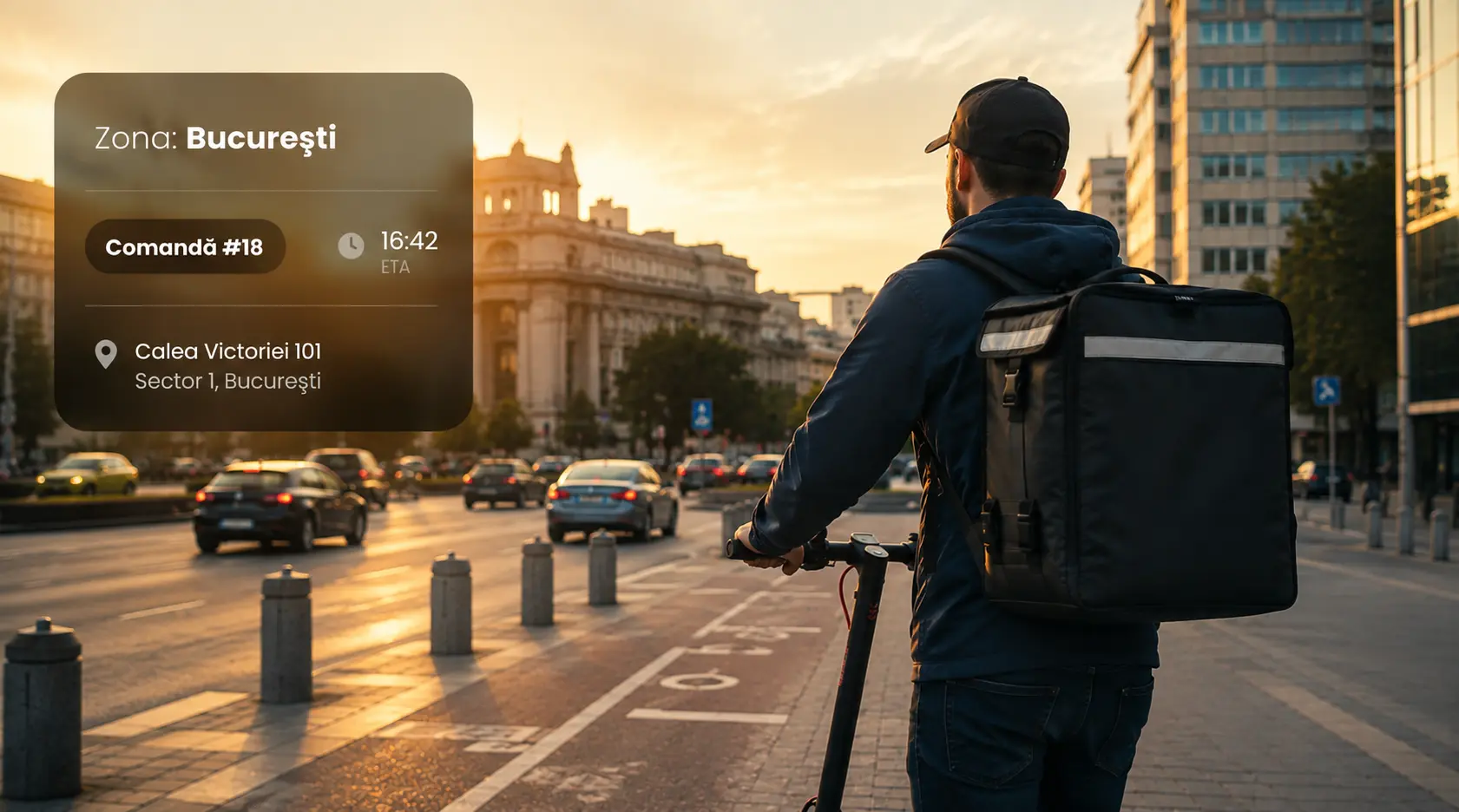
Delivering with your own fleet is one of the most profitable decisions a restaurant with a consistent volume of online orders can make. Without the commissions charged by a third-party aggregator, the profit margin per order increases immediately. And the relationship with the customer remains direct: you know who ordered, what they ordered, and you can control the quality of the experience from order to their front door.
The challenge arises when order volume grows and coordinating drivers becomes complex. Without a dedicated tool, the manager handles orders verbally or on paper, drivers leave without knowing the optimal delivery sequence, and the kitchen does not always know which order to prioritise. Restaurant delivery software solves exactly these problems: it automates order dispatch, optimises routes, and connects the driver to the rest of the restaurant's operations in real time.
This article explains why managing your own fleet is more complex than it seems, what restaurant delivery software does, what features to look for, and how the TapTasty solution works in practice.
Why Managing Your Own Fleet Is More Complex Than It Seems
At first glance, managing two or three drivers seems simple. An order comes in, the driver picks it up and leaves. The problem appears when orders come in simultaneously from multiple channels, when two drivers are available at the same time but heading to different zones, or when an order is ready earlier than expected and the driver has already left with something else.
Without a system, all of these decisions fall on the shoulders of a staff member who handles them verbally while also serving other orders at the counter. A driver sometimes leaves with a single order when they could have taken two going to the same area. The kitchen prepares a delivery order that will not be picked up for a while, while another urgent order waits. The customer does not know when to expect the delivery because no realistic estimate has been sent.
Deliverect reports that 72% of restaurants say high platform fees are their most significant challenge. This is precisely why more and more restaurants are choosing to invest in their own fleet and the tools that make it efficient. Restaurant delivery software transforms driver coordination from a manual, error-prone task into an automated and fully visible process for the whole team.
What Restaurant Delivery Software Does
Restaurant delivery software is a system that manages the entire lifecycle of a delivery order: from the moment the order is marked as ready in the kitchen, through to confirmation that it has reached the customer. The main functions it covers are:
Automatic order dispatch. Instead of a staff member manually deciding which driver takes an order, the system assigns it automatically based on availability and delivery zone. If a driver already has an order in that zone, the system can group orders to maximise the efficiency of a single route.
Route optimisation. The system calculates the optimal delivery sequence when a driver has multiple orders, taking into account distance and the priority of each order. Less time on the road means more deliveries per hour and food that arrives warmer.
Mobile app for drivers. The driver receives the order details directly on their phone, without needing to ask for them verbally or write them down. They see the address, any special instructions, and the delivery sequence if they have multiple orders.
Customer notifications. The customer can automatically receive an estimated delivery time and a notification when their order has left. This reduces the number of calls the restaurant receives to check on order status.
Integration with the POS and kitchen. Most importantly, restaurant delivery software does not work in isolation. It connects with the restaurant's POS system, so a new order entering the POS automatically triggers the delivery process without any additional manual input.
What Features to Look For
Not every delivery software suits every restaurant profile. Before choosing, here are a few criteria that make a real difference in practice:
Native POS integration. A delivery system that does not communicate with your POS means orders must be entered twice. Look for a solution that pulls orders automatically from the POS with no manual intervention.
Kitchen integration (KDS). The delivery order needs to reach the kitchen screen with the right priority, based on when the driver is due to pick it up. A driver who arrives and has to wait for the order wastes time, and the customer receives colder food.
Dedicated mobile app for drivers. The driver needs simple access to all the order information: address, special instructions, order sequence. A clear app reduces errors and eliminates the need for constant verbal communication.
Order grouping by zone. If you deliver across multiple areas of the city, the system should be able to automatically group orders for the same route, so a driver does not make a separate trip for each order.
Performance reports. How many deliveries does a driver complete per hour? What is the average time per delivery? Which zones generate the most orders? The data that answers these questions is essential for optimising the fleet over time.
According to Locus.sh, the most effective restaurant delivery management systems combine complete real-time visibility with automated order dispatch, significantly reducing customer wait times and the number of delivery errors.
How the TapTasty Delivery Software Works
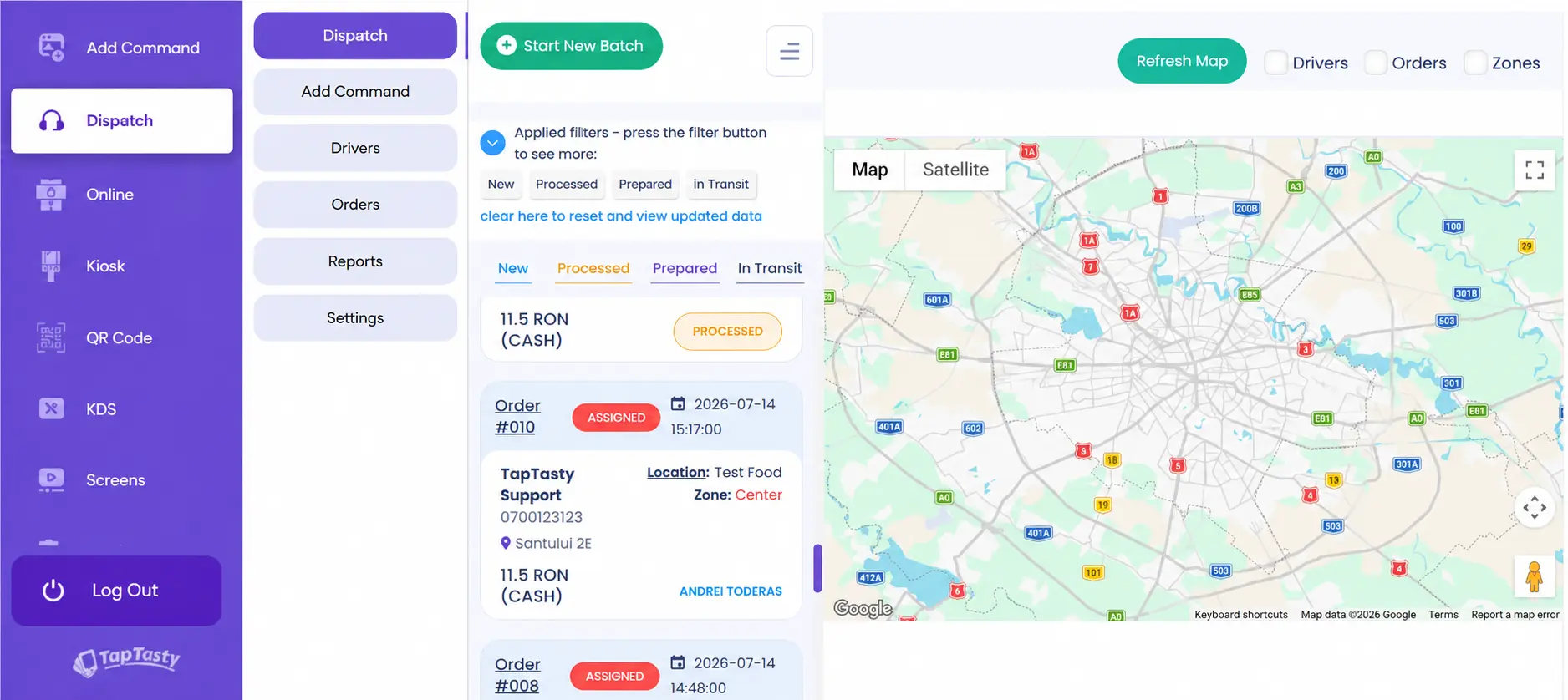
The TapTasty delivery management software is built specifically for restaurants with their own delivery fleet and is natively integrated with the platform's other modules: the POS, the KDS, and online ordering channels.
The flow of an online order looks like this: the order enters the POS through the mobile app or the website, it arrives automatically on the kitchen KDS with the correct priority, and the moment the cook marks it as ready, the details are automatically sent to the delivery software, where it is organised and then dispatched to the driver's app. The driver does not need to ask anyone what they are picking up, at what address, or in what order. Everything is on the screen of their phone.
If a driver has multiple simultaneous orders, the system groups them by zone and suggests the optimal delivery sequence. The manager has a real-time picture of all orders in progress: what is being prepared, what is ready for pick-up, what is already on the way, and what has been delivered. There is no longer a moment when nobody knows where an order is.
Integration with the rest of the TapTasty platform means that delivery data appears in the same sales reports as in-venue orders or orders from other channels. You can see how many delivery orders you have per day, what the average value of a delivery order is compared to an in-venue order, and how volume is evolving week by week, without accessing separate systems.
How to Measure Delivery Efficiency
Implementing restaurant delivery software brings with it data you did not have before. What should you measure to know whether delivery has become more efficient?
Average time per delivery. How long does it take, on average, from the moment an order is marked ready in the kitchen to delivery confirmation? If this time increases, you can identify the cause: unoptimised routes, insufficient drivers during certain periods, or zones with heavy traffic.
Number of deliveries per driver per hour. This indicator shows how efficiently the fleet is being used. A driver with a well-optimised route can complete significantly more deliveries per hour than one who leaves without prioritised orders.
Percentage of orders delivered within the estimated time. How many orders arrive within the window communicated to the customer? A low rate affects customer satisfaction and increases the likelihood of complaints or negative reviews.
Average cost per delivery. Including the driver's wage and operational costs, how much does a delivery cost relative to the order value? If the cost per delivery exceeds a certain threshold, it may be time to adjust the delivery zone or the delivery price.
Without restaurant delivery software to collect this data automatically, it is almost impossible to calculate these figures accurately using manual processes.
Conclusion
Your own delivery fleet is a genuine competitive advantage for a restaurant with consistent order volume, but without the right tools it quickly becomes a source of operational chaos. Restaurant delivery software is not a luxury reserved for large chains. It is a practical necessity for any operator who wants to coordinate more than two or three drivers with real efficiency.
If you already have your own fleet or are planning to build one, you can see how the TapTasty delivery management module works and how it integrates with the platform's other tools. And if you are thinking about the broader strategy of reducing dependency on aggregators, you can also read our article on how to build your own alternative to food delivery aggregators.