
There is a widespread fear among restaurant employees when it comes to technology: that it is coming to take their jobs. This fear is not irrational, especially at a time when automation is present in almost every industry. But in practice, restaurants that have adopted technology have not reduced their teams. They have changed what the people in them do and, in most cases, for the better.
The restaurant industry has one of the highest staff turnover rates of any sector. Long hours, a demanding pace, the physical and mental pressure of each shift, the inevitable errors during peak hours, and difficult communication between the front of house and the kitchen all contribute to a working environment that exhausts and discourages. Technology and restaurant staff work best together when implementation is designed with people at its centre, not just processes. In this way, it does not add another layer of complexity but eliminates the friction that makes the work harder than it needs to be.
This article covers the main ways in which technology concretely helps restaurant staff: from reducing order errors and the stress that comes with them, to clearer communication between front of house and kitchen, faster onboarding for new employees, and more time for genuine hospitality.
Order Errors and Their Human Cost
The most visible source of stress for restaurant staff is not the workload itself but the errors. A wrong order sent to the kitchen, a dish brought to the wrong table, a last-minute modification that never reaches the cook. Every error carries an operational cost, but also a human one. The server who receives the complaint feels guilty. The cook who has to re-prepare a dish feels pressured. The customer who receives something wrong is dissatisfied, and that dissatisfaction is felt by the entire team on shift.
Tripleseat estimates that digital order management systems reduce errors by up to 30%, and that reduction translates directly into fewer tense moments, fewer reproaches, and a calmer service. Not because people have suddenly become better, but because the system eliminates the points where errors most commonly occur: the verbal passing of orders, manual transcription, and fragmented communication between front of house and kitchen.
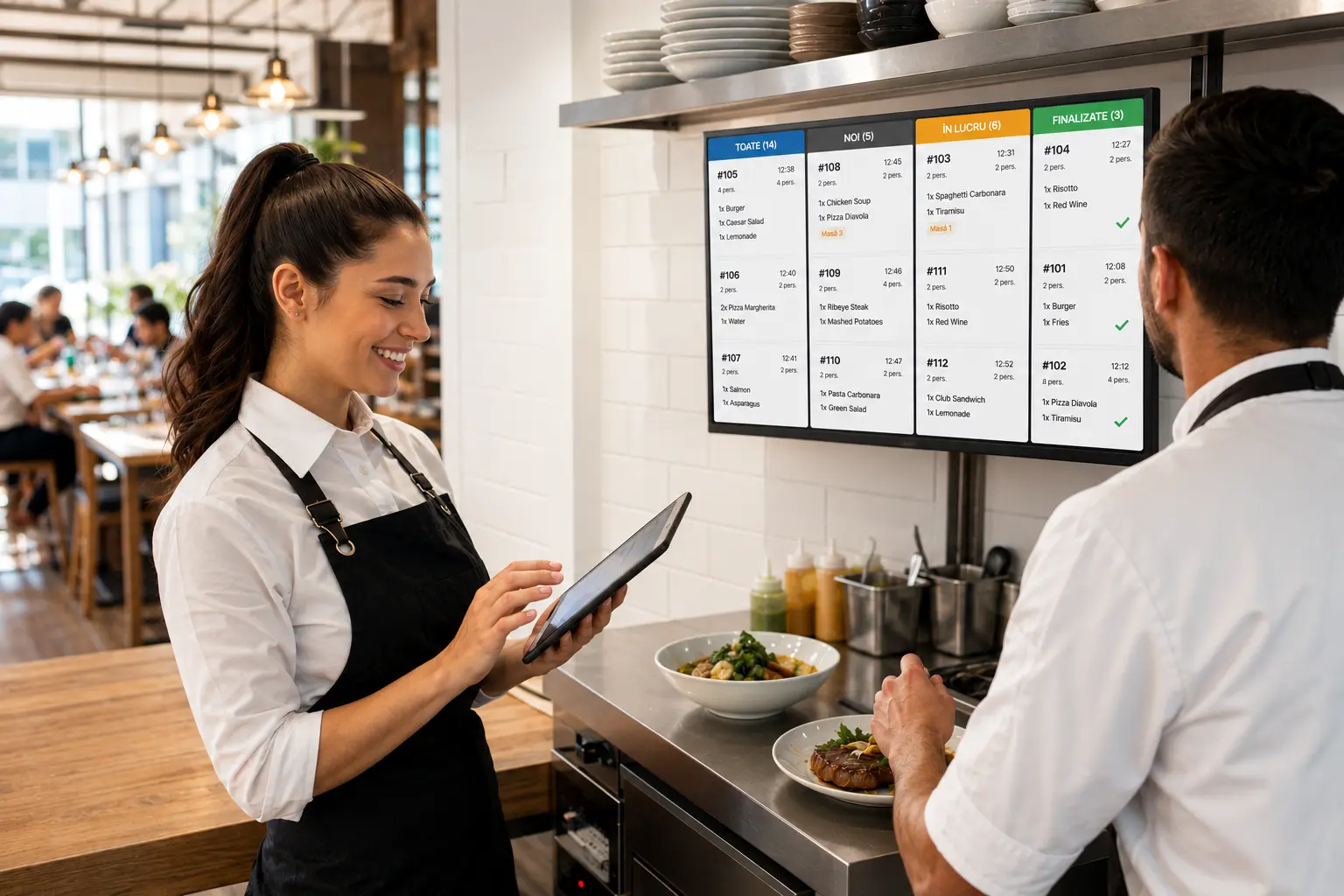
A KDS screen (Kitchen Display System) displays orders from the POS directly on the kitchen screen, organised by station and automatically prioritised. The cook no longer has to decipher handwriting on a paper ticket in the noise of a busy service. They see clearly what needs to be prepared, in what order, and with what specifications.
The Mobile POS and the Time Servers Gain Back
A server in a table-service restaurant makes dozens of trips per shift between the tables and the counter or POS terminal. They need to enter an order, check the status of a dish, process a payment. Each trip takes a few minutes. Over a four-hour service, the sum of those minutes becomes hours lost from direct interaction with the customer.
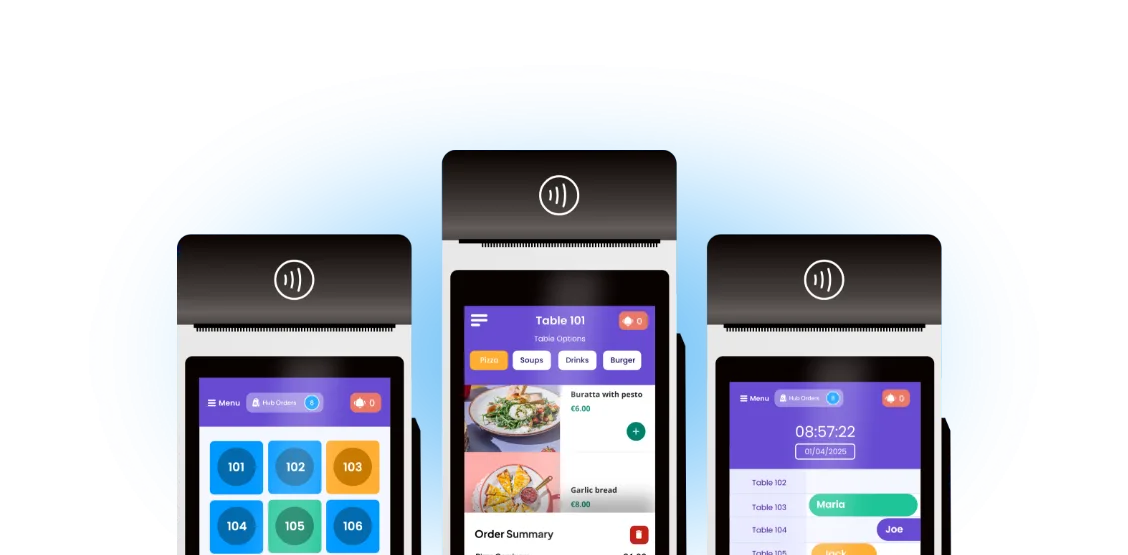
A mobile POS, installed on a tablet or phone, changes this dynamic. The server takes the order directly at the table, sends it to the kitchen from the same spot, and can process payment without leaving the customer waiting. They are no longer a courier of information between the table and the counter, but a host who spends time where it matters.
The mobile POS also reduces the pressure during peak hours. When the whole team can take and process orders from anywhere in the venue, without crowding around a single fixed terminal, service flows more smoothly and the tension is distributed more evenly across the team. Furthermore, the TapTasty mobile POS can receive notifications when a dish is ready in the kitchen, so the server simply needs to serve it, keeping the operational flow uninterrupted.
Communication Between Front of House and Kitchen
One of the main reasons stress builds up in restaurants is poor communication between the dining room and the kitchen. Orders called out, lost tickets, modifications passed on informally all create situations in which staff on one side of the restaurant work with incomplete information compared to those on the other side. This is precisely where technology and restaurant staff complement each other best: not by replacing human interaction, but by removing the points where it most often breaks down.
Barmetrix notes that a KDS does not just replace paper but reduces stress. This is an important distinction. It is not about abstract efficiency, but about the fact that the cook no longer has to guess the priority of orders, that the server knows when a dish is ready without having to go and ask, and that modifications reach the kitchen without depending on anyone’s memory.
How Technology Helps Managers
Restaurant managers spend a disproportionate amount of time on administrative tasks that, without a digital system, cannot be delegated. Manual stock-takes at the end of the day, reconciling orders from multiple sources, sales reports compiled from several different records. These are all important tasks, but none of them is where a manager’s real value lies.
Hostie.ai notes that automating repetitive administrative tasks leaves managers more time to support their team and keep operations running smoothly. This is the real impact of technology on a manager’s role. It does not replace them, but it frees their attention for what no software can do: resolving difficult situations within the team, mentoring new employees, noticing when service is not running well, and stepping in before a small problem becomes a large one.
An inventory management system updated automatically from sales, and a dashboard with the day’s reports, do not eliminate the manager’s role. They give back a few hours a day so that role can be performed at full capacity.
Faster Onboarding for New Employees
Restaurants with high staff turnover face a recurring challenge: every new employee needs to quickly understand how the system works, how orders flow, and what the procedures are for unusual situations. Technology and restaurant staff form a more effective partnership when the digital system is intuitive. The new employee adapts more quickly, asks fewer questions of their colleagues, and contributes meaningfully to the team’s work sooner.
A clear digital system, with logical workflows and screens that guide the employee through the usual steps of service, significantly reduces this adaptation period. A new server who uses a modern POS knows, after a few shifts, how to process an order, how to remove an item, or how to send a modification to the kitchen. They do not need to memorise procedures or ask a colleague at every step. This reduces the new employee’s frustration, reduces the pressure on their colleagues, and speeds up the moment when they are genuinely contributing to the service.
Multiple Tablets and Cognitive Overload
A familiar sight in restaurants that deliver through multiple platforms: a counter covered in tablets. One for Glovo, one for Bolt, one for Wolt, sometimes a separate one for orders from the restaurant’s own app. Each device makes different sounds, displays information in different formats, and requires simultaneous attention at the busiest moments.
The employee managing these tablets during peak hours is not doing one task faster. They are doing multiple tasks simultaneously, with an increased risk of missing a notification, entering an order incorrectly, or forgetting that an order exists. The result is more errors, slower response times, and faster fatigue.
Integrating orders from all platforms into a single POS eliminates this overload. All orders, regardless of source, appear in the same place, in the same format, on the same screen. The counter employee has one task instead of four, and the kitchen receives all orders on the same KDS.
Delivery Drivers: Less Time Lost, More Deliveries
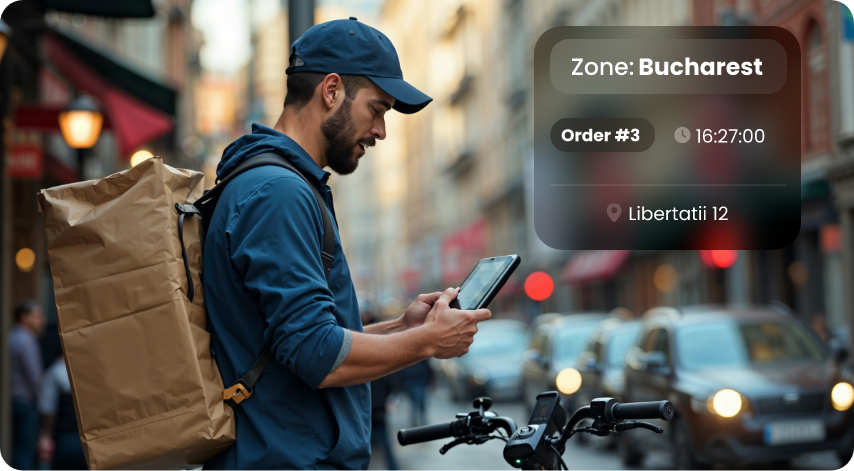
Restaurants with their own delivery fleet know that coordinating drivers is usually the least digitised point in the entire operational flow. The driver picks up the order, but often without knowing the optimal delivery sequence if they have multiple orders, without being automatically notified when an order is ready, and without a clear connection to what is happening in the kitchen.
A delivery management system provides exactly this connection. The driver receives the order directly in their app the moment the kitchen marks it as ready, with the address, any special instructions, and, if they have multiple orders, the optimal delivery sequence by zone. There is no longer any need for a counter employee to act as an intermediary in passing on the information. The result is a more efficient driver who can handle more orders without confusion, and a better customer experience.
Fewer Conflicts and Clearer Accountability
A less-discussed benefit of digital systems, but one that teams using them quickly notice, is the reduction of conflicts between front of house and kitchen. Not because people suddenly become more understanding of each other, but because there is a digital record of every order.
In a manual system, when a dish arrives incorrectly at the customer, an inevitable verbal reconstruction follows: “I said something different,” “I wrote down what was said to me,” “that’s not what the kitchen understood.” Nobody is necessarily lying, but everyone is working from a different version of the same information. The conflict has no objective resolution, which creates frustration and resentment.
When an order is entered digitally, there is an exact record of what was ordered, at what time, and with what specifications. If an error occurs, it can be pinpointed. This clarity does not mean errors disappear, but it does mean that accountability is no longer subjective. Difficult conversations become shorter and more productive, and the working atmosphere between teams improves over time.
The Server’s Role Changes, It Does Not Disappear
Perhaps the most important thing to understand about the relationship between technology and restaurant staff is that digital tools do not eliminate the need for people. They eliminate the need for people to spend time on tasks that a system can do better.
A server freed from order logistics, trips to the counter, and repeated checks on dish status has time for what no kiosk can do: noticing that a customer needs something before they ask, recommending a dish with genuine enthusiasm, creating that moment of connection that makes the difference between a good meal and a memorable one. Authentic hospitality cannot be automated. It becomes possible when people have the time and energy for it.
Conclusion
Technology and restaurant staff are not in competition. They are partners, when implementation is designed with people at its centre, not just processes. Fewer errors mean less stress. The mobile POS reduces physical fatigue. The KDS reduces tension between front of house and kitchen. Automating administrative tasks gives managers back time for what truly matters. Faster onboarding reduces the frustration of new employees.
Restaurants that understand this dynamic do not implement technology to cut staffing costs. They implement it so that the staff they have can work better, stay longer, and deliver exactly what no software can: genuine hospitality.