
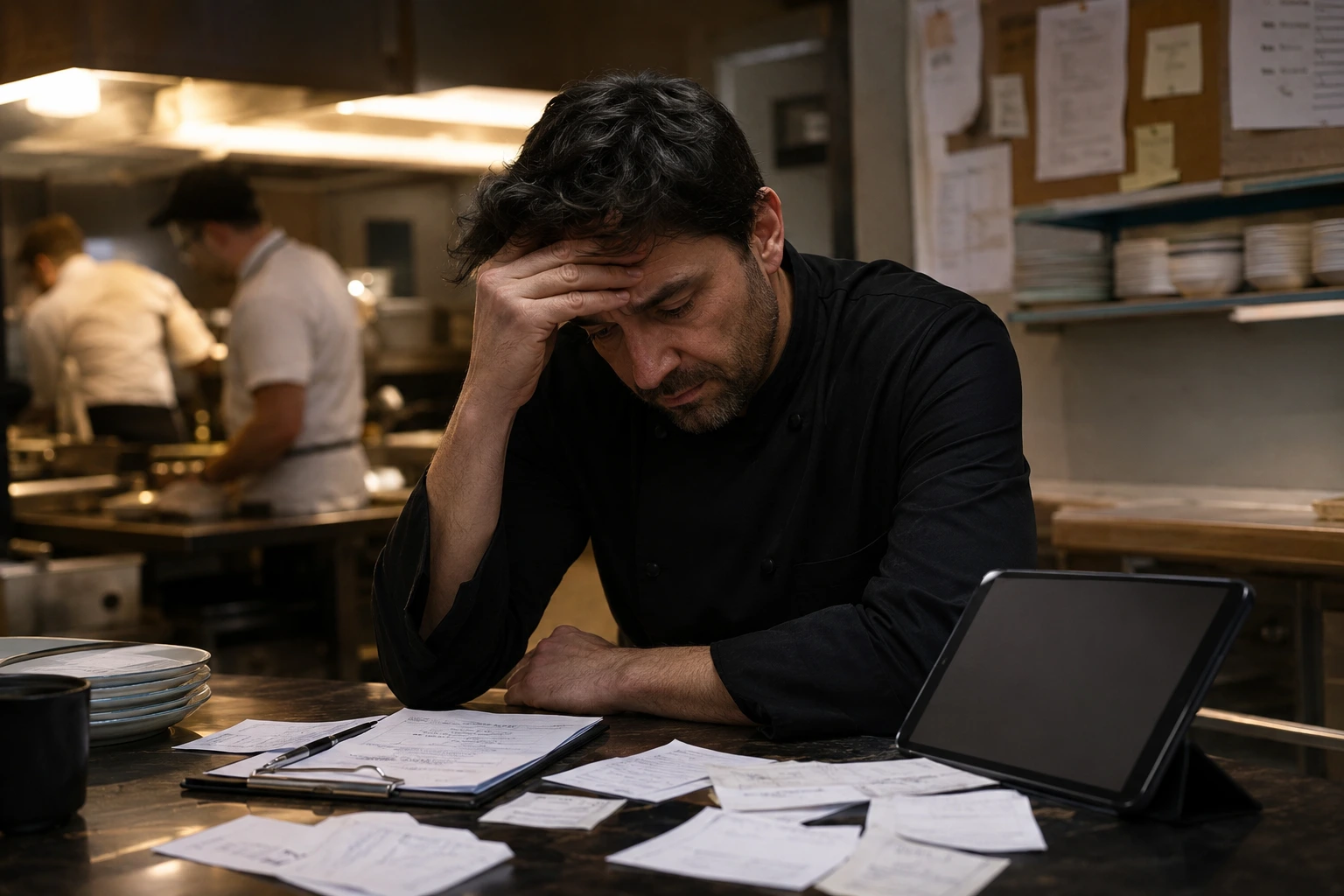
The profit margin of an independent restaurant typically sits between 3% and 5% of revenue. Full-service restaurants reported a median pre-tax margin of just 2.8% in 2024, while limited-service restaurants came in at 4% (source). At these levels, a 3-percentage-point increase in ingredient costs — without a price adjustment or reduction in other costs — can wipe out profitability entirely. And yet, 82% of failures in the sector share a common cause: cash flow problems, not food quality or location.
Losses do not necessarily come from one obvious bad decision. They accumulate from dozens of small, invisible inefficiencies: wasted food, inconsistently applied recipes, prices that fail to keep pace with costs, manual processes consuming paid hours, and order errors generating dissatisfaction. Each one, in isolation, seems manageable. Together, they can make the difference between a viable restaurant and one that struggles to pay its suppliers on time.
Food Waste: The Numbers That Make You Recalculate
The restaurant industry generates a massive volume of food losses. The National Resources Defense Council (NRDC) estimates that restaurants lose 4–10% of everything they order before it ever reaches the customer. The causes are usually three: inconsistent portioning, poor stock rotation, and overproduction — dishes prepared in advance that go unsold.
The maths behind this loss is harsher than it looks. Orbisk calculates that every kilogram of wasted food costs approximately €7 when you factor in the ingredient price, the labour of the staff involved in preparation, the energy consumed for cooking and refrigeration, and the cost of disposal. In practical terms: a restaurant spending €10,000 a month on ingredients and wasting 7% of them is effectively losing €700 per month on food that never reached a customer's plate. Galley Solutions notes that a restaurant spending $1 million on ingredients and losing 5% to waste is throwing away $50,000 in ingredients — the equivalent of $333 a day.
There is an added complication: food waste does not appear as a separate line in the accounts. It is buried in the total food cost, which from the outside can look “normal” even when it is hiding 5% in losses. Without a system that tracks theoretical stock (calculated from sales and recipes) against actual stock (physical inventory), this loss remains invisible to management. The TapTasty inventory management software automatically connects sales with inventory and generates variance reports showing exactly where and when waste is occurring, without the need for daily manual stock counts.
Ingredient Costs Are Rising. Menu Prices Are Standing Still.
This is probably the most silent and widespread problem in the industry. Restaurant Dive reports that 91% of restaurant leaders reported increases in ingredient costs in 2025, with 36% recording increases of between 6% and 14%, and 13% seeing rises of over 15%. At the same time, 90% of operators expect these costs to keep climbing in the months ahead.
The problem is not the increase itself, but the gap between how fast costs are rising and how slowly menu prices are being adjusted. The NRA estimates that to simply maintain a 5% margin — not improve it, just keep it — restaurants would have needed to raise prices by more than 30% compared to pre-pandemic levels. Many have not done so, either out of fear of customer reaction or because they lacked clear data on which dishes were most affected. When the cost of an ingredient rises 20% and the selling price stays the same, that dish’s margin quietly erodes.
The industry benchmark is clear: food cost should sit between 28% and 35% of revenue. If you exceed 35% without a strategic reason (for example, a premium menu compensating through other margins), you are already running at a loss without knowing it. Prime cost (food plus labour) should stay below 65% of revenue. If the combined total exceeds this threshold, the restaurant is probably unprofitable regardless of how full the dining room is.
Inconsistent Recipes: Portions That Vary Depending on Who’s Cooking
A dish has a standard cost calculated from a standard recipe. The recipe calls for 180 grams of meat, 50 grams of sauce, a 100-gram side. What actually happens in the kitchen — especially during the rush — depends on who is cooking and how pressed for time they are. Without scales, without recipe cards available to consult, and without portion audits, the real variation from the recipe can reach 10–20%.
The effect is twofold. On one hand, larger portions push the real cost above what was calculated. On the other, the inconsistency affects the customer’s experience: the same dish can seem bigger or smaller on different visits, generating dissatisfaction even when the food itself is good. Industry studies point to over-portioning as one of the most frequent sources of undetected loss, and the solution is straightforward: visual recipe standardisation and regular portion audits.
Connecting recipes to an inventory management system resolves this problem: the system automatically calculates theoretical consumption based on sales and compares it to actual consumption from inventory. If the discrepancy is systematic, the issue is either at the portioning stage or in kitchen waste — and it becomes identifiable within days, rather than after months of accumulated losses.
Manual Processes: Paid Hours Spent on Work That Could Be Automated
A server who takes an order verbally, passes it to the kitchen, and then enters it manually into the POS is performing the same operation three times. Add to this a manager spending 30–60 minutes a day reconciling orders from different sales channels (app, aggregators, phone orders, counter), or stock levels being updated manually at the end of the day based on estimates, and the picture becomes clear: an average restaurant loses between 2 and 4 paid working hours a day on tasks that could be automated.
The calculation becomes even more significant when you include the errors that inevitably arise from manual processes: a miswritten order, a stock level updated with a delay, an invoice entered incorrectly by hand. Each error carries a direct cost (correction, re-preparation, lost time) and an indirect cost (reduced customer satisfaction, or decisions made on the basis of inaccurate data).
Menus That Don’t Know What They’re Selling: Popularity vs. Profitability
There is a fundamental distinction that few owners track systematically: the difference between a popular dish and a profitable one. A dish that sells well but carries a food cost of 40% contributes less to profit than a dish ordered less frequently but with a food cost of 22%. Without data connecting sales to actual ingredient costs, the menu is managed on intuition.
Menu engineering — the matrix analysis of each dish’s popularity and profitability — is standard practice in restaurants that monitor performance seriously. It only becomes possible when there is a genuine connection between the sales system and stock management: you know how many portions of each dish you sold and how much each portion cost in ingredients. From this intersection come concrete decisions: which dishes deserve to be promoted, which need their ingredients or portion sizes adjusted, which have stayed on the menu out of inertia without contributing meaningfully to the margin. According to an industry study, this kind of analysis is, in 2026, one of the most effective levers available to operators for protecting margin — without changing prices and without reducing quality.
Staffing: Overstaffed During Quiet Hours, Understaffed at Peak
Labour costs account for between 25% and 35% of a restaurant’s revenue, according to VantaInsights data. Together with food cost, they form the prime cost, which should stay below 65% of revenue. The problem is not the wage itself, but the distribution of hours relative to actual demand.
Without historical data on sales by time slot, staffing schedules are an approximation based on the manager’s experience. A restaurant that keeps the same number of staff on shift regardless of whether a Monday has 40 or 150 covers is effectively paying for unproductive hours during the quiet periods.
Understaffing at peak hours carries its own cost: orders processed more slowly, customers who leave before ordering, errors that multiply under the pressure of a busy service. Both extremes generate losses, but in different ways and ones that are difficult to quantify without data.
How to Identify Your Restaurant’s Losses
Before any solution, you need to know where you are losing. A few basic measurements that can be implemented quickly:
- Weekly food cost, not monthly — discrepancies identified weekly can be corrected before they accumulate. Those identified monthly are already sunk costs.
- Theoretical stock vs. actual stock — calculated from sales and recipes, compared to physical inventory. A consistent variance points to waste or incorrect portioning.
- Order error rate — how many orders required correction or generated complaints in the past week?
- Hours worked vs. covers — how many staff hours were needed per table served?
These four measurements do not require sophisticated software as a starting point. They require discipline in data collection. Once data exists, an integrated management system centralises it and makes it available in real time, without additional manual work.
You can read more in the complete restaurant digitalization guide to understand the order in which these tools are best implemented.
Conclusion
Food waste, inconsistently applied recipes, prices that fail to track costs, manual processes, order errors, menus managed on instinct, staffing without data. All of these share one thing in common: you do not know their true scale unless you measure them.
The 3–5% margin typical of the industry leaves no room for unmonitored losses. At a restaurant with annual revenue of €500,000 and a 4% margin, the net profit is €20,000. Reducing food waste from 8% to 5% of ingredient purchases can add several thousand euros to profit without changing a single price or hiring a single additional person. The same principle applies to every inefficiency on this list. The individual impact seems small. The cumulative effect can be the difference between a profitable restaurant and one that survives month to month.