
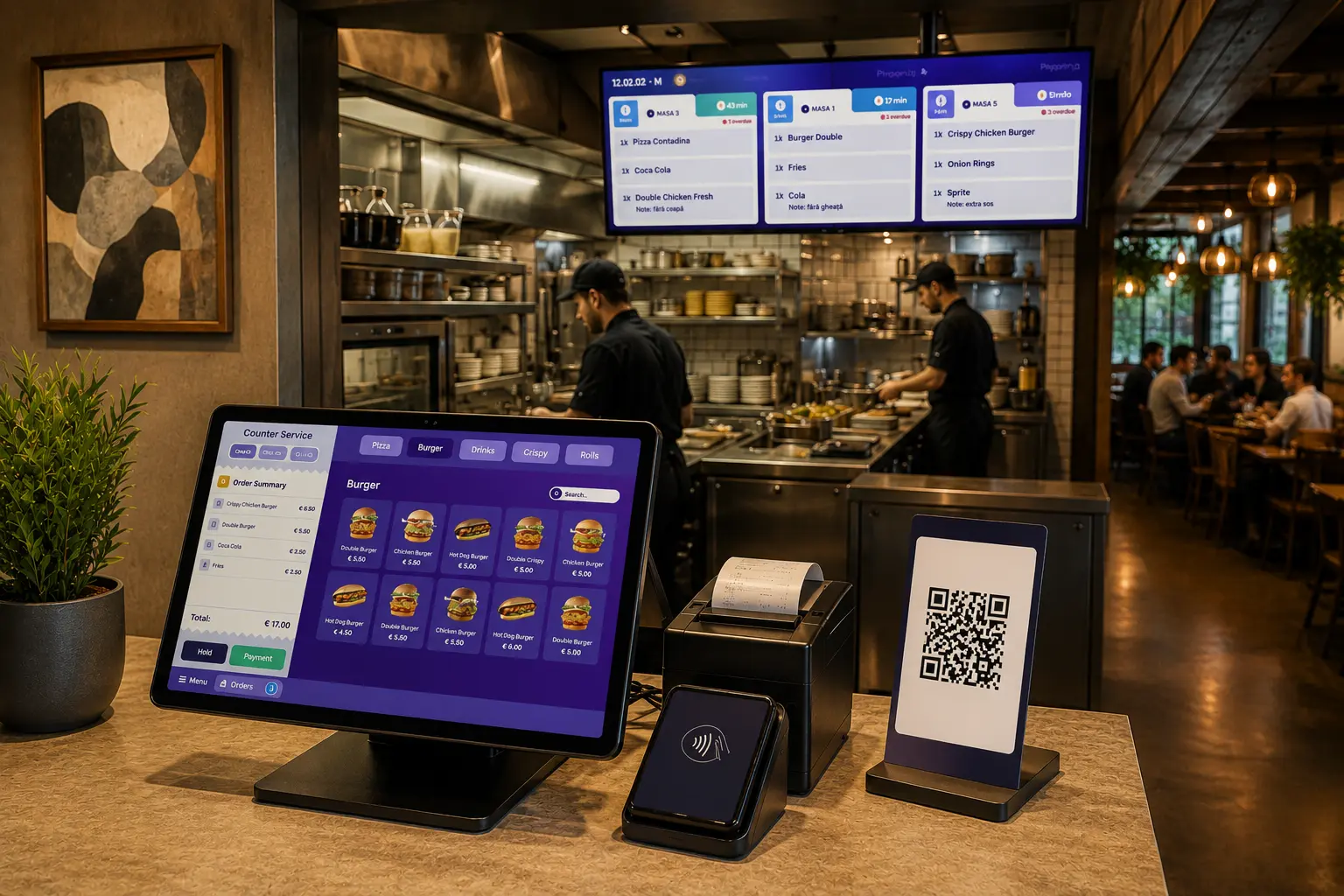
The hospitality industry’s relationship with technology spans more than three decades. In the early 1990s, electronic POS systems and kitchen display screens (then called KVS, today known as KDS — Kitchen Display System) began appearing in major restaurant chains, fundamentally changing how orders were taken and prepared. As fast food franchises expanded globally, they brought with them digital standards that most independent restaurants would not adopt for years.
By the early 2000s, the first online food ordering platforms had emerged, and the smartphone era that followed reset customer expectations around convenience and speed. The 2010s brought the explosive rise of third-party delivery services, introducing millions of consumers to on-demand restaurant ordering. Then came 2020: the pandemic compressed years of digital adoption into months, forcing operators across every segment to find digital alternatives virtually overnight.
Today, in 2026, digital fluency is the baseline expectation for restaurant customers: they pay contactless, browse digital menus, and place orders from their phones without a second thought. And yet, hospitality remains among the least digitized sectors of the economy, according to multiple industry analyses. The gap is not one of vision — it is one of execution. That is precisely why this guide exists: not to list tools, but to offer a practical framework for approaching restaurant digitalization intelligently.
Why Restaurant Digitalization Fails
Before we talk about what to do, it is important to understand why restaurant digitalization does not work for many. According to a recent report from Call the Service, the number one mistake is not choosing the wrong tool — it is choosing too many tools at once, implementing them superficially, and ending up with a system that generates more chaos than the one it replaced.
The second reason restaurant digitalization fails is that it is treated as an IT project rather than an organizational change. You buy new software, install it, and expect things to sort themselves out. But restaurant software does not fix unclear processes — it amplifies them. If your team does not know exactly who takes a phone order when the kiosk is busy, not even the best POS system will clarify that.
The third reason: the tools do not communicate with each other. According to EHL Insights, 69% of operators who adopted new technology reported meaningful efficiency improvements — but the common thread was not how sophisticated any single tool was, but how well the tools shared data with each other. A POS that does not communicate with inventory management, an ordering app disconnected from the kitchen, a marketing system isolated from the customer database — each solves one problem and creates another.
The Right Questions Before Any Decision
Before analyzing any solution, answer a few honest questions about your restaurant digitalization process:
- What is the real problem I want to solve? Not “I want to digitalize,” but something concrete: I lose orders during peak hours, the team makes too many errors, I don’t know which product generates profit, or customers don’t come back after their first visit.
- How ready is my team? A system change without preparing the people who will use it daily is a wasted investment. The high turnover typical in hospitality makes training a critical variable, not an optional one.
- Can I integrate the new tool with what I already have? Software that works well in isolation but does not connect to your existing POS or invoicing system will create more manual work, not less. Alternatively, you may choose to implement a complete digital ecosystem with its own set of benefits.
- Does customer data remain mine? This question has both commercial implications — who owns the relationship with the customer — and legal ones, under GDPR.
The answers to these questions will show you not just which tool you need, but also when you are ready to adopt it. Digitalization is not a race and there is no perfect moment. There is a first step that is right for your specific situation.
Order Matters More Than Speed
A restaurant that tries to implement a new POS, a mobile app, a reservation system, and a marketing module simultaneously over a few months risks implementing none of them well. Restaurant digitalization is a gradual process, and the order in which you begin must follow the logic of your restaurant’s workflow.
The operational core comes first. A modern POS system is the foundation on which everything else is built. It centralizes sales, generates real reports, and connects orders to the kitchen. Without a solid POS, no other digital investment makes sense.
The kitchen and inventory, the second layer. Once orders enter the system correctly, it makes sense to connect the kitchen through a KDS screen and link sales to inventory management. Only now do you begin to get a real picture of costs: what is consumed, what is lost, and where the profit margin disappears.
Digital ordering and marketing, the third layer. Online ordering channels, loyalty programs, and marketing campaigns have the greatest impact when a solid operational infrastructure is already in place. Otherwise, new orders amplify existing chaos instead of generating profit.
Tools specific to your restaurant’s profile, a separate layer. Beyond the layers common to all, there are tools that only make sense depending on how your business operates: reservation software if you take table bookings, a delivery management system if you have your own courier fleet, an order status display if you handle high volumes at the counter. They do not apply to everyone, which is exactly why they have no fixed place in the order. You add them when your restaurant’s profile calls for it.
This order is not rigid. A restaurant without major operational problems can prioritize differently. The key is to start from the real problem, not from a product’s feature list.
What Tools Exist for Restaurant Operations
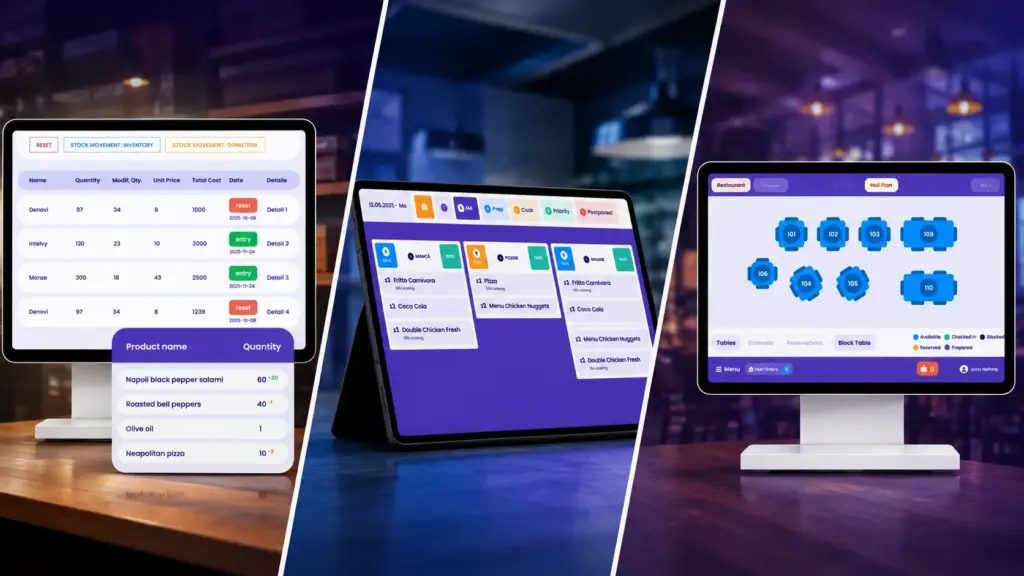
The first layer of digitalization — the operational side — covers everything that happens inside the restaurant, from order intake to the finished dish leaving the kitchen.
The POS system (Point of Sale) is the central hub of any digitalized restaurant. It manages orders, tables, payments, and sales reports. Modern solutions run in the cloud, meaning you can access your data from anywhere without relying on a physical server on-site. Some POS solutions also work offline, switching seamlessly when the connection drops. A mobile POS, installed on a tablet or phone, allows servers to take orders and process payments directly at the table without going back to the counter.
The KDS (Kitchen Display System) replaces paper tickets with a digital display that distributes orders by station (hot kitchen, salads, desserts, bar) and prioritizes them in real time. Cooks can see clearly what they need to prepare and in what order, while managers can track preparation times per station. Complementary to the KDS, an order status display informs customers in the dining room about the status of their order, without staff needing to call out order numbers.
Inventory management software connects POS sales to the inventory, automatically updating stock at every completed order. Advanced features include recipe management (to know exactly which ingredients each dish uses), low-stock alerts, and waste tracking. Integration with accounting and invoicing software automates the receipt of supplier invoices and updates stock accordingly.
Reservation software centralizes bookings regardless of their source — phone, website, app — and synchronizes them with the table plan in the POS. It allows you to set clear rules: average table duration, guests per table, and possible reservation fees to reduce no-shows.
Delivery management software, useful for restaurants with their own courier fleet, handles order distribution by zone, optimizes routes, and keeps communication with couriers via a dedicated mobile app.
What Tools Exist for Online Ordering and Customer Relations
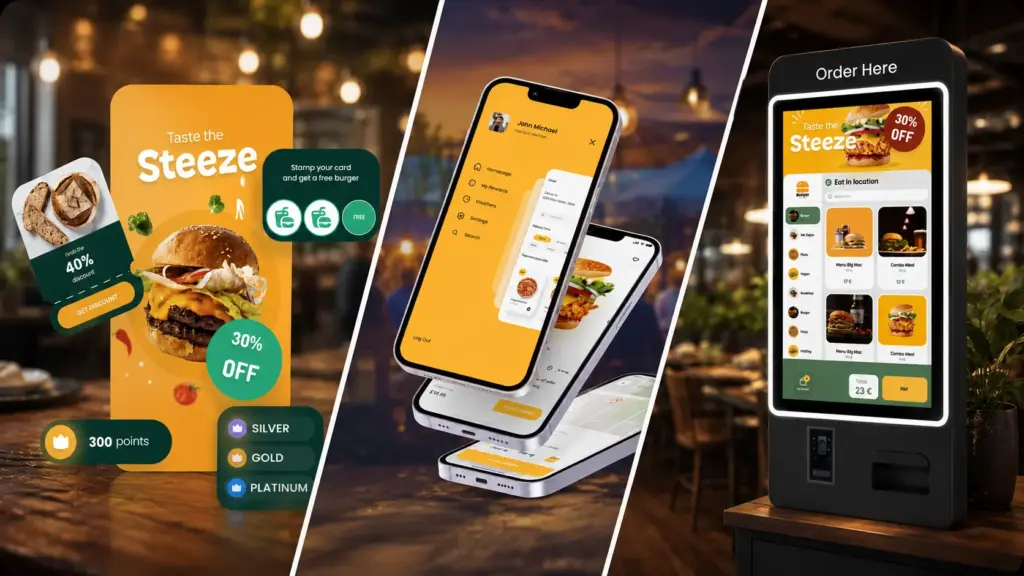
The second and third layers cover the customer touchpoints: how they order, how they pay, and how they stay connected with the restaurant after their first experience.
A branded mobile app for restaurants gives the customer a personalized ordering channel, with their account, order history, and accumulated rewards. Unlike a generic delivery app, your own app builds a direct relationship and collects valuable data about each customer’s ordering habits. The app can also include table reservations, advance payment, or push notifications.
The online ordering website serves the same purpose, without requiring the customer to download an app. It is more accessible for occasional orders and, when properly optimized for local SEO, can bring organic traffic from searches like “pizza delivery near me” or “restaurant delivery [your city].”
The self-ordering kiosk is a physical ordering terminal in-venue that customers use independently. It reduces queues at the counter, enables automatic up-selling through suggestions shown during the order, and frees staff from taking simple orders. Demand for kiosks is growing rapidly: according to Rezku, 36% of consumers wanted more kiosks in the restaurants they frequented in 2023. That figure reached 61% by 2025.
QR menu ordering lets customers access the menu, order, and pay directly from their phone without interacting with a server. The minimal version — a simple digital menu for viewing — can be implemented quickly and inexpensively, making it an excellent gateway into in-venue digital ordering.
Digital marketing tools operate on the data collected through the channels above. Loyalty programs (points, digital stamps, membership cards) encourage repeat orders. Customer segmentation by ordering behavior enables targeted communications: a coupon for a customer who has not ordered in three weeks, a birthday offer, a promotion on a product they viewed but did not purchase. Promotional campaigns and integration with Google Analytics and Meta Pixel complete the picture, showing where customers come from and which advertising campaigns generate real orders.
The People Behind Digitalization
No digital platform works well if the team has not truly adopted it. This is one of the lessons the industry has learned the hard way: 74% of operators today consider that technology augments rather than replaces staff work — and approach implementation accordingly, according to the State of the Restaurant Industry 2025 (NRA).
The server using a mobile POS needs to understand not just how to operate it, but why it is better for them and for the customer. The cook working with a KDS needs to know how to prioritize the orders shown on screen. The manager receiving digital reports needs to know what to look for in them. Without this level of real adoption, technology remains an underused tool and a source of frustration.
Research consistently shows that while digital comfort is growing — with most consumers now accepting contactless payments and comfortable with digital menus — diners still do not want technology to fully replace the human element of hospitality. Well-designed digitalization does not eliminate the server; it frees them to focus on genuine customer interaction, on personalized recommendations, and on the kind of hospitality that no software can replicate.
What to Measure to Know It Is Working
One of the most common mistakes is that restaurant owners or managers adopt technology without defining in advance what success looks like. You implement inventory management software, but how do you know it is working? You launch a mobile app, how do you measure its real impact?
A few concrete indicators worth tracking after any digital implementation:
- Average order preparation time: does it decrease after implementing the KDS?
- Order errors: how many complaints do you receive per week? Does anything change?
- Inventory variance: how close is the theoretical stock (calculated from sales and recipes) to the actual stock (physical inventory)?
- Order frequency per customer: do customers enrolled in the loyalty program order more often than those who are not?
- Average order value: does it increase on channels where you have activated automatic up-selling?
Without these and other measurements, digitalization remains a cost, not an investment. With them, it becomes a decision-making tool and a concrete argument for the next step.
Artificial Intelligence: Already Present, Still Underutilized
Industry data consistently shows that hospitality employees already use dozens of digital tools daily. Paradoxically, while AI is increasingly discussed, adoption of AI-driven automation among independent restaurant operators globally remains limited, even as these tools become more accessible and affordable than ever.
The concrete applications of AI in restaurants are not robotic or spectacular. They are, on the contrary, quiet and practical:
- automatic analysis of reviews across platforms to quickly identify recurring problems
- generation of daily operational reports without manual intervention
- demand forecasting for weekends or special occasions to reduce waste and optimize supplier orders
- personalized product recommendations based on each customer’s order history
The AI virtual waiter, capable of taking voice orders, offering suggestions, and completing transactions without staff involvement, already exists in several market solutions and will become commonplace in high-volume restaurants. For now, the most useful AI for most restaurant operators is data analysis and the automation of administrative tasks, areas where the time savings are immediate and measurable.
Conclusion
Restaurant digitalization is not about technology itself — it is about solving real problems with the right tools, in the right order, with people who are prepared to use them. The restaurants that succeed are not those that buy the most sophisticated system. They are the ones that start from a clear problem, implement a first tool that solves it well, and build from there, layer by layer.
If you are still searching for the right solutions to digitalize your restaurant, TapTasty is here to help. TapTasty is a complete digital ecosystem for restaurant digitalization across three key areas: online ordering, operations, and digital marketing. Discover the TapTasty modules that fit your needs and request a personalized quote!