
The hospitality industry has changed radically in recent years, and customers now expect the same speed and transparency they find in any other digitized industry. Yet the hospitality sector remains, paradoxically, among the least digitized domains, according to the conclusions of the EnterTech 2026 conference. The difference between restaurants that grow consistently and those that stagnate increasingly comes down to the package of restaurant technologies they adopt.
In this article, we review the most important technologies for modern restaurants, from online ordering and POS systems to automated marketing and artificial intelligence. You will understand what each technology does, why it matters for your business, and how they all connect into a single digital ecosystem.
Why Modern Restaurants Need Technology
Restaurant technology is no longer a luxury but a basic requirement for staying competitive. Studies show that the majority of customers feel their experience at a restaurant is improved by technology, and the availability of digital options directly influences their decision to return. In other words, customers no longer choose solely based on food quality — they also choose based on how easily they can order, pay, or reserve a table.
Beyond the pressure from customers, there is also cost pressure. Internationally, labor costs represent on average 28–33% of a restaurant’s revenue, and, according to a report cited by EHL Insights, most operators consider recruiting and retaining staff a significant challenge. Technologies for modern restaurants take over some of the repetitive tasks, reduce human errors, and allow the team to focus on service and hospitality.
In brief, modern restaurant technology covers four essential areas:
- in-venue and online ordering (mobile app for restaurants, online ordering website, self-ordering kiosk, QR menu ordering)
- internal operations (POS, KDS, inventory management software, delivery software, table reservation software)
- marketing and customer loyalty
- integrations with the external platforms you already use
We cover each of these in the sections below.
Technologies for Online Restaurant Orders: Your Own Sales Channel
One of the most important technologies for modern restaurants is the ability to receive orders through multiple digital channels, without depending exclusively on aggregators. A mobile app for restaurants or an online ordering website allows you to build a direct relationship with the customer, without additional commission fees on every order.
In-venue, self-ordering kiosks reduce waiting times and increase the average order value through automated up-selling suggestions. QR menu ordering goes even further: customers order and pay directly at the table, without waiting for a waiter.
These four online ordering channels should not be treated in isolation. The real advantage comes when all of them send orders to the same central system, so the kitchen and delivery team see them identically, regardless of where the order originated.
Demand for these digital channels is growing steadily: more than 6 in 10 customers say they would like to see more self-ordering kiosks in the restaurants they frequent, because they perceive kiosk ordering as more accurate, faster, and more convenient than traditional ordering (source).
Technologies for Restaurant Operations: From Kitchen to Delivery
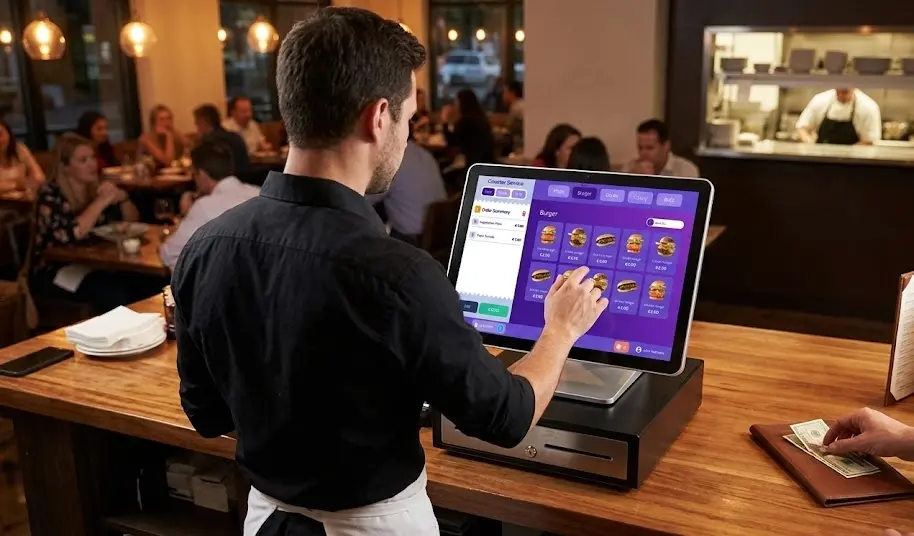
Beyond ordering, a restaurant’s daily operations can benefit enormously from digitization. A modern POS system for restaurants centralizes sales, tables, and payments, while a mobile POS allows order-taking and payment processing directly at the table, without unnecessary trips to the counter.
In the kitchen, a KDS screen (Kitchen Display System) displays orders in real time and distributes them by department, eliminating paper tickets and the confusion of peak hours. Completed orders can be displayed through an order status screen, without staff having to call out order numbers at the counter.
These technologies are complemented by inventory management software, which automatically updates stock based on sales and reduces waste, table reservation software, which eliminates overlaps, and delivery software, which optimizes routes and automatically groups orders by zone. When all these modules communicate with each other, the flow of an order becomes straightforward: it enters through a sales channel, is automatically routed to the POS, transmitted to the KDS for preparation, and finally reaches the customer through the order status screen or via delivery.
Marketing Technologies for Restaurants: From Occasional to Loyal Customers
Acquiring a new customer costs far more than retaining an existing one. This is well known both in the restaurant industry and in other fields. For this reason, loyalty is one of the main pillars of any technology strategy for restaurants. A loyalty and referral program featuring loyalty points, digital cards, and referral rewards turns occasional customers into restaurant ambassadors.
This is complemented by tools such as coupons, vouchers, and gift cards, customer segmentation with targeted push notifications and emails, and contests or prize wheels to increase in-app and website engagement. Integrations with Google Analytics 4 and Meta Pixel, for example, complete the picture of a professional marketing module, giving restaurants clear data about customer behavior and campaign performance.
Crucially, all this customer data should remain in the restaurant’s hands. That way, you know exactly who your customers are, what they order, and how often they return — information essential for any well-targeted marketing campaign.
Artificial Intelligence: The Future of Restaurant Technology
If a few years ago artificial intelligence seemed a topic reserved for major international chains, by 2026 it is becoming accessible even to independent restaurants. Voice recognition systems for ordering are one of the fastest-growing segments in restaurant technology, and predictive sales analytics help operators reduce food waste and anticipate demand more accurately.
In ordering modules, for example, an AI virtual waiter can take orders by voice, offer personalized recommendations, and complete an order without the team’s involvement. In practice, AI does not replace human hospitality — it takes over repetitive tasks, leaving the team more time for genuine customer interaction.
On the marketing side, recommendations automatically generated based on order history can increase the average cart value, while on the operations side, smart inventory alerts reduce the risk of a popular item running out during peak hours. These are concrete applications, already available — not merely experimental concepts.
Why Integrations Matter in a Connected Technology Ecosystem
Many restaurants end up using six or seven different tools: a POS, a delivery app, an accounting application, a marketing system, and a reservation platform, each with its own database. The result is operational chaos and hours wasted manually re-entering the same information across different systems.
Integrations with delivery platforms and restaurant marketplaces, payment processors, and other systems solve exactly this problem. Orders coming in from aggregators arrive automatically in the same POS and on the same kitchen screen as direct orders — without separate devices and without manual entry. The goal is not to abandon aggregators, but to treat them as one additional sales channel, integrated into the same workflow.
For your restaurant, this means centralized reporting, fewer errors, and a complete picture of your business — regardless of how many sales channels you use.
How to Choose the Right Technologies for Your Restaurant
Not every restaurant needs all the technologies described above, at least not from the start. The safest approach is to begin with the real problems of your business: are you losing too much time on phone orders, experiencing inventory errors, or finding that customers don’t come back? The answer tells you which module should be implemented first.
Before choosing a technology, it is worth considering a few criteria:
- Does it integrate with the systems you already use, or does it require you to replace everything at once?
- Can you start with a single module and add others as your restaurant grows?
- Does customer data remain yours, or does it belong to a third-party platform?
- Is there real support available when technical issues arise?
A modular platform — one where you pay only for the features you need now and add more later — is generally a safer investment than simultaneously purchasing a complete package of technologies for modern restaurants that your team is not yet ready to use.
Frequently Asked Questions about Restaurant Technologies
What technology should a small restaurant implement first? Usually, the greatest quick impact comes either from a modern POS system, which organizes sales from the ground up, or from your own online ordering channel (website or app), which reduces dependence on aggregator commissions.
Can modern restaurant technologies be implemented gradually? Yes. There are also modular platforms like TapTasty with which you can start with a single module, see the results, and then gradually add operations and marketing capabilities as your restaurant grows.
Does technology replace restaurant staff? No. Modern restaurant technology takes over repetitive and predictable tasks, such as order-taking or inventory updates, leaving the team more time for hospitality and direct customer interaction.
Conclusion
Modern restaurant technologies are no longer an optional advantage but the foundational structure on which a healthy hospitality business is built: from online ordering and POS systems to automated marketing and artificial intelligence. The key is not to accumulate as many tools as possible, but to connect them into a single digital ecosystem, easy to manage from one place.
TapTasty is a modular platform for restaurants that brings exactly these technologies for modern restaurants together — ordering, operations, and marketing — in a single digital ecosystem. You can view all available modules and request a personalized quote for your restaurant.