
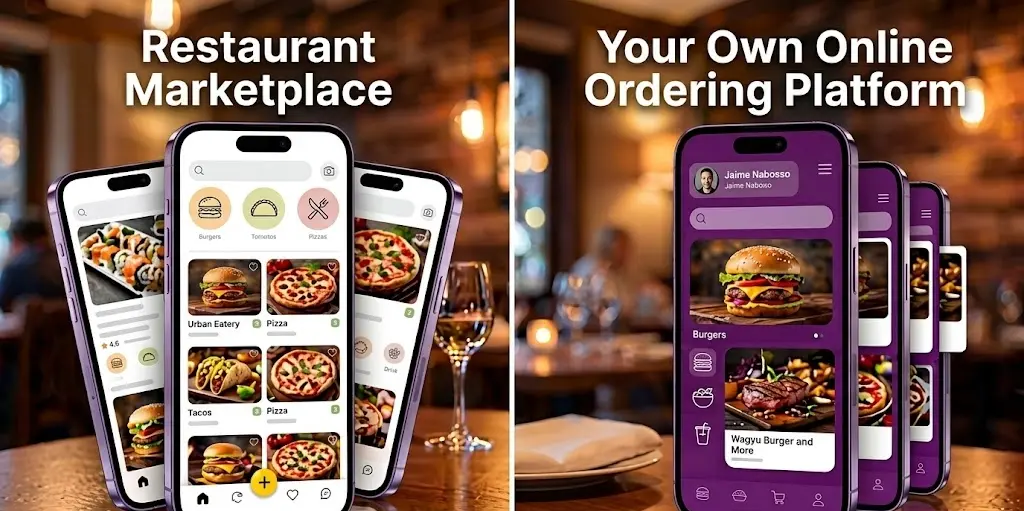
If you're a restaurant owner who already lets customers place online orders through a delivery marketplace, an aggregator like the ones operating in your market, you've probably already wondered how to keep more of the profit from those online orders. And, in your search for an answer, you've found out that you can build your own channel for online orders. Whether that means developing a mobile app for restaurants, or a website for online orders.
But now another question comes up. Do you stick with the delivery marketplace, or do you invest in your own platform for the restaurant? The short answer, from direct experience with dozens of businesses in the hospitality industry, is that the question itself is framed wrong. It isn't a fight between a marketplace for restaurants and a mobile app or website for the restaurant, it's a discussion about balance, and about who controls the customer relationship in the long run.
Delivery marketplaces have given restaurants unprecedented access to new customers, especially in big cities. At the same time, every order placed exclusively through an aggregator means a commission paid, data you don't own, and a customer who, digitally speaking, stays the platform's, not the restaurant's. This article explains how the two solutions complement each other, and why, even so, your own online ordering platform should be the strategic priority for 2026.
What Is a Marketplace for Restaurants
A marketplace for restaurants is a platform that gathers the offerings of several restaurants in one place and exposes them to an already-built audience of active users. For a new restaurant, or for one that wants to test a new area, this instant access to demand is hard to match through any other channel.
The U.S. online food delivery market alone was valued at roughly $31.9 billion in 2024, with projections putting it at $74.0 billion by 2033, according to an analysis by the Independent Restaurant Coalition. In other words, the marketplace for restaurants isn't a passing trend, it's a piece of market infrastructure that will stay relevant for many years to come.
That's exactly why ignoring aggregators completely isn't a realistic strategy for most restaurants, especially ones that are still building their customer base. The marketplace remains an excellent discovery channel for the segment of customers who don't know your brand yet.
The Price of Visibility: Commissions
Visibility on a marketplace for restaurants isn't free, though. Commissions charged by the major delivery platforms typically start at 15% and can climb to 30% of the order value, depending on volume and the type of partnership (source). For a restaurant already running on thin operating margins, that percentage can be the difference between a profitable quarter and a losing one.
What never shows up in the commission calculation is the invisible cost of dependence. The customer stays the platform's, not the restaurant's, and you don't know who ordered, what they usually order, or when the right moment is to send them an offer to bring them back.
In practice, every order placed exclusively through aggregators is a missed loyalty opportunity. The restaurant pays to acquire the customer but doesn't keep the relationship that would turn that customer into a repeat one, at no extra marketing cost.
What Your Own Online Ordering Platform Means
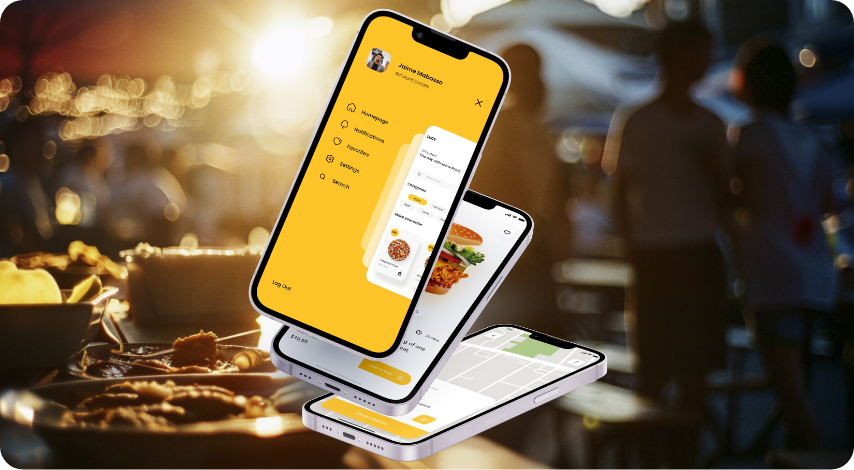
Your own platform for the restaurant isn't just a presentation site with a static menu on it. In practice, it means a set of direct ordering channels, under your own brand, through which customers reach you without an intermediary taking a commission on every transaction: a native mobile app for orders, or a website with its own online ordering system.
The key difference from the marketplace is that the restaurant owns the customer data, controls prices without artificially inflating them to cover the commission, and can build a real loyalty program over time. Your own platform for the restaurant works as a direct ordering channel through which every new customer gradually becomes a repeat customer of the brand, not of the delivery app.
Marketplace for Restaurants vs. Your Own Platform
We've reached the most important clarification in this article. The right discussion isn't “marketplace or your own platform,” it's “what role does each one play in the restaurant's sales funnel.” Aggregators are excellent for acquiring new customers and for visibility in busy areas; your own platform is the tool that turns those customers into loyal ones, with an acquisition cost that keeps falling over time.
A digitally mature restaurant isn't anti-aggregator, it's an intelligent extension of one. In practice, the marketplace remains a valuable discovery channel for new customers, but every order delivered through it is also a chance to quietly invite that customer to discover your own channel too, whether through a discount code for their next direct order or a flyer attached to the package.
Specialists in hospitality software have confirmed the same logic time and again: your own platform doesn't compete with the major delivery apps, it's complementary, helping the restaurant become the owner of its own customer base. In other words, the real question isn't whether you drop the marketplace, it's how quickly you manage to build your own direct ordering channel alongside it.
What a Balanced Hybrid Strategy Looks Like in Practice
In practice, restaurants that strike this balance best usually do the following:
- Keep a presence on delivery marketplaces for visibility and new customers, especially in high-traffic areas.
- Build a mobile app and a website of their own, through which direct orders no longer carry a platform commission.
- Give delivery customers, through flyers or promo codes, a concrete reason to order direct next time.
- Use the data collected from their own channel for push notifications, emails, and personalized loyalty programs.
This approach doesn't call for dropping aggregators overnight, but for a gradual transition in which the share of direct orders keeps growing. That way, you start paying less and less in commissions, without losing the initial visibility the marketplace offers.
Why Your Own Platform Deserves to Be the Long-Term Priority
Beyond the commissions avoided, the great advantage of an independent platform is access to your own customer database. A useful example from the global hospitality industry is Starbucks, where Rewards members drove nearly 60% of the company's U.S. revenue in fiscal year 2025, more than $13 billion in spend, built on a direct digital relationship with the customer (source).
The scale is obviously different, but the principle holds true for any restaurant, however small.
The cost of acquiring a customer through the marketplace is constant, no matter how often they order. The commission applies to every transaction. On your own platform, the acquisition cost only exists at the first interaction; every later order from that same customer costs significantly less, because there's no longer an intermediary taking a cut. The higher the retention rate climbs, the more visible the profitability gap between the two channels becomes.
On top of that, your own platform for the restaurant gives you full control over the brand: design, tone of voice, offers, and the ordering experience reflect exactly the restaurant's identity, not the templates imposed by a third-party app. This is why more and more industry consultants recommend treating aggregators as one acquisition channel, not as the restaurant's only digital strategy.
How a Digital Ecosystem Helps You Make the Shift Without Giving Up the Marketplace
The good news is you don't have to choose between operations and marketing, or between aggregators and your own channel. A digital ecosystem for restaurants, like TapTasty, centralizes every order no matter which channel it comes through: mobile app, website, QR code ordering, self-ordering kiosk, or directly from a delivery marketplace, through the platform's native integrations. They all land in the same POS and are sent automatically to the kitchen display screen (KDS).
At the same time, the platform centralizes marketing and loyalty too: loyalty points, coupons, vouchers, customer segmentation, notifications, and emails, all built on the data collected from your own ordering channels. In practice, once you implement a restaurant ecosystem like TapTasty, the restaurant doesn't have to choose between a marketplace and its own platform to run the business efficiently; it can use a single piece of software that keeps all of these flows coherent.
For a restaurant that wants to gradually reduce its dependence on aggregator commissions, without giving up the visibility they bring, this is the logical next step: building your own platform for online orders, integrated into a digital ecosystem where all sales channels communicate without friction.
Conclusion
Delivery marketplaces and your own online ordering platform aren't rival solutions, they're two floors of the same growth strategy. Delivery marketplaces remain valuable tools for visibility and new customers, but the future profitability of a restaurant gets built through its own ordering channel, where the data, the customer relationship, and the margin stay entirely part of your business.
If your restaurant is still dependent on aggregators, the right time to build your own platform was yesterday; the second-best time is now.
Want to find out how you can build your own platform for the restaurant, integrated with the delivery marketplaces you already use, from the same digital ecosystem? Get a quote from TapTasty and find out how you can reduce your dependence on commissions without giving up the visibility marketplaces bring.