
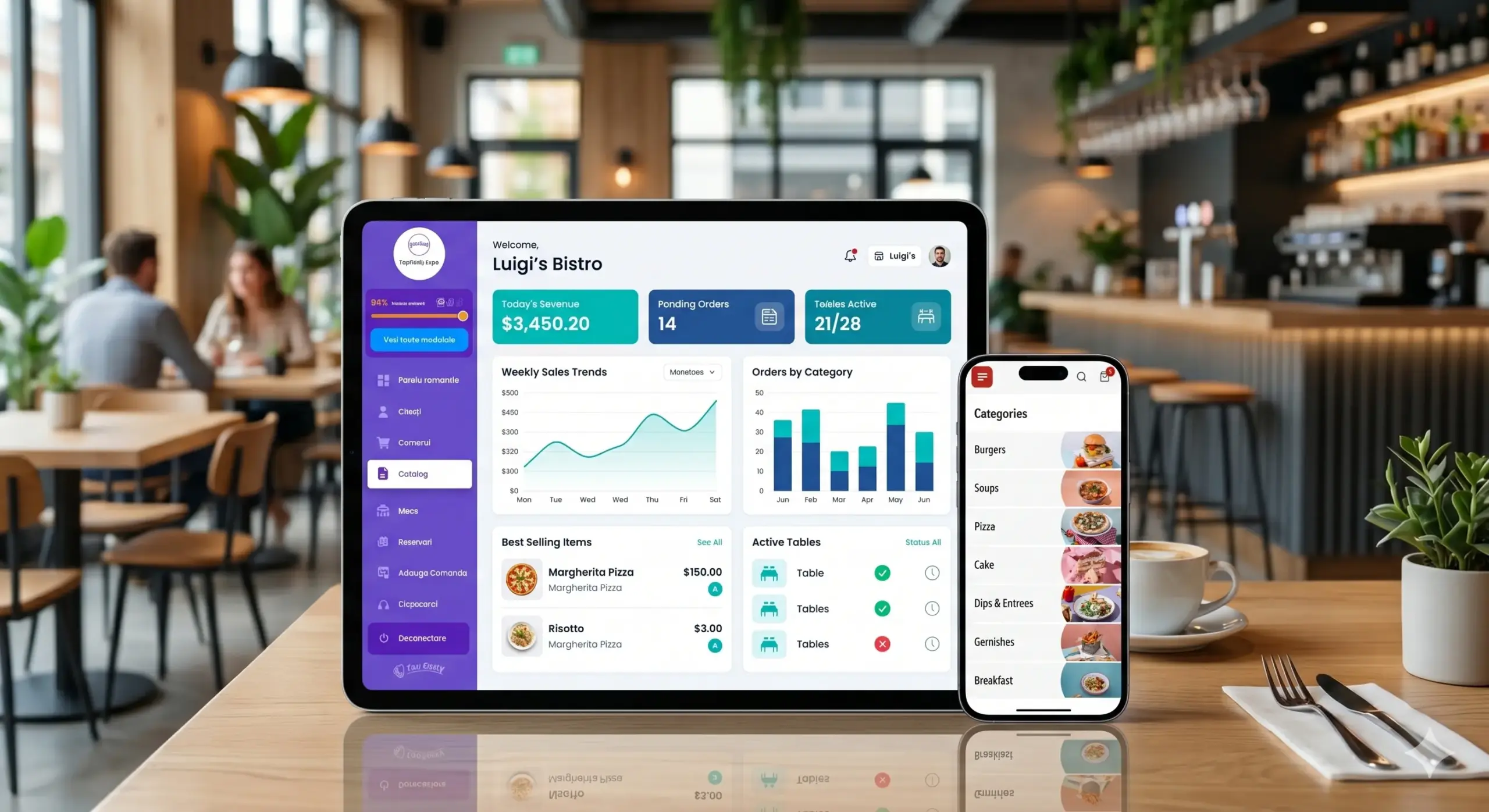
The restaurant software market is more varied than ever. There are dozens of solutions available, with prices, features, and support levels that differ considerably from one supplier to another. According to a report published by Oyster Link, 76% of restaurant operators globally believe that technology gives them a real competitive advantage, but only 13% say they are satisfied with the solutions they currently use.
This tells us something very important: it’s not enough to adopt restaurant software — you have to choose the one that’s right for you. If you’re looking for a new solution or want to replace your current one, the criteria below will be a concrete guide to help you evaluate each solution beyond the commercial presentations.
Before anything, understand your restaurant’s needs
The most common mistake when choosing restaurant software — and unfortunately it happens very frequently — is starting from what suppliers offer, rather than from what your business actually needs. A restaurant with table service and reservations has a completely different profile from a pizzeria focused on delivery or a café with high counter volumes.
Before comparing solutions, honestly answer a few questions: Through which channels do orders currently reach you, and how do you want them to? Do you have your own delivery or do you work with external platforms? How important is customer loyalty to your business model? Do you have multiple locations or are you planning to expand? The answers to these questions will show you what is truly essential for your restaurant and what you can leave for later.
Essential criteria for choosing restaurant software
1. Fit with your type of restaurant
The first thing you need to find out is whether the software was designed and tested for your type of restaurant, not whether it is a generic solution that has been forcibly adapted. A fast-food has completely different needs from a table-service restaurant, and a chain of locations has much greater complexity than a single-location restaurant.
Ask the supplier directly: how many clients similar to you use this solution? Can you speak with one of them? If the supplier hesitates at this question, that’s an important sign. Industry references are, in many cases, more relevant than any well-presented demo.
2. Flexibility and scalability
Restaurant software should grow with your business, not force you to replace it every time you add a new sales channel, location, or type of operation. Check whether the solution allows the gradual activation of features you need and whether it supports multiple locations without disproportionate costs.
Flexibility also means paying for what you use, not for a complete package of which half is not useful to you. Rigid pricing models, where you’re forced to buy the entire ecosystem from the start, waste resources unnecessarily and tie you to features you may never use.
3. Coverage of the channels through which you operate
Every restaurant has a different combination of channels through which it interacts with customers: table service, online orders through a restaurant app or website, own delivery, external platforms, self-ordering kiosks on-site. The right restaurant software must cover the ones that matter for you, not necessarily all of them.
According to the National Restaurant Association State of the Restaurant Industry 2025, 75% of delivery customers consider the availability of digital ordering options an important factor in choosing a restaurant. This means that if delivery is part of your model, the software you choose must support this channel well, including integrations with aggregators, if you are active on them.
4. Ease of use
No matter how complete the feature list of a restaurant software is, if your team struggles to use it, it won’t be adopted correctly. Waiters take orders under pressure, chefs work under high stress conditions, and the manager wants to see reports quickly. The interface must be intuitive, with as few steps as possible for repeated actions.
Request a live demo or a demo account before making any decision. Test the basic flows personally and let at least one colleague interact with the software independently, without guidance from the supplier. If after 30 minutes of testing clear signs of frustration appear, consider another option — subsequent training does not fix a poorly designed interface.
5. Quality and availability of technical support
Restaurants operate 7 days a week, often until late at night. A technical incident in the middle of evening service means blocked orders, dissatisfied customers, and real losses. Technical support is a critical criterion for adopting or dismissing restaurant software.
Specifically check what the support offered means: is there a telephone line you can call (not just email or a ticketing system with a 48-hour response time)? During what hours is it available? How long does it take on average to resolve a critical issue? Serious suppliers have clear and verifiable answers to all these questions.
6. Implementation and onboarding process
Transitioning to new restaurant software doesn’t happen overnight. There is data to migrate, staff to train, and workflows to reconfigure. The way the supplier manages this stage is just as important as the product itself. An implementation handled incorrectly can leave the team confused and create long-term resistance to adoption.
Ask concretely: who handles the implementation, how many training sessions are included, is there a dedicated point of contact during the first months, and what is the backup plan if something doesn’t go as expected? According to Restroworks, 69% of restaurants that adopted new technology report better operational efficiency, but this also requires an implementation that went smoothly.
7. Completeness of the solution
A question that deserves separate attention is how complete the solution you’re evaluating is. Does it cover all the main areas of a restaurant (orders, operations, marketing) or will you need to supplement it with third-party tools to truly function? The more modules come from the same supplier and communicate natively with each other, the less manual effort, the lower the risk of errors, and the more clarity over the restaurant’s data.
This doesn’t mean you have to choose the largest and most complex software available — it means it’s worth knowing from the start what the solution’s limitations are and what you’ll manage outside of it. We have written more extensively about why a complete digital ecosystem for restaurants brings more value than multiple separate solutions in this article.
8. Price transparency and the real total cost
The monthly price displayed on a supplier’s website is rarely the total price you will pay. To the basic subscription, the following may be added: implementation and configuration fees, costs per activated feature, fees for additional locations, commissions per transaction, or premium support costs. Some suppliers also include hardware in packages with significant costs that are not visible at first.
Request a detailed and complete offer, not an estimated price. Calculate the total cost over 12 months and compare offers based on the same features. Software that appears cheaper at first glance can become considerably more expensive once you add everything you truly need.
9. Reputation and stability of the supplier
Restaurant software is a medium to long-term decision. You want to know that the supplier will still be there in two years, that the product will receive updates, and that you won’t be forced to migrate again in a year because the solution is no longer being actively developed.
Find out how long the supplier has been on the market, how many active clients they have, and whether the product receives regular updates. Software that hasn’t seen new features in the past year is usually a warning sign. Also request references from clients with a profile similar to yours. A 15-minute conversation with a restaurant that already uses that solution tells you more than any commercial presentation.
How you can use these criteria in practice
Put together a short list of 3–5 relevant suppliers for your type of restaurant, give different weightings to each criterion according to your priorities, and evaluate each solution based on them. Don’t be seduced by impressive features you won’t use — focus on what truly matters for your daily operations.
Conclusion
Choosing restaurant software is a decision that influences your daily operations in the long term. Don’t rush and don’t be driven by impressive commercial presentations. Evaluate each solution based on the criteria above, test before signing, and request real industry references. A well-founded choice now can make the difference between a restaurant that operates with clarity and control and one that struggles day after day with tools that don’t suit it.