
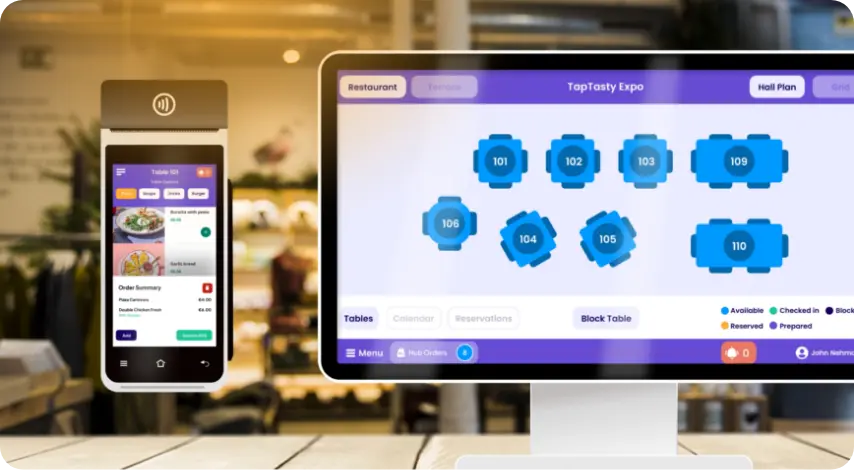
One restaurant management software, two pieces of software, three… If you own a restaurant, a fast-food outlet, a pizzeria, or a café and you’re looking for the best solution to digitise your business, you’ve probably already discovered that the market offers dozens of separate options.
You found “the best POS” at supplier X, got “the most efficient” kitchen display system (KDS) from supplier Y, wanted customer loyalty features and found “the most advanced” ones at supplier Z, and put them all to work together. And maybe they do work — but now you have multiple subscriptions, different interfaces for each system, every supplier pointing the finger at another when something goes wrong, and reports that don’t speak the same language.
What if, instead of working with different systems — systems that were never designed to work together — you could have a single platform for managing your restaurant, with all the necessary modules for online or in-venue sales, operations, and marketing built right in?
What Is Restaurant Management Software?
The difference between separate solutions and complete restaurant management software isn’t about modules or features. A complete restaurant software is made up of the very same modules you can buy separately from different vendors. The difference is that, while separate solutions are built independently and integrated with one another afterwards — in the hope that they’ll communicate optimally — a restaurant management software is designed from the ground up as a unified system, where each module knows what the others are doing.
In complete restaurant software, the POS, KDS, online ordering app, aggregator orders, and marketing campaigns aren’t separate products glued together — they’re pieces of the same operational flow. Together they form a complete digital ecosystem. When an order comes in from any source, all modules see it, without manual syncing and without data getting lost between systems.
The reality of the hospitality industry in 2026 makes this distinction more important than ever: customers order through mobile apps, through websites, through aggregators, self-ordering kiosks, or directly at the counter; the kitchen simultaneously manages orders from different channels; the manager wants real-time reports; the owner wants to know which sales channel is truly profitable after deducting commissions. None of these needs can be well met with separate solutions forced to communicate with each other.
A restaurant management software, therefore, is no longer just a point-of-sale tool — it’s a digital infrastructure on which the entire restaurant operation is built, from the first order, to stock management, to order preparation, to bringing the customer back a second time.
How Restaurants End Up Using Multiple Software Systems
Digital fragmentation doesn’t happen all at once. It creeps in gradually, with good intentions.
You start with a POS. Then you want to be on Glovo and integrate an online ordering system — which doesn’t connect to the POS, so orders are entered manually. You want a kitchen screen to get rid of paper order tickets, but your POS vendor doesn’t have a KDS, so you buy a separate system. At some point you want to offer loyalty points to turn customers into regulars, so you add a loyalty system. Now you have four subscriptions, four interfaces, and four vendors to call for technical support.
Each decision made sense individually. Together, however, they’ve created a digital Frankenstein and an operational problem that costs money every single day.
The Real Costs of Using Separate Software
The most obvious cost of fragmented solutions is multiple subscriptions. But that’s actually the smallest of them. There are at least three costs that aren’t easy to spot, yet when you factor them in, they’re enormously significant.
The Cost of Time
If a staff member manually enters orders from an aggregator into the POS, and each entry takes 90 seconds, at 40 orders a day that’s nearly one hour of manual work daily — 6 hours a week, roughly 25 hours a month. Hours paid for a task that shouldn’t exist in the first place.
The Cost of Errors
The cost of errors is harder to quantify, but any restaurant manager knows what it looks like: a wrongly entered order means a dish remade, raw materials wasted, and an unhappy customer. When data transfer is manual, errors aren’t exceptions — they’re predictable. They happen when the front of house and kitchen communicate without a connected POS and KDS, when reservations are taken over the phone and entered manually, whenever a person does what a system should be doing.
The Cost of Obscurity
When data lives in separate systems, you have no clear, accurate picture of your business. To find out which order channel brings the most profit after commissions, which customers haven’t ordered in three months and deserve a reactivation campaign, or which products sell better through delivery, you have to manually export data from different systems, compare it, and hope the result is correct. And most of the time, it isn’t.
What Integrating a Digital Ecosystem Actually Looks Like for Your Restaurant
Friday evening, 7:30 PM. The restaurant is full, orders are coming in from three directions at once.
One customer orders through the restaurant’s mobile app, a waiter takes a table order via the mobile POS, and at the same time an order comes in from Wolt. With complete restaurant software, all three arrive in the same POS and are automatically sent to the kitchen’s KDS, where they’re organised by delivery time. Restaurant orders can be visually separated from delivery orders, and the chef knows exactly what they’re preparing, for whom, and in what order — without looking in three different places and without anyone entering anything manually.
At the same time, a customer makes a reservation for two via the restaurant’s website. It appears instantly in the same system. The waiter sees it in the POS, the table is automatically blocked in the floor plan, and nobody finds out about it through a phone call or a notepad left by the till.
At the end of the evening, a single system provides all the reports you need: which sales channel was most profitable, which products sold best and through which channel, how many reservations were honoured and how many cancelled, the performance of each individual waiter. The manager sees at a glance what worked, what didn’t, and what’s worth adjusting next week.
No manually entered orders. No switching between five interfaces in a single evening. One single database.
What Modules Does Complete Restaurant Software Include?
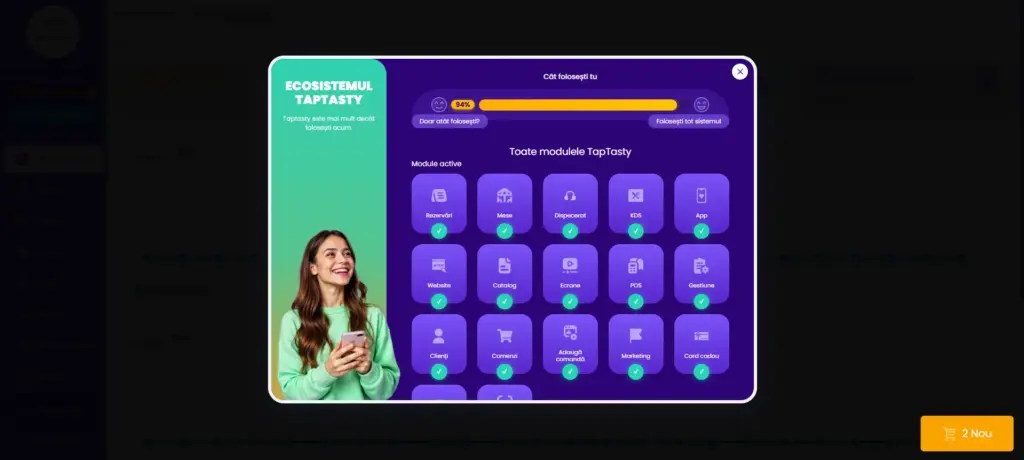
A digital ecosystem for restaurants doesn’t just mean a better POS — it means that every customer touchpoint and every moment in the operational flow is covered by the same, connected, coherent system. TapTasty is built on exactly this logic: a single restaurant software that covers everything, from the channels through which orders arrive to the kitchen screens, from stock management to marketing campaigns.
Restaurant Ordering — Online or On-Site
- Restaurant mobile app — your own direct ordering channel, under your brand, without an aggregator’s commission
- Website for online orders — for customers who prefer desktop or don’t want to install an app
- QR code ordering — customers order at the table directly from their phone, without waiting for a waiter
- Self-ordering kiosk — customers place their own order on-site, without queuing and without order transmission errors
Restaurant Operations
- POS — the core through which all orders pass, regardless of source
- MPOS — the mobile version of the POS, for taking orders directly at the table
- Inventory management software — consumption is automatically updated based on processed orders; you know at any moment what you have in stock, what needs to be ordered, and where stock is being lost
- Delivery software — where home delivery orders and your own delivery fleet are managed
- Reservations software — customers can make reservations from the mobile app or website, and these feed into the reservations module where they’re centralised and managed
- Kitchen display system (KDS) — automatically organises orders by priority; chefs process them and notify other modules when an order is ready
- Order status screen — displays the real-time status of orders in the dining room or waiting area
Restaurant Marketing
The restaurant marketing module enables reactivation campaigns, personalised offers, and direct customer communication based on real data from the same system — no manual export, no external tool required. The digital advertising screen rounds out the in-venue experience, displaying promotions, recommended products, or brand messages directly in your restaurant.
Comparison Table: Complete Restaurant Management Software vs. Separate Solutions
| Integrated Ecosystem | Separate Solutions | |
| Orders from all channels | Centralised automatically | Entered manually |
| Reporting | Single dashboard, real-time | Manual export from 3–4 sources |
| Loyalty campaigns | Automated, based on real data | Requires export + external tool |
| Staff onboarding | One interface to learn | 3–4 different systems |
| Technical support | One single vendor | 3–4 vendors blaming each other |
| Customer data | Yours, centralised | Partly held by aggregators |
Conclusion
At the end of the day, a well-run restaurant isn’t one with the best POS or the prettiest app — it’s one where the owner has clarity, the team has a system they can rely on, and the customer has a reason to come back. TapTasty is built for exactly that: a single restaurant software covering orders from every channel — including aggregators — kitchen operations, stock management, reservations, and marketing, all connected and speaking the same language. If you’d like to see concretely how TapTasty can help you build a digital infrastructure for your restaurant, get in touch and request a free demo.