
Most restaurants are built around one implicit objective: bringing in new customers. Advertising, launch promotions, presence on delivery platforms, influencer collaborations — all of these are, at their core, acquisition tools. The problem with this exclusive orientation is the mathematics behind it: according to industry-specific data for restaurants, a new customer costs five to seven times more than retaining an existing one. And yet, 70% of customers who visit a restaurant for the first time never return, without the restaurant having done anything obviously wrong.
There is a structural gap between what restaurants invest in customer acquisition and what they invest in customer retention, and that gap is not a strategic mistake, but a failure of perspective. Acquisition delivers visible results immediately: a new customer, a new order today. Customer retention delivers compounded results that are harder to measure in the short term, but decisive in the long run.
This article explains why, in the context of 2026 — with more selective consumers, lower average spend, and rising marketing costs — customer retention is no longer a secondary strategic option, but the baseline condition for profitability.
The Maths of a New Customer: What Acquisition Really Costs
The customer acquisition cost (CAC) includes everything you spend to bring a customer to their first order or visit: paid advertising, welcome promotions, presence on delivery platforms, commissions paid to aggregators, and launch discounts. Industry data is specific by restaurant type: a fast casual restaurant spends an average of $83 per newly acquired customer through paid channels, a casual dining restaurant reaches $125, and fine dining nearly $180.
These figures become critical when placed alongside the average spend and the likelihood of a customer returning. If a fast casual customer spends $12 on their first visit and does not come back, you have spent around $80 in CAC for a single $12 order. If 70% of new customers do not return, the majority of your restaurant’s marketing budget is, in practice, financing one-time visitors rather than a base of recurring customers — which makes customer retention all the more financially relevant.
The probability of selling to an existing customer is 60–70%. The probability of converting a completely new customer: 5–20%. This 3–14x difference in conversion rate is the strongest economic argument for a strategy oriented toward customer retention — not instead of acquisition, but alongside it, with a correctly calibrated weighting.
Customer Lifetime Value: What a Loyal Customer Really Brings
Customer Lifetime Value (CLV) is the total amount a customer generates for your restaurant over the entire course of the relationship. The core formula, also used by customer retention platforms such as Paytronix, is: CLV = Average Order Value × Order Frequency per Period × Duration of Relationship. As an illustrative example: a customer who spends an average of $14 per order, twice a month, for 18 months has a CLV of approximately $500.
The CLV/CAC ratio is the real indicator of your marketing’s health: a CLV three to five times greater than CAC is considered healthy. If your CAC is $80 and the average CLV is $100, you are on thin ice. If CLV is $500, every acquisition investment justifies itself many times over — and that favourable ratio is, in essence, the direct result of strong customer retention.
Loyal customers do not only bring direct value. Restroworks reports that 65–80% of a restaurant’s sales come from returning customers, not new ones. And ChowNow data confirms that a returning customer spends 67% more than one on their first visit — because they already trust the quality, are more likely to explore new dishes, and are less price-sensitive than a first-timer who does not know what to expect.
Industry Retention Rate: A Structurally Ignored Problem
The restaurant industry has one of the lowest retention rates of any sector: an average of 55%, compared to a global average of 75% across other industries. In practice: if you have 1,000 active customers in January, you have approximately 550 in February. Not because the other 450 were dissatisfied — but because they received no reason to return sooner.
The problem is that this 55% rate is rarely calculated explicitly by owners. Without a system that tracks individual customers — their ID, order history, date of last visit — you cannot calculate customer retention. And what you do not measure, you cannot improve. Many restaurants operate with the impression that things are going well because the tables are full, without knowing how many of today’s customers are visiting for the first time versus returning. A restaurant with 80% new customers and 20% returning ones has a structural customer retention problem, even if it is always busy.
The 2026 context adds significant pressure to the retention argument. According to the NRA’s 2026 State of the Restaurant Industry report, 40% of consumers are already cutting back on how often they visit restaurants, and more than 60% of operators reported traffic declines in 2025. McKinsey confirms that even when diners do show up, many are trading down — ordering fewer items or choosing cheaper options. When customers dine out less often and spend less per visit, the value of a loyal customer increases proportionally, and the cost of losing one becomes harder to offset through new customer acquisition.
The Real Reasons Customers Don’t Come Back
Intuition says a customer who does not return had a bad experience. Data says otherwise. Industry research shows that the main factors driving return visits are, in order: order accuracy, speed of service, and the relevance of communications received after the first visit. The first two are operational. The third is a marketing function and depends entirely on having the customer’s data.
The most frequent reason customers do not return is not dissatisfaction — it is perceived indifference. The customer ordered, received their food, may even have been satisfied… and your restaurant simply did not cross their mind in the weeks that followed. If they received no communication, no offer, no sign that the restaurant is aware they exist, their decision to order again was left entirely to the moment. And in that moment, a competitor with a more visible promotion or a more convenient location can win the order.
Another underestimated factor: digital friction. If the only way to order again is to remember the restaurant exists, search for it on a platform, and start the ordering process from scratch, the likelihood of reordering drops significantly compared to a customer who has the restaurant’s own app installed, with their account and order history saved. The restaurant’s branded mobile app reduces friction for repeat orders to a minimum: the customer opens the app, sees their previous orders, and reorders with a few taps.
The Psychology of Loyalty: What Works and What Doesn’t
Not all customer retention methods are equal. A counter-intuitive but well-documented principle in marketing literature: frequent promotions and discounts do not build loyalty — they build the habit of discounting. A customer who only returns because you have an active coupon will leave the moment a competitor offers a better one. Real loyalty is built through consistent quality, personalised experiences, and relevant communication.
Neuroeconomics research shows that people are more motivated by recognition and a sense of belonging than by purely transactional discounts. A customer who receives a birthday message with a personalised offer feels that the restaurant knows them. A customer who receives their tenth generic 10%-off coupon feels part of a mass campaign. The psychological effects are completely different — and their long-term impact on customer retention is equally different.
Personalisation — sending the right messages, to the right person, at the right time — is the mechanism that transforms mass marketing into marketing that generates loyalty. According to McKinsey research cited by Evokad, personalisation can reduce acquisition cost by up to 50% and increase revenue by 5–15%, precisely because it converts more efficiently and reactivates inactive customers more quickly.
Loyalty Programmes: The Real Data on Impact
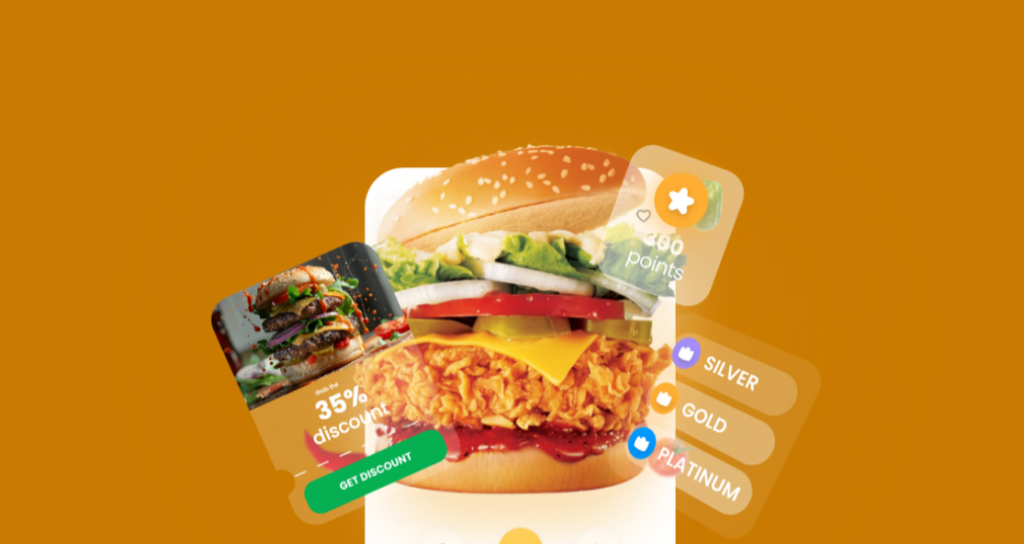
Loyalty programmes are the most discussed customer retention tool, and also the most misunderstood. Concrete data shows that, when implemented correctly, they have a significant impact: loyalty programme members visit the restaurant 20% more often and spend 20% more per order than non-members. 61% of customers say that the existence of a loyalty programme influences their choice of restaurant when deciding where to order delivery. And 67% of Gen Z consumers say they would participate in a “house account”-type programme if one existed.
When implemented incorrectly, loyalty programmes become a cost without ROI. The most common mistakes: rewards that are not attractive enough relative to the effort of participation, infrequent or irrelevant communication with members, absence of personalisation (all members receive the same messages), and lack of clear visibility for the customer (they do not know how many points they have or how much more they need to spend for the next reward).
The TapTasty loyalty module integrates loyalty points across all sales channels — app, website, kiosk, QR menu, POS — and makes them visible to the customer in real time through the app. Conversion rules are configurable: how many points per dollar spent, the value of accumulated points, which products are eligible. All programme communication can be automated and personalised based on individual behaviour, directly strengthening customer retention without additional manual effort from the team.
Direct Marketing for Restaurants: The ROI Few Calculate
Beyond loyalty programmes, direct communication with the existing customer base has one of the best ROI figures in all of marketing. The Litmus State of Email 2025 reports an average ROI of $36 for every dollar invested in email marketing, with a peak of $48 per dollar for the optimal frequency of 5–8 emails per month.
For restaurants, the combination of push notifications (through the app) and emails enables precise segmentation: customers inactive for more than 30 days (reactivation campaign), customers whose birthday falls this week (personalised offer), customers who viewed a dish without ordering it (targeted discount), customers who have reached a loyalty threshold (recognition message and reward). Each of these campaigns can be set up once and run automatically, without manual intervention at each send — a direct mechanism for growing customer retention through relevance, not volume.
The difference compared to generic campaigns is significant: an email sent to all customers reading “Promotion! −15% this weekend” generates a mediocre open rate and a low conversion rate. An email sent to a customer who has not ordered in three weeks reading “We’ve missed you! Your favourite dish is waiting with 10% off today” generates several times the conversion rate, because it is relevant and personal.
How to Build the Customer Retention Infrastructure: The Right Order
Customer retention is not built from a hastily launched loyalty programme. It requires a data infrastructure and a communication strategy. What is the right order?
1. Collect customer data at the first order. Every customer who orders through the restaurant’s own channels — the branded mobile app, the online ordering website, the self-ordering kiosk, QR table ordering — creates a profile with their order history. Every customer who orders exclusively through aggregators remains anonymous. This is why building your own ordering channel is the prerequisite for any customer retention strategy: without data, there is no personalisation.
2. Implement a rewards accumulation mechanism. Loyalty points are the simplest and most familiar mechanism. The customer knows that every order brings them concrete benefits — and has a reason to come back to your restaurant rather than ordering from a competitor.
3. Automate communication. Automated campaigns based on behaviour (inactivity, birthday, loyalty threshold, abandoned cart) are more effective than any manual campaign because they are sent at the relevant moment, not at the moment convenient for marketing.
4. Measure retention rate monthly. How many of last month’s active customers ordered again this month? How is the average CLV evolving? Which customer segments have the highest churn rate? The answers guide continuous adjustments to the customer retention strategy.
You can read more about the marketing tools available for restaurants in a dedicated article on the TapTasty blog.
Conclusion
Customer retention does not replace acquisition. A restaurant needs both. But the balance of investment between the two is frequently skewed, with direct consequences for profitability. If you are spending significant sums to bring in new customers and have no mechanism to turn them into returning ones, you are running a business where every customer must be won from scratch, every single time. With the right tools — a loyalty programme, targeted marketing, your own ordering channels — your restaurant can transform occasional visitors into loyal customers, and TapTasty can help you do exactly that.
The concrete first step: calculate your restaurant’s retention rate. How many of the customers who ordered last month also ordered the month before? If you cannot answer that question, you may not have the data you need — and the absence of data is, in itself, an answer about the current state of customer retention in your restaurant.