
“AI” has become the most overused term in restaurant technology over the past two years. Every hospitality software vendor now includes it in their product description, industry conferences put it on their banners, and trade publications present it as the force that will redefine the sector. The problem is that the enthusiasm has far outpaced the operational reality for most restaurants, generating a confusion that can lead either to misguided investments or to ignoring altogether tools that do have real impact.
A State of Digital report published by Qu in March 2026, based on a survey of nearly 170 limited-service restaurant chains, offers an honest perspective: 51% of brands are already investing in AI, and another 22% plan to do so during the year. And yet, among those already using AI, only 9% report a significant impact, while 43% describe the value obtained as limited. 37% of brands say that fragmented systems and siloed data are the main reason their technology investments are not delivering results. “AI has arrived in restaurants, but ROI is lagging” — that is the exact title of the analysis, and it sums up the situation well.
This situation does not mean that AI does not work. It means that expectations and implementations are, more often than not, out of alignment. This article draws the distinction that most commercial presentations avoid: where AI generates real, concrete, and measurable value — and where it is, for now, more marketing than substance.
What Does AI Mean for Restaurants?
Before anything else, a necessary clarification of terms. When we talk about artificial intelligence in restaurants, we are talking about systems that analyse historical and current data to identify patterns, generate predictions, or automate repetitive decisions. We are not, for the most part, talking about culinary robots or virtual waiters replacing people.
There are three levels of AI present in the restaurant industry today:
- Predictive analytics — systems that use sales history, the calendar, weather conditions, and other factors to forecast future demand: how many customers will come tomorrow evening, what they will order, what ingredients need to be prepared.
- Automation of repetitive decisions — systems that automatically execute actions based on rules and data: sending a reactivation email to a customer inactive for X days, generating an end-of-day sales report, adjusting stock order levels from suppliers based on sales from the equivalent previous period.
- Conversational and voice interfaces — chatbots and voice assistants that take reservations or orders, answer frequently asked questions, or guide the customer through the menu.
Each level has different applicability and different implementation requirements. Confusing them is the primary source of industry disappointment.
Large Chains vs. Independent Restaurants: Two Completely Different Realities
The AI examples that appear in the press are almost always from large chains: McDonald’s with AI voice ordering at drive-throughs, Starbucks with the Deep Brew platform for order flow optimisation and staff scheduling, Chipotle with Autocado for avocado preparation, Wendy’s with its Google Cloud partnership for the voice assistant. These implementations are real and they work — but behind them are dedicated data teams, significant budgets, and infrastructure built over years.
KitchenHub summarises this reality well: large chains can absorb failed projects and iterate. Independent restaurants and smaller groups do not have that margin. The conclusion is not that AI is irrelevant for independent restaurants, but that the type of AI relevant to them is different from what appears in media examples.
Useful AI for independent restaurants in 2026 comes integrated into the platforms they already use — not from a separate project with a dedicated budget. Many operators are already using it without calling it that: they call it “the automated sales report,” “the automated reactivation campaign,” or “the low-stock alert.”
Six Concrete Applications Where AI Generates Real Value
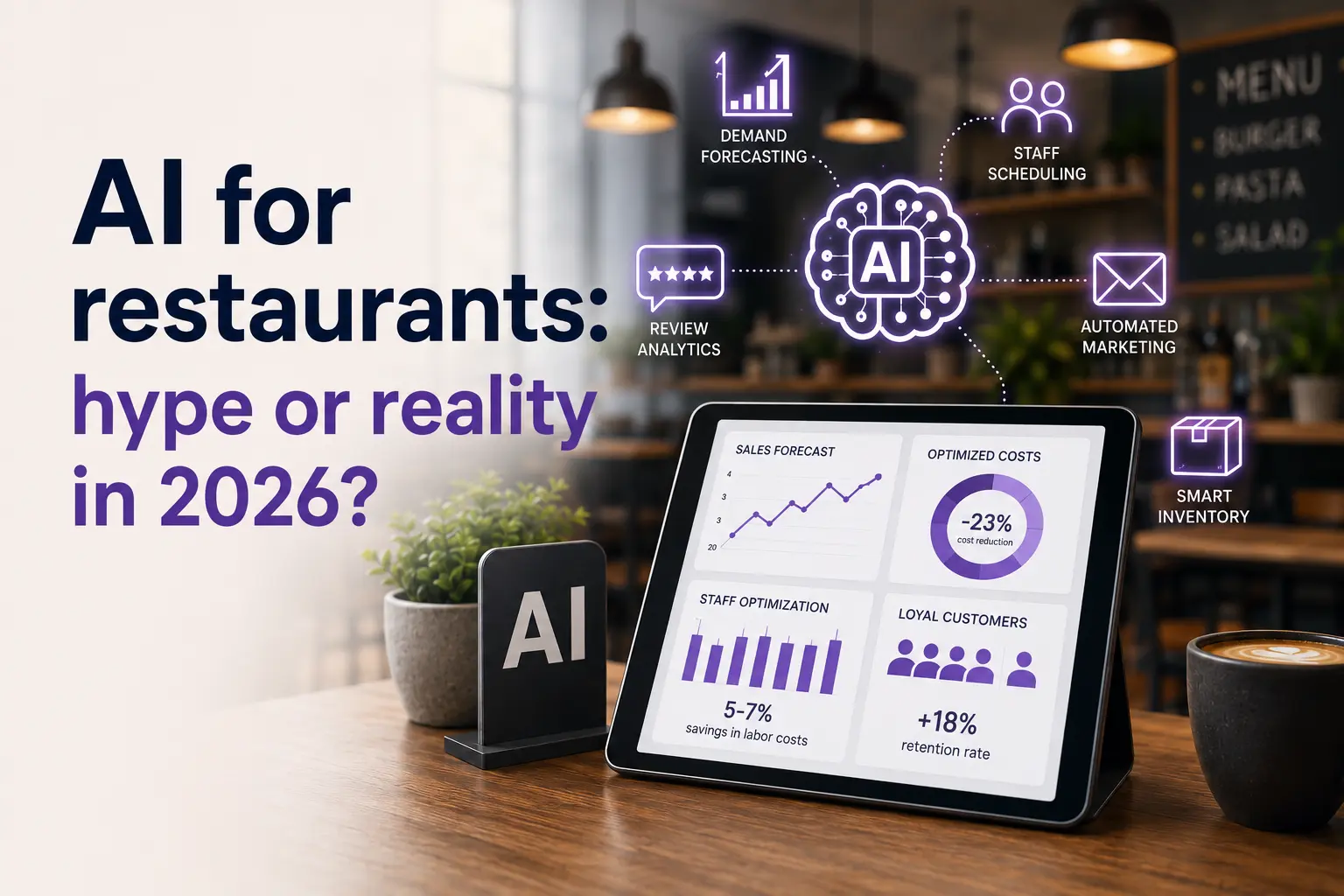
1. Demand forecasting and inventory optimisation. Systems that analyse sales history, the local calendar (concerts, events, holidays), and weather conditions to estimate how many customers will come and what they will order. The direct benefit: reduced overstocking and food waste. According to industry data, AI-based forecasting systems can reduce over-ordering by 20–30% — savings of thousands of dollars a month for a mid-volume restaurant.
2. Staff scheduling optimisation. Platforms that correlate the POS with sales history by time slot and generate staffing recommendations aligned with projected demand. EHL Insights cites that such systems generate savings of 5–7% on labour costs by eliminating overstaffing during quiet hours. On a monthly labour budget of $10,000, 5% means $500 saved per month without affecting service quality.
3. Automated review analysis. Systems that aggregate reviews from all platforms (Google, TripAdvisor, delivery platforms) and automatically identify recurring themes: dishes mentioned negatively, hours with poor reviews, service aspects consistently criticised. Without AI, a manager would need to read hundreds of reviews a month to spot patterns. With AI, the thematic report is generated automatically and can be acted upon immediately.
4. Behaviour-based automated marketing. Campaigns triggered automatically based on customer actions: a reactivation email for a customer inactive for 30 days, a birthday message, an offer on a dish they viewed without ordering, a notification when a favourite product returns to the menu. According to the Qu report, marketing and personalisation are the most common uses of AI in restaurants (53% of operators). All of these campaigns can be set up once and run automatically, without manual intervention.
5. Menu engineering. Systems that analyse each dish’s performance — popularity, margin, preparation time, reviews — and generate adjustment recommendations: what to promote, what to pull, what price to adjust when an ingredient cost rises. Sauce describes this as one of the most concrete, fast-result applications available today for independent restaurants, precisely because it answers an immediate and financially relevant question.
6. Intelligent reservation management. Reservation systems that use historical data to calculate the probability of a no-show per time slot, strategically manage overbooking, and automatically send personalised confirmations and reminders. The impact: fewer lost bookings and maximised actual occupancy relative to available capacity.
Where AI Is Overhyped: An Honest Assessment
Tenzo, a restaurant analytics provider, puts it plainly: “The hype is real. There are a lot of AI-powered tools that are standard reporting with a chatbot UI.” This problem is widespread in the market, and all the more so in the hospitality sector, where operators’ technological maturity varies enormously.
The AI voice waiter — which takes complete orders by voice, offers personalised recommendations, and completes the transaction without human involvement — exists and works in large fast-food chains with ultra-standardised processes. For restaurants with complex menus, table service, or a varied clientele, the implementation cost and the complexity of handling errors exceed the current benefits. The situation will change for most independent restaurants, but not in 2026.
Full kitchen robotisation is a reality for a few dozen restaurants worldwide (Sweetgreen with Infinite Kitchen, Chipotle with Autocado for avocado), not a scalable solution for the industry. EHL Insights notes that the more useful question for most operators is not whether robots will replace staff, but whether targeted automation of specific repetitive tasks makes economic sense for their volume and margin.
AI dynamic pricing — real-time adjustment of menu prices based on demand, similar to hotel pricing models — is an emerging trend in a few large chains, but it raises customer perception and regulatory issues that make it impractical for independent restaurants at present.
The Problem Nobody Mentions: Data
There is a basic condition for any AI implementation in a restaurant that commercial presentations routinely omit: data must exist, be clean, and be connected. Tenzo states it directly: “A sophisticated model on weak data does not produce sophisticated insights — it produces nonsense that looks like certainty.” The Qu report confirms it: 37% of brands say that system fragmentation and data silos are precisely what prevent them from getting value from their technology investments.
In concrete terms: a demand forecasting system needs at least 6–12 months of historical sales data, broken down by time slot and day. An automated marketing system needs a customer profile: order history, preferences, date of last visit. A menu engineering system needs data on the real cost of ingredients per recipe, connected to actual sales.
A restaurant without a modern POS system, that does not collect customer data, or that manages stock in a spreadsheet, does not have the data foundation needed to benefit from AI. Any investment in AI tools before resolving this foundation will produce disappointment. That does not mean AI is irrelevant — it means the right order is: digital basics first, then AI.
You can read more about the right order of digitalization in the complete restaurant guide on the TapTasty blog.
How to Evaluate an AI Tool: Four Questions Before Any Decision
The market is flooded with products that self-declare as “AI-powered.” A few questions to help you separate substance from marketing:
1. What specific problem does it solve, and how does it measure that? A serious AI tool has a clear metric: it reduces waste by X%, saves Y hours of manual work per week, increases customer return rate by Z%. If the vendor cannot articulate the benefit in concrete numbers, that is a negative signal.
2. What data does it require, and which of that data do you already have? Check whether you have the minimum data necessary for the tool to work. A forecasting system without historical data cannot make predictions. A personalisation system without customer profiles cannot personalise.
3. Does it integrate with the systems you already use? An AI tool isolated from the POS, inventory system, or marketing platform you use creates a separate data island and complicates rather than simplifies operations. The most effective AI is the one integrated into the existing ecosystem, not layered on top of it.
4. Is there evidence from similar operators? Case studies from restaurants comparable in size, segment, and volume are far more relevant than examples from large chains. Ask for concrete references and speak to operators who are already using the tool.
A Practical Roadmap: How to Get to AI in Four Stages
Stage 1: The digital foundation — a modern POS connected to all sales channels, systematic collection of customer data, digital stock management. Without these, AI has nothing to analyse. If you are at this stage, consult the complete digitalization guide or the modules available in TapTasty to understand which tools you are missing.
Stage 2: Automation of repetitive tasks — automatically generated sales reports, low-stock alerts, marketing campaigns with automated triggers (customer birthday, inactivity, loyalty threshold). This is the first form of AI that is useful and accessible for any restaurant, regardless of size.
Stage 3: Predictive analytics — demand forecasting, staff scheduling optimisation, data-driven menu engineering. Requires 6–12 months of historical data accumulated in stages 1 and 2.
Stage 4: Conversational interfaces and advanced experiments — reservation chatbots, voice assistants, dynamic pricing. Relevance varies by restaurant type and volume. Evaluate against the criteria in the previous section before any investment.
Conclusion
Artificial intelligence in restaurants is neither pure hype nor a complete revolution. It is a maturing technology whose concrete applications are less spectacular than the headlines suggest, but more valuable than many operators realise. The restaurants seeing real results are not the ones that bought the most sophisticated tool. They are the ones that started from a concrete problem, verified that they had the necessary data, and implemented a specific solution.
If you operate an independent restaurant in 2026, the AI that is useful to you already exists — probably in the platforms you use or could use. And more likely, the first step is not an AI project, but making sure your data is collected, centralised, and available. Without good data, any AI produces, as Tenzo puts it, “nonsense that looks like certainty.”