
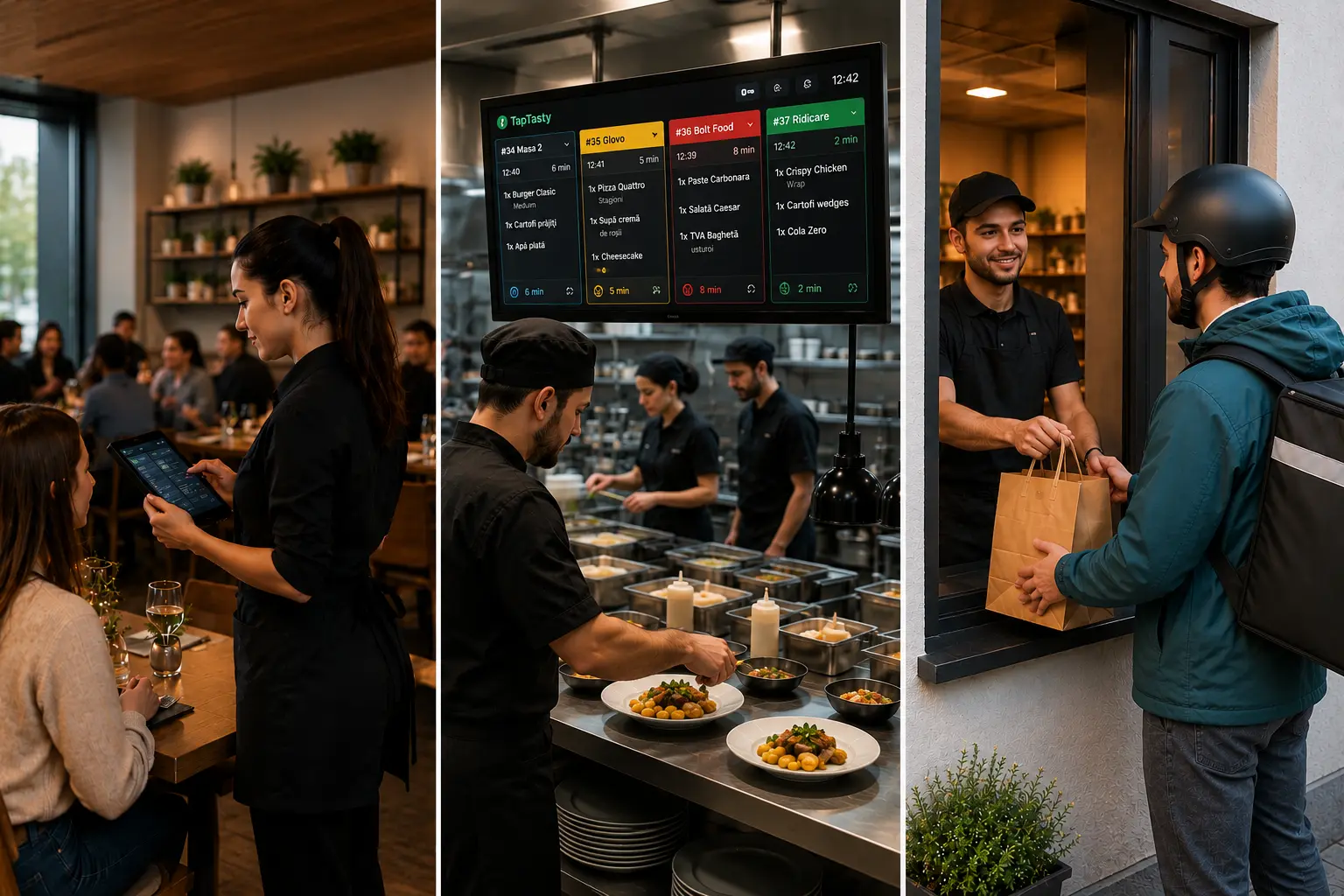
There is a common paradox in the restaurant industry. The food is good, the staff is welcoming, the location is right — and yet customers do not come back. The reason often surfaces in reviews: a wrong order, an unexpectedly long wait, a delivery that arrived with something else in the bag. None of these is a food quality problem. They are operational flow problems, rooted in how information moves between the dining room, the kitchen, and the delivery team.
The importance of this flow is confirmed by recent data. A Qu 2026 report, cited by Forbes, shows that 62% of restaurant brands say improving order flow across all channels is their number one priority for 2026. Next come workflow and station efficiency (52%) and the accuracy of order pick-up times (48%). This is not a marginal problem — it is the most pressing operational challenge in the industry right now.
Why Operational Flow Breaks Down
In a restaurant without an integrated digital system, an order travels a route full of friction points. The server takes it on paper, passes it to the kitchen on a physical ticket, the cook prepares it, and the server picks up the plates and brings them to the table. At every handoff there are risks: a ticket that gets lost, an instruction misheard, a last-minute modification that never reaches the cook.
Obypay describes the problem clearly: “Lost tickets, orders taken from memory or through verbal communication alone create zones of inevitable friction. Add in the noise of the dining room and the pace of the kitchen, and misunderstandings become unavoidable.” The issue is not that people make exceptional mistakes — it is that manual systems generate errors systematically, especially during peak hours.
The operational flow breaks at the same point every time: the manual transfer of information between people. Every time someone has to retransmit a command that already exists somewhere — to call it out, write it down again, enter it a second time into a different system — they have created a predictable failure point.
Dining Room - Kitchen: From Order to Preparation
The first link in the operational flow is the connection between the dining room and the kitchen. The order must arrive in the kitchen accurately, completely, and promptly the moment the server takes it. In manual systems, this transmission depends on the server’s memory, the legibility of handwritten tickets, and the cook’s attention while reading a ticket in the middle of a busy shift.
The direct consequence of a breakdown at this link is not just a wrong dish. It means time lost remaking orders, wasted ingredients, and a dissatisfied customer who passes it on to others.
The solution at this link is fairly straightforward: the order must arrive in the kitchen automatically the moment it is entered into the POS, with no manual retransmission. A KDS screen picks up the order directly from the POS and displays it in the kitchen, organises it by station (hot kitchen, salads, desserts, bar), and prioritises it in real time. There is no physical ticket to get lost, no instructions to be misunderstood. A Lavu study shows that digital systems of this type reduce order errors by 60–80% compared to paper-based systems.
Kitchen - Dining Room: Communication in Reverse
Operational flow does not only run from the dining room to the kitchen. The kitchen also needs to communicate back: when a dish is ready, when an ingredient is missing and an order needs modifying, when preparation will take longer than expected. In manual systems, this communication happens through shouting or through servers periodically walking into the kitchen to ask about the status of an order.
The KDS resolves this communication in both directions. Servers using a mobile POS receive notifications directly on their device when dishes are ready, without needing to go into the kitchen to check. They go to the table at exactly the right moment — not before and not after.
For restaurants with fast counter service, an order status display completes this loop from a different direction: customers can see in real time when their order is ready and go to collect it without staff calling out numbers or making verification rounds. Both tools reduce the chaos of peak hours and free up staff for what actually matters.
Delivery: The Third Link in the Flow
If the restaurant handles deliveries, the operational flow gains a third actor: the delivery driver. They need to know exactly what they are picking up, when, and where it is going. If the information reaches them incorrectly or late, the delivery suffers. If they do not know in what order to pick up orders, or whether they can group multiple orders by zone, they waste time and fuel unnecessarily.
A delivery management system sends orders directly to the driver’s app the moment the kitchen marks them as ready. The driver does not need to ask anyone for information, write down addresses by hand, or wait for a counter employee to finish serving another customer before passing on the details. The order arrives automatically, with the address, any special instructions, and the optimal pick-up sequence if there are multiple orders on the same route.
Customer expectations for delivery are just as high as for in-venue service. Lavu data shows that 42% of customers consider five minutes the maximum acceptable wait time, and 27% expect their order within two to three minutes. While these figures are specific to the quick-service segment, the trend applies to delivery too: unjustified delays are one of the main drivers of dissatisfaction.
Orders from Multiple Channels
Operational flow becomes more complex as a restaurant receives orders from multiple sources: the dining room, its own mobile app, its website, the self-ordering kiosk, and third-party delivery platforms. Each new channel means an additional device on the counter or in the kitchen if there is no centralisation system. A staff member trying to monitor three tablets simultaneously from three different platforms is not monitoring any of them effectively.
Integrating aggregator platforms with the same POS that manages in-venue orders resolves this fragmentation: all orders, regardless of origin, arrive in the same place, are sent to the same KDS, and are managed from the same dashboard. This centralisation also eliminates one of the main sources of error in multi-channel restaurants: manually re-entering orders from one platform into the internal POS.
What to Measure to Know the Operational Flow Is Working
An improved operational flow is not only felt qualitatively — it can be measured. A few concrete metrics that show whether the optimisations are producing results:
- Average preparation time per order. If the KDS records preparation times by station and by dish, you can identify where bottlenecks occur systematically and at which hours.
- Error rate. How many orders required corrections or generated complaints this week compared to last week?
- Time from order placement to dish delivery. Tracked separately for in-venue and delivery. If it increases during peak hours, the flow has a bottleneck that can be identified.
Rezku notes that modern KDS platforms track preparation times by station, by dish, and by time slot, generating data that identifies bottlenecks and informs staffing decisions. These reports turn operational flow optimisation from an intuition-based decision into a data-driven one.
You can read more about the digital tools that help optimise restaurant operations in the complete restaurant digitalization guide or in the article about the most important technologies for modern restaurants.
Conclusion
The operational flow of a restaurant is not a technical subject reserved for IT specialists. It is a practical, daily problem that affects the speed of service, the error rate, and customer satisfaction. InTouch Insight 2026 data shows that an efficient flow can mean 87% of orders ready on time, while a deficient one drops that figure to 38%.
Optimisation does not necessarily mean a radical overhaul of how things work. It means removing the points where information gets lost or is retransmitted manually. The order placed by the customer must reach the kitchen without additional human intervention. The kitchen must be able to communicate back to the dining room without shouting and unnecessary back-and-forth. Delivery drivers must receive orders automatically, with everything they need. And TapTasty can help you with all of this. Check out TapTasty’s modules and find out what your restaurant’s operational flow could look like.