
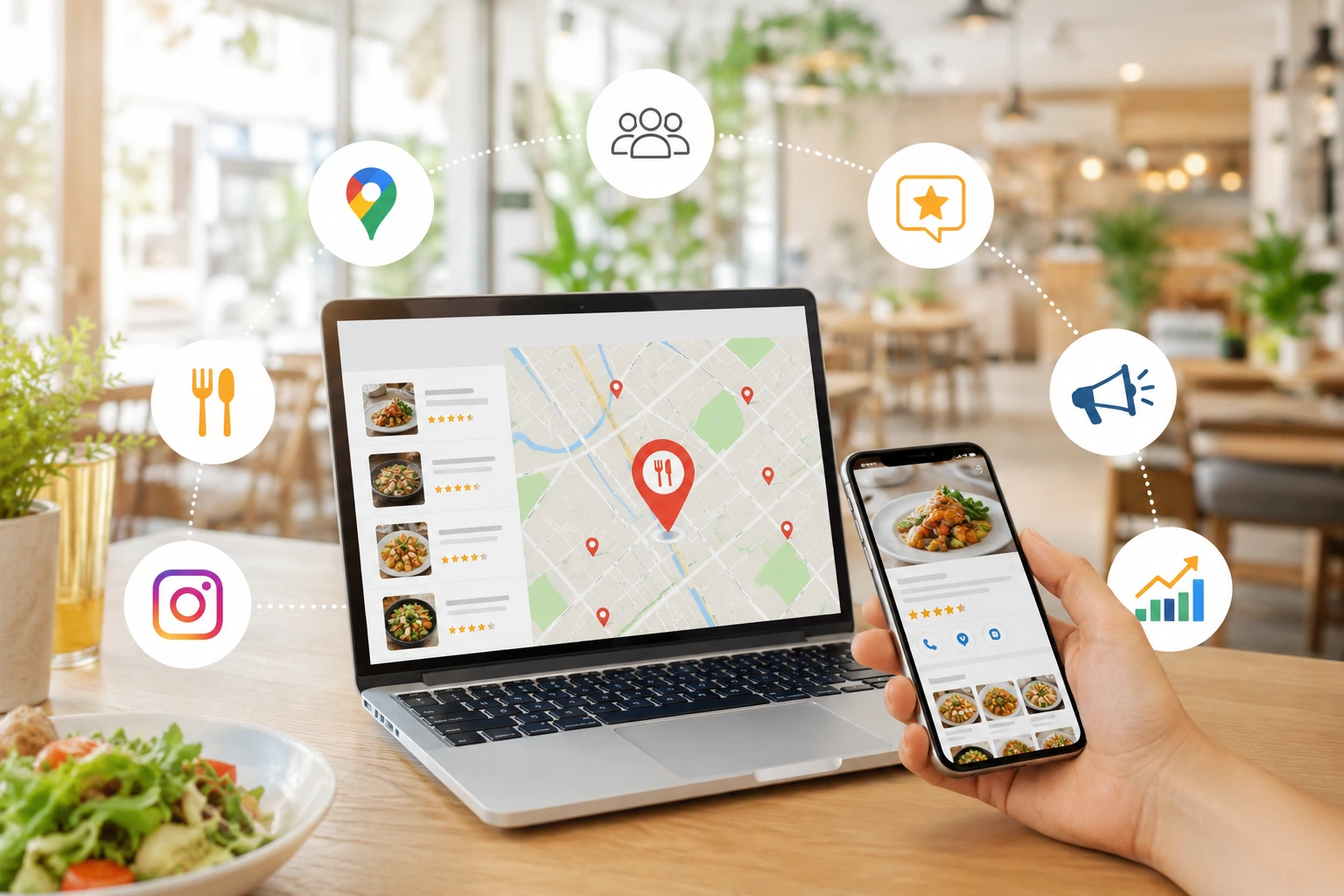
Most of a restaurant's customers come from within a few kilometres. Not from across the city, not from another town, but from the neighbourhood, near the office, or along the daily commute. That means local marketing is not one channel among many — it is the primary channel through which a restaurant attracts new customers. And yet, much of what restaurants spend on marketing goes to generic campaigns that target no one in particular.
The data shows the stakes are high. 88% of consumers who do a local search on their phone visit or contact that business within 24 hours. 64% of people looking for somewhere to eat check Google or Google Maps first before making a decision. And one detail that surprises many operators: 79% of restaurant searches are non-branded — meaning people search for “pizza near me” or “restaurant delivery Sunday evening,” not the name of a specific restaurant. That means you can win new customers even if nobody knows you exist, as long as you are visible at the right moment, in the right place.
This article walks through the main local marketing tools for restaurants in 2026 and how to use them practically, without large budgets and without specialist agencies.
First Step: Google Business Profile
Google Business Profile (formerly Google My Business) is the most important local marketing tool available to a restaurant, and it is free. It is the listing that appears in Google Maps and in local results when someone searches for a restaurant in your area. Without it being correctly set up, you effectively do not exist on the digital map of your city.
The basic setup does not take long: the correct address, an up-to-date opening schedule, phone number, and the right category. But the real difference from competitors comes from the details: good photos of the dishes and the space, an updated menu, a direct link for reservations or online orders, and responses to reviews. A complete profile generates significantly more traffic than an incomplete or neglected one. And more importantly, incorrect information costs real customers. A wrong opening time or an old address can mean a potential customer never reaches you, even if they were interested.
A few elements that matter more than they seem: the primary category chosen in Google Business Profile directly affects which searches you appear in. “Restaurant” is too generic if you are a pizzeria or a café. Recently added photos signal that the profile is active. Periodic posts from within the profile (promotions, events, new dishes) also contribute to relevance. And one aspect often overlooked: Google Business Profile is the first place customers leave reviews. Those reviews are not just a reputation tool — they are also a ranking factor in local searches. Restaurants with more recent reviews and a higher rating appear higher in results than those with neglected profiles.
Your Restaurant Website: Online Presence and a Local Customer Channel
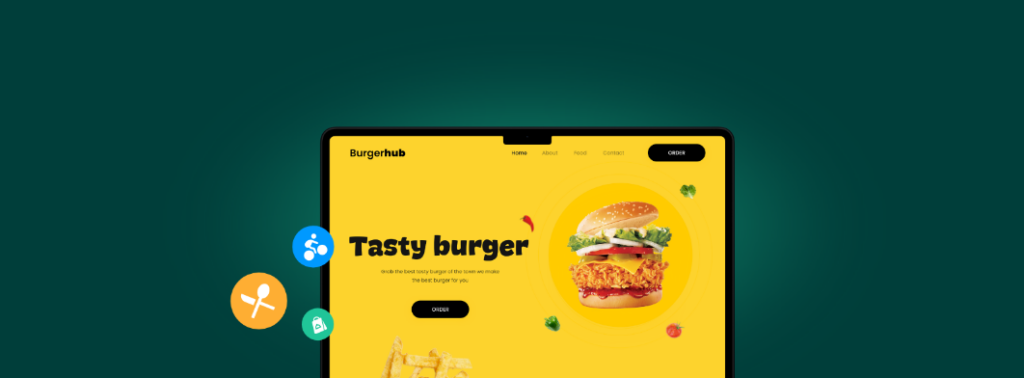
Many restaurant owners treat their website like a digital business card: the address, the hours, a few photos, and that's it. The problem is that a static website does nothing for you. A well-built website, on the other hand, works for your restaurant around the clock. It attracts organic traffic from Google searches, converts visitors into customers, and, if it supports online ordering, brings in direct orders without commissions to third parties.
From a local marketing perspective, the website matters in two ways. The first is technical: Google reads your site's content to decide whether your restaurant is relevant to a local search. A site that explicitly mentions the city, neighbourhood, or type of cuisine, that has structured data (schema markup), and that loads quickly on mobile has significantly better chances of appearing in the top local results. The second is behavioural: after reading positive reviews, a large proportion of consumers look up the restaurant's website. What they find there decides whether they make a reservation or go back to the search results.
This is also where the value of a website with integrated online ordering comes in. A visitor who lands on your site after a local search is already interested. If they can order directly from there, without being redirected to a third-party platform, the conversion rate increases. If they have to find another link or download a separate app, some of them give up.
The TapTasty website is built specifically for restaurants and optimised for local searches. Customers can order directly from the site without commissions, make reservations, and view an updated menu. From an SEO perspective, it is built with the correct structure to appear in searches like “restaurant delivery [your city]” or “where to eat [cuisine type] [neighbourhood]” — exactly the kind of non-branded searches through which new customers are won. Integration with Google Analytics 4 and Meta Pixel lets you track where visitors come from, which products they browse, and at what rate they convert into paying customers — essential data for any subsequent marketing decision.
Online Reviews: The Cheapest Local Marketing Tool
In a market where 79% of searches are non-branded and customers choose restaurants they did not know before, a review is the first trust signal. 87% of consumers read online reviews before choosing a local restaurant. This is not a niche habit — it is the majority behaviour.
Managing reviews does not mean waiting for them to appear. It means three active things. The first is to collect reviews consistently — through a direct request after the meal, through a link on the receipt, or a push notification via the app. Restaurants that actively ask for reviews accumulate higher volumes and better ratings than those that do nothing. The second is to respond to all reviews, positive and negative. A response to a negative review, if empathetic and constructive, can turn a dissatisfied customer into one who returns and shows others that the restaurant takes feedback seriously. The third is to keep the profile constantly updated with new photos, new dishes, and special hours — signs that the place is active and well-maintained.
Social Media: Presence Without a Huge Budget
Social media is no longer a platform for pure organic reach. Facebook and Instagram algorithms increasingly favour paid content. But for a local restaurant, there is a structural advantage: your target audience lives in the same city. That means you can build a relevant presence with a modest budget, if you understand what type of content works.
Content that performs organically for restaurants shares a few common characteristics: it is authentic (real photos from the kitchen, not stock images), it is consistent (you post regularly, not every few months), and it creates interaction (questions, polls, invitations to give opinions). Instagram and TikTok are channels where food performs well visually. Facebook remains useful for local events and neighbourhood groups where people recommend restaurants.
An underused tool is collaborating with local micro-influencers — accounts with a few thousand followers who have a loyal local audience. A post from a local food blogger about your restaurant can bring dozens of new bookings at a much lower cost than a national paid campaign. Authenticity matters more than reach.
Local Paid Campaigns: When and How They Work
Paid advertising on Google and Meta (Facebook/Instagram) works well, but only when correctly configured for local targeting. An ad seen by people from another region usually means wasted money.
Google Ads campaigns for local searches have a clear advantage: they capture active intent. Someone searching for “sushi delivery” on Google is ready to order. A well-set ad with strict geographic targeting and a direct link to the order page can convert efficiently. On Meta, retargeting campaigns (people who have already visited your website or app) and local awareness campaigns for events, new menus, or limited-time promotions tend to work better. Integration with Meta Pixel lets you build audiences based on the real behaviour of site visitors, not just general demographic criteria.
One principle worth keeping in mind: paid advertising amplifies what already exists. If the website is slow or the Google profile is incomplete, money spent on ads will convert at a much lower rate. The organic foundation comes before the ads, not after.
The Mobile App and Proximity Marketing
One local marketing channel that is often underestimated is the restaurant's own app. Compared to a generic ad or a social media post, the app reaches directly the customers who have already chosen to download it and use it: they created an account, they have ordered at least once. This is the most receptive audience you have.
The TapTasty mobile app includes a geolocation module that automatically detects when a customer is near the restaurant and sends them a personalised notification: an offer, a new dish, an invitation. It is not spam — it is relevant communication at the moment the customer is physically close and might walk in or place an order. Combined with customer segmentation by ordering behaviour, this type of local marketing becomes far more precise than any paid ad: you know who receives the message, when they receive it, and what offer is likely to convert them.
Conclusion
Local marketing for restaurants does not require large budgets. It requires the right presence in the places where customers search: Google Maps, local search results, reviews, and social media. Each channel reinforces the others: a good Google profile brings traffic to the website, the website converts visitors into orders, orders generate reviews, and reviews improve local rankings.
The starting point is not advertising. Make sure first that all information about your restaurant is correct, up to date, and visible where customers are looking. Opening hours, address, phone number, and menu must be identical across all platforms: Google, website, app. After that, each additional step (an optimised website, a local campaign, a review strategy) adds a new layer of visibility and appeal.
Effective local marketing and customer retention are two sides of the same strategy: the first brings in new people, the second turns them into recurring customers. You can read more about how to build a direct and lasting relationship with your customers in the article on retention on the TapTasty blog.