
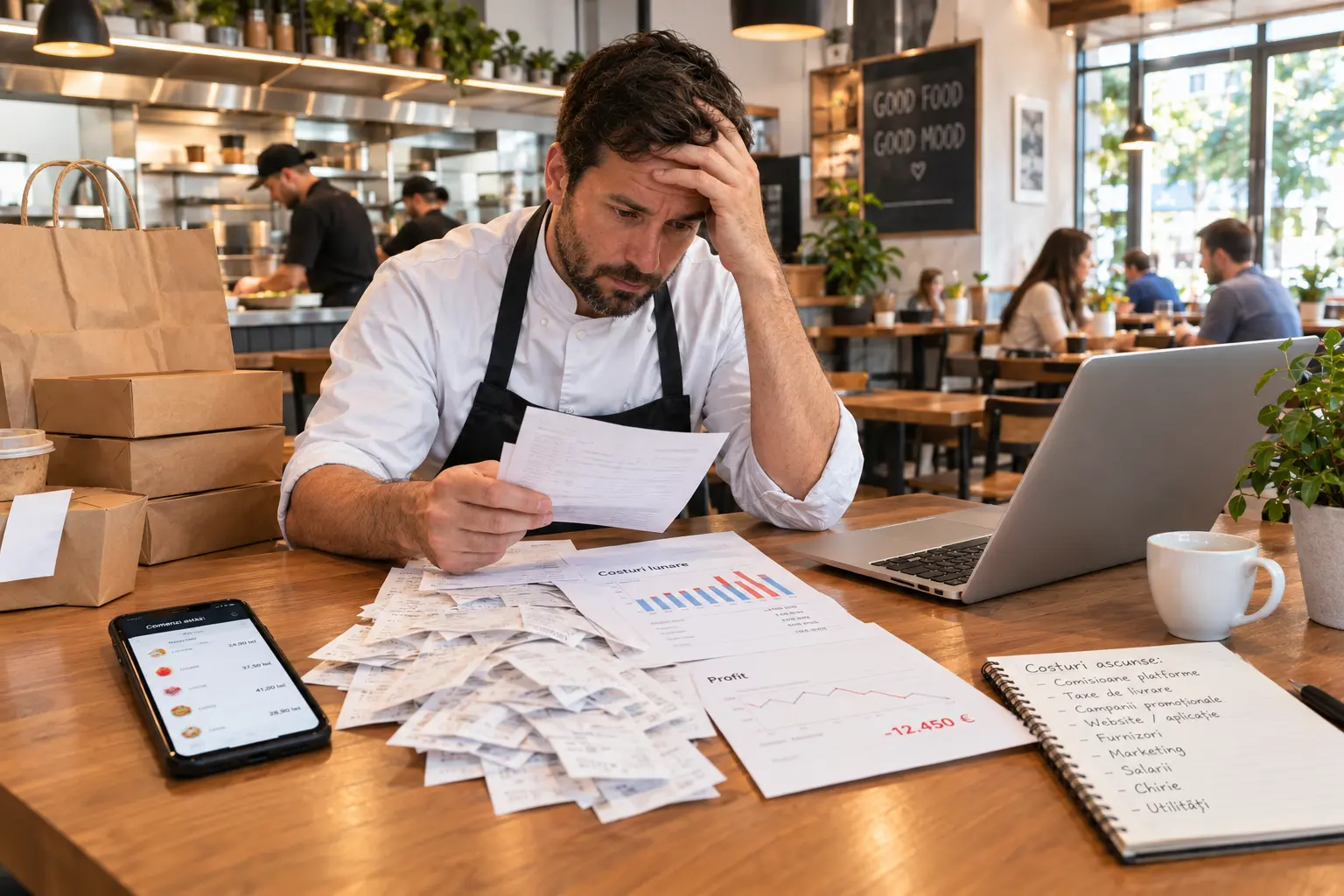
There is a paradox in the restaurant industry that has been growing more visible in recent years: sales go up, order volume goes up, the venue is busy, and yet profit does not reflect any of it. According to Restaurant365 data, 45% of restaurant operators closed 2025 at a loss or on the edge of profitability, despite record revenue figures across the industry. The problem is not that restaurants are not selling enough. It is that losses are happening in multiple places at once and, most of the time, without anyone having calculated them carefully.
The modern restaurant has more sales channels, more technology, and more suppliers than it did ten years ago. Each of these also brings its own costs, some visible on an invoice, others absorbed into general overheads and never analysed as a distinct expense. The result is that money leaves through several doors and nobody is standing at any of them.
This article does not repeat the classic operational losses, food waste, order errors, or unoptimised food cost, which we have covered separately in our dedicated article on hidden restaurant losses. It focuses on the losses specific to the modern restaurant, those that come from how delivery, technology, and digital marketing work today.
Commissions That Do Not Show What They Actually Take
Delivery platform commissions are the most discussed topic in the restaurant industry and, paradoxically, the most accepted. Most operators know that Glovo or Bolt Food take a percentage of every order and have come to accept this as the price of visibility. The problem is that the advertised percentage does not reflect the real cost.
KitchenHub shows that beyond the base commission of 15 to 30%, the effective cost per order on delivery platforms frequently reaches 30 to 40% of the order value when you include the additional visibility fees paid separately, participation in the platform's promotional campaigns, and refunds for problematic orders. In other words, a restaurant that calculates it is losing 25% per order on the platform may discover on closer analysis that it is losing 35% or more.
There is also a less-discussed mechanism at play: the pressure to participate in the platform's promotional campaigns. Glovo or Bolt Food periodically run campaigns of the “20% off at all partner restaurants” type, and restaurants that do not participate are penalised algorithmically, appearing lower in results than those that accept. Participation means the restaurant funds the discount from its own margin, on top of the commission already paid. The effective cost per order during these periods can exceed 40% of the order value, making some orders genuinely unprofitable rather than just low-margin.
On top of all this there is a less obvious cost: customers who order through platforms remain anonymous to the restaurant. Their data belongs to the platform, not to you. You cannot reactivate them, cannot send them a direct offer, cannot build a relationship with them outside the platform. Every order generates a sale, but not a restaurant customer — a platform customer.
Paid Digital Infrastructure Left Waiting
Many restaurant owners have invested in recent years in a mobile app or a website with online ordering, convinced that their own digital presence would reduce their dependence on third-party platforms. The investment was real. The problem appears after launch: the app exists, but nobody is actively promoting it, direct orders remain a small fraction of the total, and the monthly platform cost is being paid for a solution used at 20% of its capacity.
A mobile app or an ordering website does not bring in customers simply by existing. It requires a continuous redirection effort: inserts in delivery bags, conversion campaigns from third-party platforms, exclusive offers for direct orders, constant communication with the existing customer base. Without this work, the restaurant's own digital infrastructure becomes a fixed monthly cost that does not deliver the return it was purchased for.
Menus Too Large, Costs Too High
There is a longstanding belief in restaurants that a richer menu means more satisfied customers, because everyone finds something to their taste. The economic reality is different, and increasingly difficult to sustain given current ingredient prices.
GetSauce documents that extended menus carry a series of hidden costs that become harder to justify as ingredient prices rise. Every dish on the menu requires ingredients to be stocked, even if the dish sells twice a week. Every stocked ingredient can expire. Every recipe must be taught to every new employee, increasing the complexity of training. And every dish that takes up space on the menu without generating a real contribution to profit is, in practice, a cost that appears on no invoice but very much exists.
Beyond the direct costs, there is a subtler effect: a menu with too many options puts the customer in difficulty. Consumer behaviour research shows consistently that an excessive number of choices does not increase satisfaction, but prolongs the decision and increases hesitation. A customer who cannot make up their mind at the table takes more of the server's time and slows table turnover. A customer who hesitates on the app or website abandons the order more often. Both situations translate into lower revenue compared to what a clearly structured and well-calibrated menu would generate.
The solution is not a menu with four dishes, but a menu designed to exclude low-margin, low-turnover items and keep what sells well and contributes to profit. The TapTasty inventory management software provides the data needed to make these decisions on the basis of real consumption figures, not on personal preferences.
Ten Systems Doing What One Could Do
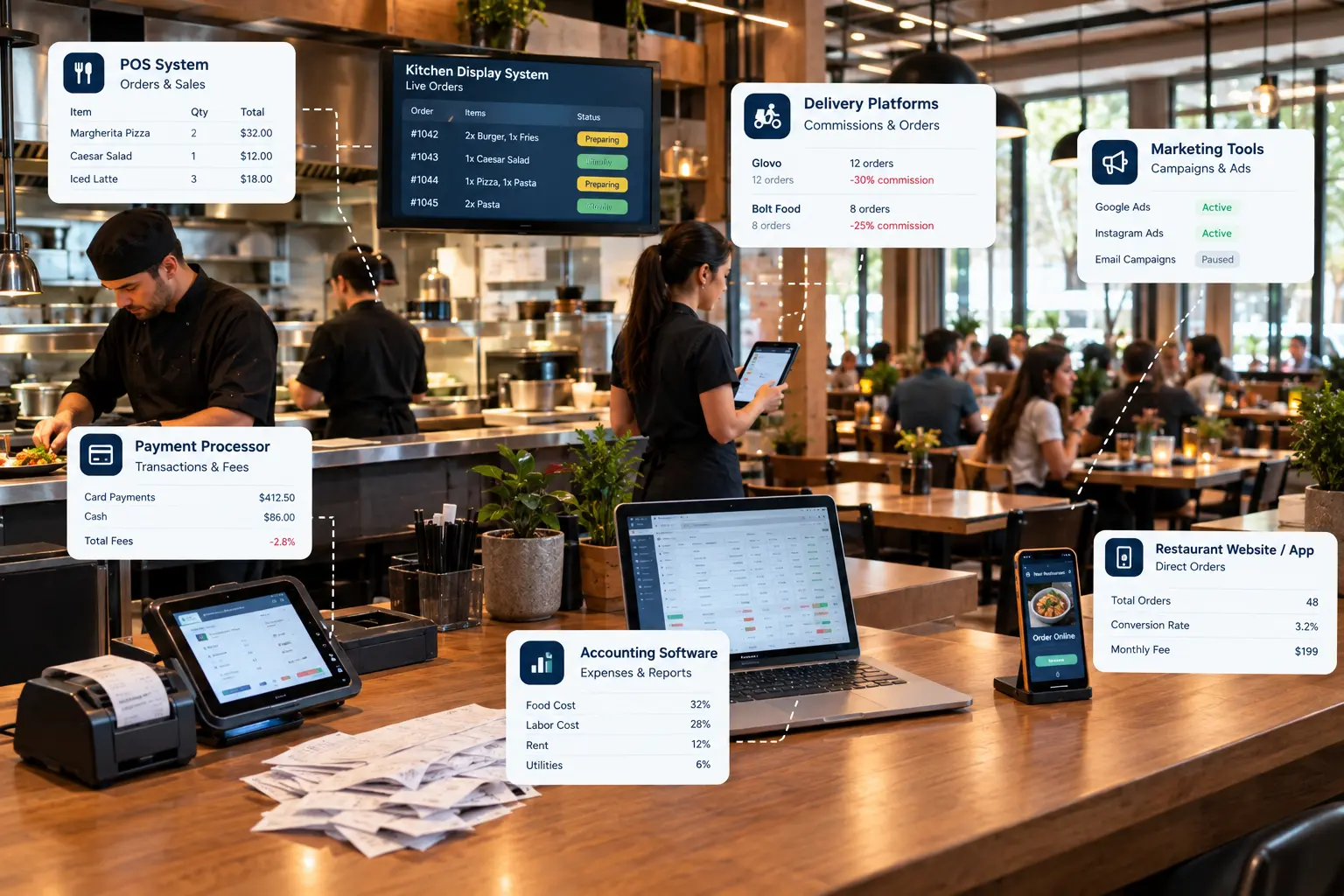
Another place where modern restaurants lose money is less spectacular than commissions, but just as persistent: the number of apps and platforms they pay for monthly, each solving a partial problem and none of them talking to the others. One system for the POS, another for reservations, another for online orders, another for inventory management, another for loyalty, another for reports. Each with its own subscription, each with its own isolated data.
Nomni documents that most restaurant operators run between 10 and 30 disconnected systems, generating what the industry calls application chaos: multiple monthly subscriptions, integration fees, constant screen switching, and data that does not communicate. The cost of this fragmentation is not only financial. It is also operational: staff work more slowly, errors occur more often at the junctions between systems, and the manager has no overall view because the data is scattered across too many places.
The solution is not to abandon technology, but to replace the collection of partial solutions with an integrated ecosystem where the POS, online orders, stock, loyalty, and reports all communicate from the same system. TapTasty's integrations centralise even orders from external delivery platforms into the same operational flow, eliminating the need for separate tablets per platform.
Unanswered Negative Reviews
Another place where restaurants lose money systematically, without realising it, is the management of online reviews. An unanswered negative review on Google or TripAdvisor is not an abstract image problem. It is a concrete factor in a potential customer's decision about whether or not to choose your restaurant, just as concrete as the price or the location.
Consumer behaviour research consistently shows that people give more weight to negative reviews than positive ones in their decision process. A thoughtful response to a negative review, one that acknowledges the problem and explains what has changed, shifts the perception not only of the customer who wrote it, but of everyone who reads it afterwards. A customer who sees that the restaurant takes feedback seriously is more likely to choose it over one that does not respond at all.
The reverse is equally true: a Google page with dozens of reviews and no responses from the restaurant signals that nobody there cares what customers think. This is not a loss that appears on any invoice, but it shows up in the page's conversion rate: how many people who see it actually end up ordering or booking.
Two Places Where You Lose Quietly
There are two categories of losses that we have covered in separate articles and that are worth noting here as well. Frequent discounts do not build loyalty. They build a specific type of customer who comes back only when there is a promotion and disappears when it ends. The cumulative effect is the erosion of your brand's perceived value and a customer base with no real reason to stay. We have covered the full mechanism in our article on promotion dependence.
Customers who stop returning are the most silent form of loss. You do not hear them leave, receive no complaint, and nothing appears in reports to signal that 30 returning customers have disappeared in the last month. The only way to detect and act on this is to have your own customer database and a system that shows you who has not ordered in X days. We have written about how to build this infrastructure in our article on direct customer relationships.
Conclusion
A modern restaurant's losses do not come from one large, visible source. They come from several small places that, individually, seem manageable, but together erode profitability despite sales figures that look fine. The real commissions on delivery platforms, unactivated digital infrastructure, menu complexity, disconnected systems, discounts that do not build loyalty, and customers lost silently are all losses that accumulate over time, not in crises.
The difference between a restaurant that finds these losses and one that does not is not one of luck or volume. It is one of visibility: whether or not you have the systems that show you what is actually happening.