
The first restaurant is managed through presence. The owner is there every day, knows what the kitchen looks like at 1 PM on a busy Friday, recognises each server by their habits, and can sense intuitively whether a service went well or not without reading a single report. This form of management works, and many owners spend years refining it until it delivers excellent results.
The second location makes exactly that impossible. Not because the owner becomes less capable, but because physical presence cannot be split. You are either at one location or the other, and whichever one you are at, the other is running without you. If everything you know about your business comes from what you see with your own eyes, the second location is, at best, a half-guessed experiment.
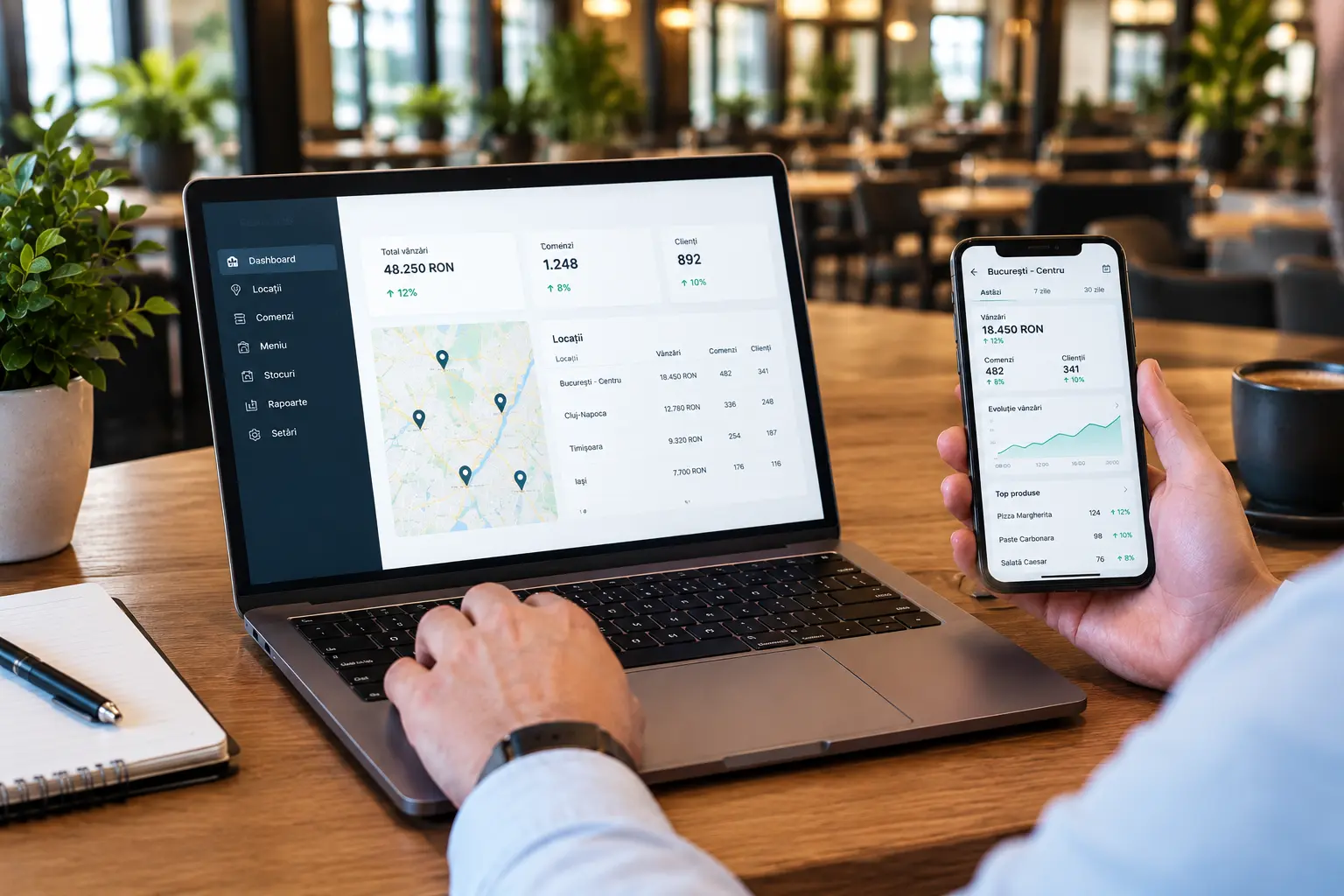
Managing multiple restaurant locations is not a larger version of managing a single one. It is a different discipline, one that requires data in place of presence, systems in place of intuition, and a digital infrastructure that gives you complete information wherever you are. This article explains what breaks in the absence of that infrastructure, and what a digital ecosystem that scales alongside your restaurant actually looks like.
From Management Through Presence to Management Through Data
At a single location, an attentive manager can compensate for the absence of systems through direct observation. They can see that a server is slower than usual, notice the kitchen falling behind on orders after 8 PM, and sense that an evening’s service was below par. These signals reach them without any digital tool.
When you manage multiple locations, the same signals exist at each of them, but you no longer have access to them through simple presence. Problems accumulate at each location at its own pace, each with its own team and its own customers, and no periodic visit from the general manager can catch everything. According to Restaurant365, one of the main challenges for multi-location operators is precisely this mixture of disparate systems running in parallel, which makes it impossible to get a coherent overall picture without hours of manual reconciliation work.
The only sustainable way to manage multiple locations is to replace presence with data. Not to give up visits or hands-on involvement, but to stop depending exclusively on them to know what is happening.
Consistency as the Central Challenge
When you open a second location, you quickly come up against a problem that did not exist at the first: how do you ensure the customer experience is identical, whichever door they walk through? The same menu, the same recipes, the same delivery times, the same way of handling complaints. Consistency is not an aesthetic aspiration; it is a basic condition for a brand to make sense at scale.
The consistency problem is not about the goodwill of the teams. It is about systems. According to Operandio, most operational procedures are designed for a single location and fail when applied across multiple ones. The result is that each location ends up operating slightly differently from the others, as teams adapt processes to their local reality in the absence of a unified digital framework that standardises and monitors.
A menu updated manually at each location at different times means that a customer who visits both may find different prices or options. Stock managed separately per location means a recipe may be executed differently depending on what ingredients are available. A loyalty programme that does not communicate across locations means that points a customer earned at location 1 simply do not exist at location 2. Each of these situations is a signal that the brand is not functioning as a whole.
Added to this is the challenge of training new team members. At a single location, a new employee learns from longer-serving colleagues and from the manager, in an environment where standards are passed on through direct example. At multiple locations, the same training process must work equally well regardless of location and regardless of whether the general manager is present or not. Without digitalised procedures, without a system that guides the employee step by step through the workflows, each new location risks reinventing its own standards, which will gradually drift from what was built at the original venue.
What You Cannot Know When Data Is Isolated
Beyond consistency, managing multiple restaurant locations raises another fundamental problem: the ability to compare. The most valuable thing you have as a multi-location operator is precisely the ability to compare. Which location has the highest average check? Where are preparation times longer than average? Which location is losing returning customers faster than the others? These questions have no answer if each location’s data is locked inside its own system.
Modern Restaurant Management notes that 2026 marks a major turning point in the industry: after years of fragmented solutions for POS, kitchen displays, and inventory management, operators are increasingly moving towards unified technology ecosystems, precisely because isolated data per location does not allow intelligent management at scale.
Without centralised data, multi-location managers end up doing the same thing repeatedly: exporting data from each system, combining it manually in a spreadsheet, trying to make comparisons, and losing so much time in the reconciliation process that there is none left to act on the information found. The restaurants that avoid this trap are those that invested from the start in a digital infrastructure shared by all locations.
More serious than the time lost, however, is that isolated data creates an illusion of normal functioning. A location with real problems, falling sales, rising preparation times, or an error rate above average, can go unnoticed for weeks if the general manager is not physically there and there is no system to raise an automatic alert. By the time the problem becomes visible, its cost is already significant, whether through lost customers, eroded margins, or a team that has grown accustomed to operating below standard without consequence.
Managing Customers Across Locations
One aspect of managing multiple restaurant locations that is frequently overlooked in the early stages is that of shared customers. If a loyal customer at the first location visits the second location and finds their loyalty points do not exist there, that the programme does not recognise them, or that the benefits are different, the experience is disappointing, not because the second location has done anything wrong, but because the infrastructure was never designed to function as a whole.
Loyalty programmes that scale are those that work independently of location. The customer accumulates points wherever they order, their consumption profile is visible across the entire system, and targeted marketing campaigns can be segmented and sent centrally, rather than being reinvented by each location individually. This is not a marketing problem. It is a digital infrastructure problem.
What a Digital Ecosystem That Scales Looks Like
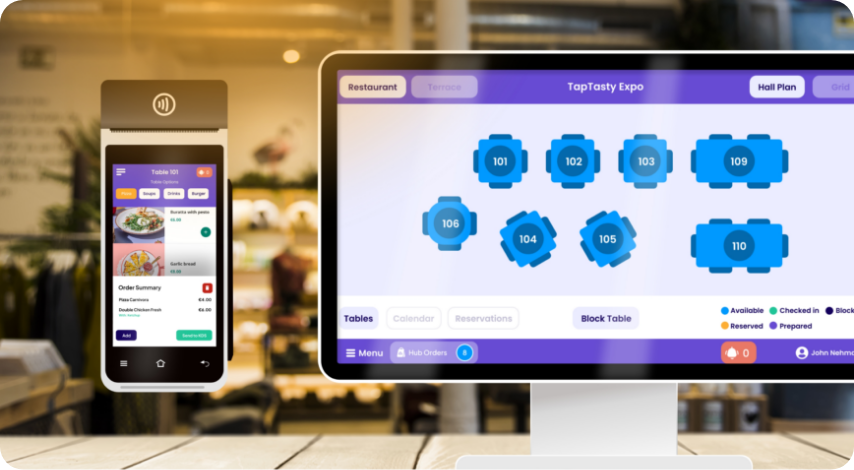
A digital ecosystem designed for multiple restaurant locations does not mean each location has its own set of applications. It means all locations operate within the same system, with the same data and the same operational logic, but with differentiated visibility by level: the operator at each location sees what is happening at their venue, and the general manager sees everything.
The TapTasty POS functions as the core of this ecosystem: in-venue orders, online orders, and those placed through the app or kiosk all flow into the same system for each location, and from a reporting perspective are visible both separately, per location, and aggregated across the entire group. Menu updates can be pushed centrally, and inventory management can be configured with identical or location-adapted recipes, as needed. Managing stock across multiple locations no longer means separate stock-taking on tablets or spreadsheets per location. It means a system that automatically synchronises the theoretical stock with each location’s sales and makes discrepancies visible from a single place. Stock transfers between locations are recorded in the system rather than managed over the phone.
Loyalty programmes work across the entire ecosystem, not per location. The customer who orders at the city centre location and also visits the neighbourhood one has the same profile, the same points, and accesses the same benefits everywhere.
And sitting above all of this data is TapTasty BI, the analytics platform that enables comparison of performance across locations using the same indicators, built from the same data source. The general manager no longer manually reconciles separate reports. They can see directly where a location is deviating from the average, at what time, across which product category, and with what likely causes.
Conclusion
Managing multiple restaurant locations is not solved by more coordination staff or more frequent visits. It is solved through centralised data, digitally standardised processes, and an infrastructure that makes visible, in real time, what is happening at each location without needing to be there. Consistency between locations is not a matter of team discipline; it is a consequence of the systems you have or do not have.
Operators who open a second or third location without investing in this infrastructure do not fail because they do not know how to run restaurants. They fail because they try to apply a management model designed for a single location to a reality that requires something entirely different.