
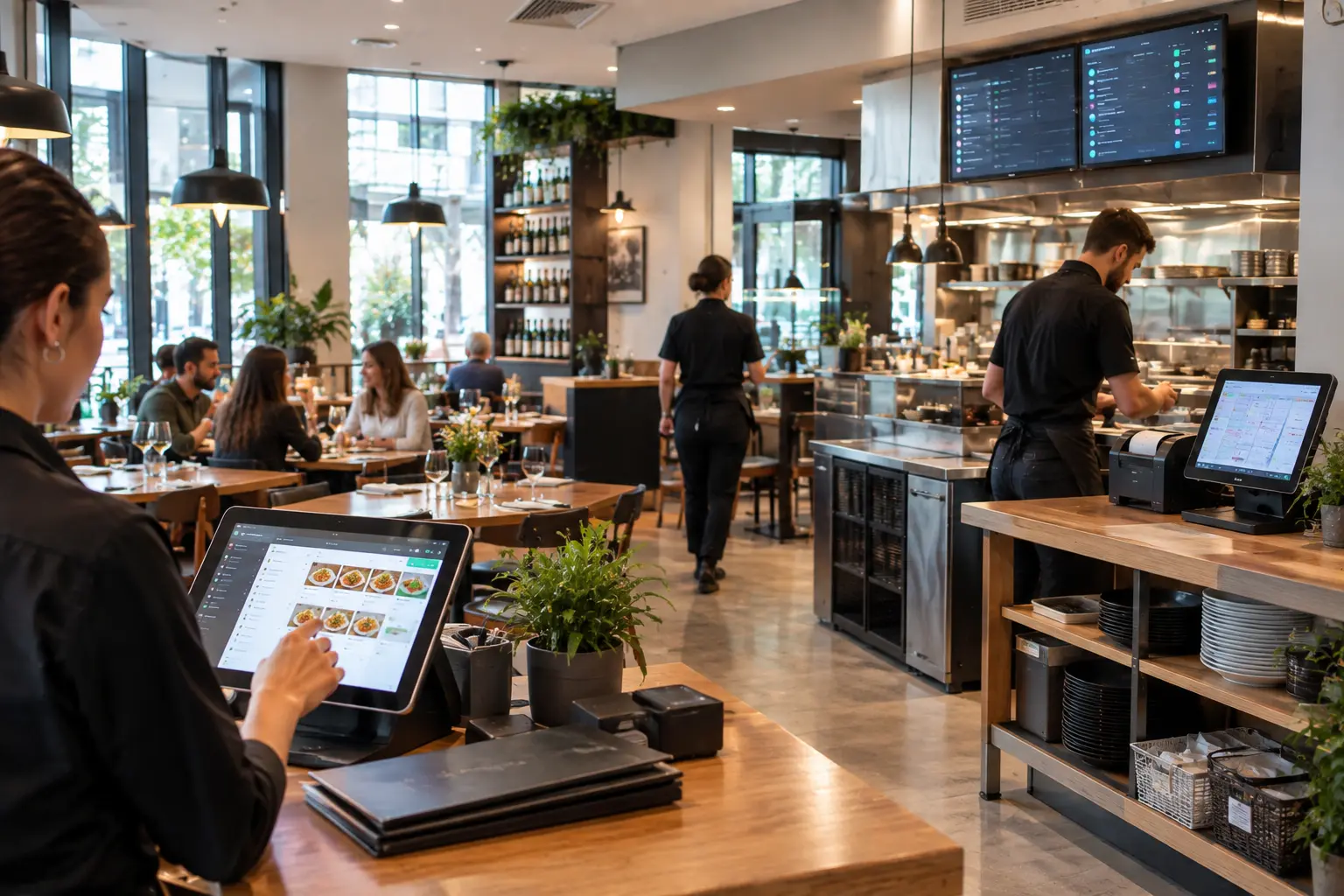
There is a paradoxical situation that many restaurant owners who have invested in digital solutions over recent years find themselves in. They have an order management system, a loyalty app, a reservations platform, and perhaps a general marketing tool. And yet, at the end of the month, they cannot say with certainty where the profit is coming from, who their most valuable customers are, or why one location performs differently from another. They have bought digital tools, but they have not built a digital ecosystem.
The difference between the two is not one of sophistication or budget. It is one of logic. A set of digital tools solves specific problems: one system takes orders, another manages stock, another sends campaigns. Each of them works, but works in isolation, with its own data, without knowing what the others are doing. A restaurant’s digital ecosystem works like an organism rather than a collection of separate organs: each module knows what the others are doing, data flows natively between them, and a complete picture is available at any moment without manual reconciliation.
This article explains why building an integrated digital ecosystem is not a technological luxury but the basic condition for a modern restaurant to make correct decisions, build genuine customer loyalty, and grow without multiplying the chaos.
What a Digital Ecosystem Is and What It Is Not
Before any argument, it is worth clarifying what a restaurant’s digital ecosystem actually means, because the term is used far too loosely to describe any combination of apps.
A digital ecosystem is not the sum of all the applications you use. It is a set of modules built on the same architecture, sharing the same database and communicating natively, without external integrations or manual exports. When a customer places an order through the app, stock updates automatically. When they reach a loyalty threshold, the marketing module can automatically trigger a message. When the manager wants to compare one week’s performance with the previous one, they do not need to pull data from three different systems; they see everything in the same place.
The opposite of an ecosystem is not the absence of technology. It is what the industry has come to call application chaos: a POS bought from one vendor, a reservations system from another, a loyalty platform from a third, a marketing tool from a fourth. Each of them solves a real problem, but together they do not form a coherent whole. They form a disorganised collection of solutions where data does not flow, decisions are made on incomplete information, and every new integration adds another potential point of failure.
Isolated Data Does Not Tell the Whole Truth
The most concrete argument for a restaurant’s digital ecosystem is the data argument. Every separate system collects data, but collects it in its own isolated compartment. The POS knows what was sold. The loyalty platform knows how many points a customer has accumulated. The online ordering system knows how many orders came through the app. None of them knows everything, and nobody can answer the genuinely important questions without manually combining data from all of them.
Who are the customers generating the most profit, not those who order most frequently, but those with the best ratio between frequency and order value? Which sales channel attracts returning customers, and which attracts one-time orderers who never come back? Which menu item is most often correlated with a customer’s return visit a week later? None of these questions can be answered if the data sits in separate systems.
According to a Qu 2026 report cited by Forbes, 37% of restaurant operators identify fragmented systems and isolated data as one of the main barriers to a consistent customer experience. And 64% of brands said they planned to move to unified systems that centralise data and improve reporting, not because it is fashionable, but because they discovered that decisions made with incomplete data cost more than any subscription to an integrated platform.
The Customer Seen Whole, Not Fragmented
Beyond operational data, fragmented systems create a problem that many restaurant owners only become aware of when a customer points it out: the customer is not recognised as the same person across all of their touchpoints with the restaurant.
A customer who has ordered twenty times through the app and visits the venue for the first time is, as far as the system there is concerned, a new customer. Their loyalty points are not visible at the counter if the loyalty system is separate from the POS. Their ordering preferences do not appear on the server’s screen because the two systems do not communicate. The effort they have made to become a loyal customer of your restaurant becomes invisible the moment they switch the channel they interact through.
A restaurant’s digital ecosystem puts the customer at the centre. Their profile is built from every interaction, regardless of channel: an order from the mobile app, an online reservation, a visit to the venue, an order from the self-ordering kiosk. Every interaction enriches the same profile and makes a consistent experience possible: the customer is recognised, their benefits apply everywhere, and the communication they receive reflects who they are, not which platform they happened to order through last time.
Why Your Own Data Changes the Dynamic with Third-Party Platforms
There is a direct, though often unspoken, connection between a restaurant’s digital ecosystem and its ability to reduce dependence on third-party delivery platforms. Many owners try to reduce this dependence by launching their own app or ordering website, without understanding that the app alone is not the solution. The ecosystem behind it is.
If the restaurant’s own app is not connected to a loyalty programme that motivates customers to return, it does not build the habit of ordering directly. If the app does not feed a customer database from which the restaurant can run reactivation campaigns, the investment in it generates orders but not relationships. If the data from the app is not visible in the same report as the data from the venue and from other channels, the restaurant does not know whether its direct ordering strategy is working or not.
The restaurant’s digital ecosystem is precisely what makes independence from third-party platforms possible, not in an absolute sense, but in a practical one: you have somewhere to direct customers, something to motivate them to stay, and data that shows you whether it is working.
Scalability That Does Not Multiply the Chaos
A less frequently discussed argument for building a restaurant’s digital ecosystem is scalability. When you open a second location with a set of separate solutions, you are not dealing with the same systems at a larger scale. You are dealing with the same chaos, multiplied. Each new location means a new set of subscriptions, new integrations to configure, new data that does not communicate with that from the first location, and, most likely, a different combination of systems because the local team chose something different or the previous vendor did not cover the second location’s needs.
In an integrated ecosystem, the second location joins the same system. Menu updates can be pushed centrally, reports are comparable across locations, the customer who orders at both locations has the same profile, and the general manager sees data from both locations without logging into two separate systems. According to Back Office, the restaurant industry has shifted in exactly this direction over the past five years: from platforms operating with isolated data, each in its own system, to integrated ecosystems that enable intelligent management at any scale.
The Cost of Fragmentation, Briefly
We have covered the financial cost of fragmented systems in detail in our article on where modern restaurants lose money. In summary: multiple subscriptions, integration fees, hours of manual data reconciliation, and wrong decisions made from lack of visibility carry a cumulative cost that frequently exceeds the cost of an integrated ecosystem.
NibbleIQ documents that restaurants using truly integrated solutions report margin improvements of 25 to 35% compared to combinations of separate systems, precisely because they eliminate the losses caused by imperfect synchronisation between systems and significantly reduce the administrative work needed to get a coherent picture of the business.
What a Restaurant’s Digital Ecosystem Looks Like in Practice
A real digital ecosystem for restaurants does not mean you have bought the most expensive product on the market or have the greatest number of active features. It means every module in your system knows what the others are doing, and data flows without manual intervention.
The TapTasty POS is the core of the TapTasty restaurant ecosystem: orders from the venue, the app, the website, the kiosk, or external delivery systems all arrive in the same place, with no separate tablets and no manual entry. Stock updates automatically with every order. Customer data grows richer with every interaction. Reports are generated from the same source.
Above the operational data sits TapTasty BI, the analytics platform that transforms daily transactions into concrete answers: what sold and at what margin, how the team performed, where exceptions appeared in the audit, and how locations compare with each other. The manager no longer reconciles reports. They read them.
TapTasty’s modular model means you can start with what you need now and add modules as the restaurant grows, without changing the underlying architecture and without losing the data you have accumulated. If you would like to understand which modules suit your situation, you can explore the offering and request a personalised quote.
Conclusion
A restaurant’s digital ecosystem is not a concept for large restaurants or for chains with million-dollar budgets. It is the answer to a problem shared equally by the single-location restaurant and the one with three: how do you know what is really happening in your business, and how do you make decisions based on real data rather than instinct and estimates?
The difference between buying digital tools and building an ecosystem is the difference between having information and being able to use it. The first step is to choose systems that communicate with each other from the outset, rather than buying partial solutions with the promise that you will integrate them later. Most of the time, later costs more than the integrated option would have from the beginning.