
Promoting a restaurant in 2026 looks fundamentally different from what worked five or ten years ago. Printed flyers and local press adverts have a return rate close to zero. Generic Facebook advertising without precise targeting reaches people who will never order from you. And, perhaps most importantly, a restaurant with great food but no digital presence is, for a significant proportion of potential customers, a restaurant that does not exist.
The good news is that promoting a restaurant does not require a huge marketing budget. It requires consistency, a few well-chosen channels, and an understanding that the most effective marketing tools do not just bring in new customers, but keep existing ones coming back. And returning customers are, in the long run, the most profitable segment of any hospitality business.
This guide covers the main channels and strategies for promoting a restaurant, what actually works on each channel, what no longer works, and how to connect them into a coherent strategy.
Online Presence as the Foundation
Before any campaign, any post, or any collaboration, a restaurant needs a solid online presence. This means that when a potential customer searches for “restaurant near me” or “restaurant with delivery in [city]”, your restaurant shows up, looks good, and provides the information the customer needs to make a decision.
A solid online presence includes: a complete and up-to-date Google Business Profile, a website with a current menu and the ability to book a table or order online, active profiles on the relevant social media platforms, and, ideally, a direct ordering channel that helps you build your own customer database. For more detail on optimising your local presence, including managing Google reviews and local SEO strategies, take a look at our dedicated article on local marketing for restaurants.
What matters at this stage: consistency of information (the same opening hours, the same address, the same phone number across all platforms), up-to-date quality photographs, and a menu that is easy to find and read online. A customer who cannot quickly find what they are looking for will most likely go to a competitor.
Social Media
Barmetrix reports that 74% of people use social media to decide where to eat. This is not a statistic about influencers or paid campaigns. It is about what someone sees when they search for or come across your profile organically, before any investment.
Social media is, at the same time, the most accessible promotional tool a restaurant has and the easiest to use ineffectively. Occasional posts announcing menu items or discounts do not build anything. Consistency and relevance of content are what separate an active profile from one that ends up followed by a handful of people and ignored by the rest.
Instagram remains the main platform for restaurants, especially for visual content. Well-executed product photographs, short videos of dishes being prepared, behind-the-scenes glimpses from the kitchen, and stories about the team or ingredients all create an authentic presence. Reels have significantly higher organic reach than static posts and should be a consistent element of the content strategy, not an exception.
TikTok has overtaken Instagram as a discovery platform for many users, particularly for restaurants with a strong visual story: spectacular dishes, interesting preparation processes, genuine customer reactions. An active TikTok account does not require complex production. It requires authenticity and regularity.
Facebook is less effective organically in 2026, but remains the most widely used platform for paid local advertising, reviews, and managing a community of older customers. Local Facebook groups are also an underestimated organic promotional channel.
How many posts per week? Resos recommends 3 to 5 posts per week plus daily Stories for a consistent presence. The exact number matters less than consistency: three posts every week is better than ten in one week and nothing for the next two.
Online Reviews
Reviews are the highest-return promotional tool a restaurant has, because they cost nothing and are perceived by potential customers as the only objective source of information. A restaurant with 4.5 stars and 300 reviews is viewed far more positively than one with 4.8 stars and 15 reviews, because review volume builds credibility.
A review strategy has three components: actively request reviews from satisfied customers, respond to all reviews (positive and negative), and handle negative reviews calmly and professionally. A thoughtful response to a negative review can turn a dissatisfied customer into one who returns, and can demonstrate to potential customers that your restaurant takes feedback seriously.
The most effective moment to request a review is immediately after a positive experience: at the end of the meal when the customer is satisfied, or through an automatic message sent after a delivery order. A QR code placed on the table or on the receipt that leads directly to the Google reviews page reduces friction and increases the completion rate.
Targeted Marketing Through Your Own Customer Database
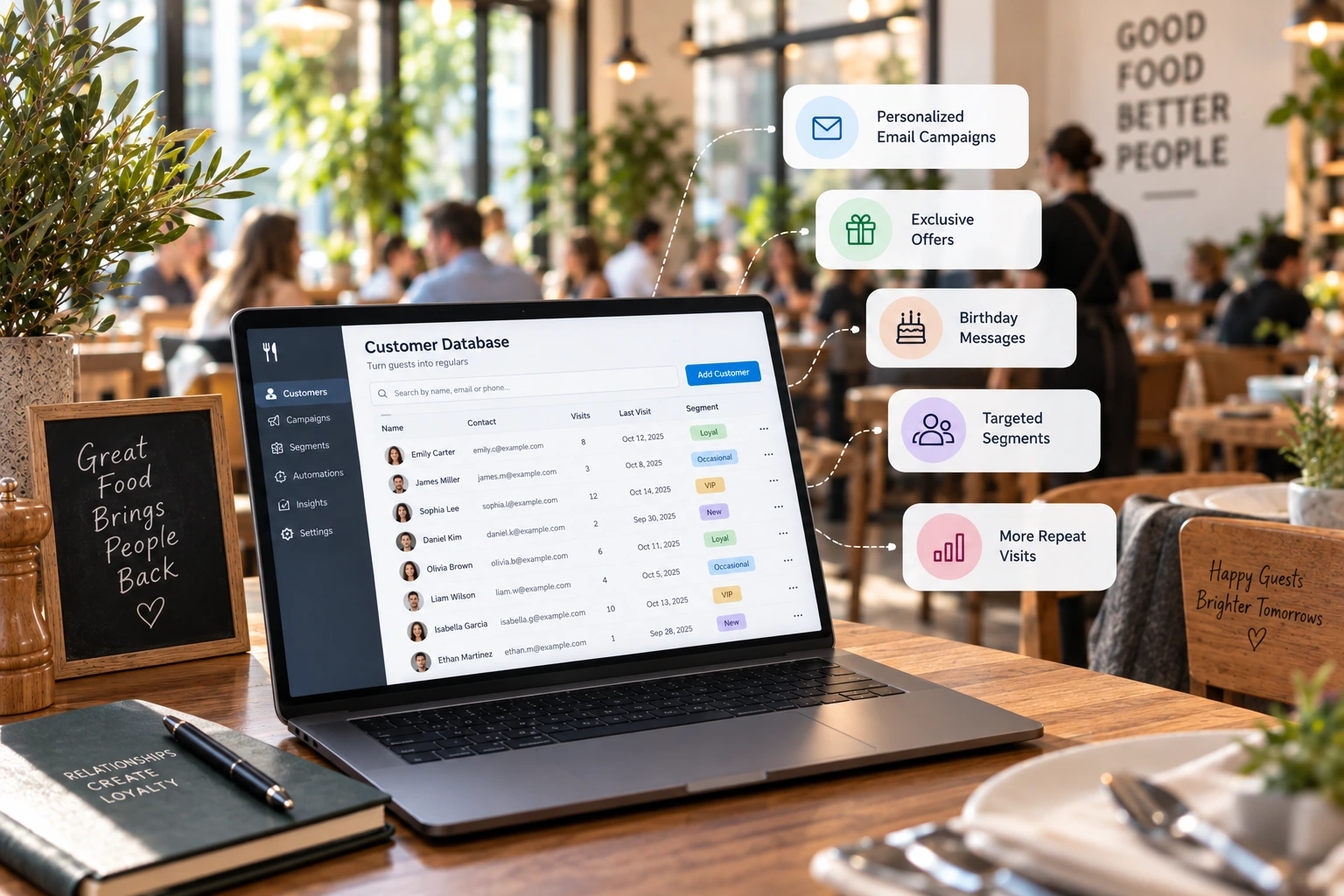
One of the most effective tools for promoting a restaurant is also the least discussed: your own customer database and communicating directly with it. A customer who has already ordered and receives a relevant message from you is far more likely to order again than a new customer you have to win over from scratch.
Direct communication with your own customer database includes push notifications through the restaurant's app, personalised emails, and reactivation campaigns for inactive customers. Not mass communication, identical for everyone, but messages adapted to each customer's behaviour: birthday offers, reactivation for those who have not ordered for a set number of days, exclusive promotions for the most loyal customers. The TapTasty targeted marketing module allows these campaigns to be configured with customisable sending days and times, with no need for manual intervention at each send. The campaigns and promotions module adds tools for coupons, time-limited offers and interactive campaigns. Contests and the prize wheel can be activated from the app or website to generate buzz and attract new customers through interactive mechanics.
Customer-Generated Content
The photographs and videos that customers post themselves about your restaurant are, from a promotional perspective, more valuable than any content you produce yourself. Not because they are more beautiful or better executed, but because they are perceived as authentic. A potential customer who sees a friend posting a photo of your food is more influenced than if they saw the same dish in your advertisement.
The strategy for customer-generated content has a few simple components. First: create the conditions that make people want to take photographs. A dish with a well-presented appearance, an interior detail that is memorable, a delivery package with an unexpected touch. Second: make sharing easy. A hashtag specific to your restaurant, displayed visibly in the venue or on packaging, collects content and makes it easier to find. Third: actively reshare. When a customer posts something positive about your restaurant, repost that content on your own profiles with a mention of the author. Recognition motivates other customers to do the same.
Customer-generated content does not replace your own content, but it complements it with a voice you cannot imitate.
Events as a Promotional Tool
Events are one of the most effective methods of promoting a restaurant that many owners overlook, precisely because they seem more complex than an Instagram post. In reality, they do not need to be. A themed evening, a seasonal menu launch, a quiz night, or a tasting with the producer of a local ingredient are all events that generate a reason to visit, organic content, and local PR.
The value of an event as a promotional tool comes from several directions simultaneously. It generates content for social media before, during, and after the event. It creates a local story that bloggers and the local press can cover for free. It attracts new customers who might not have come otherwise but are motivated by the special occasion. And it strengthens the relationship with existing customers, who feel part of a community.
Regular events, even small ones, build a promotional rhythm that keeps the restaurant visible and relevant without depending exclusively on an advertising budget.
Paid Advertising
Paid advertising is not for everyone and is not the first step. It is effective when there is already a solid organic presence and the objective is amplification, not building from scratch.
Meta Ads (Facebook and Instagram) are the most accessible for independent restaurants because they allow precise geographic targeting. A monthly budget of $100 to $200, allocated to campaigns targeting a few kilometres around the venue, can generate a significant number of clicks from people who are physically nearby and could become customers. Integrating Meta Pixel into the restaurant's website and app allows exact conversion tracking: how many people who saw an ad ended up placing an order or making a reservation.
Google Ads is more effective for capturing existing demand: people actively searching for “restaurant in [your area]” or “[type of cuisine] delivery.” The cost per click is higher than Meta, but the purchase intent of someone making a search is also higher. It is especially recommended for restaurants that deliver and want to appear in front of customers who are searching for delivery at the moment they search.
The basic rule for paid advertising: start with a small budget, test several ad variants, and quickly pause what is not working. There is no universal formula. There is testing and continuous optimisation.
Collaborations with Local Micro-Influencers
Influencer collaborations are underestimated by some restaurant owners and overestimated by others. The truth is somewhere in between and depends on the type of influencer chosen.
Mega-influencers with hundreds of thousands of followers rarely justify the cost for an independent restaurant, because their audience is geographically spread and the local impact is diluted. TrueFutureMedia shows that partnering with local micro-influencers, with 2,000 to 25,000 followers concentrated in your geographic area, is the most cost-effective paid amplification strategy for independent restaurants. These creators are seen by their audiences as trusted sources, similar to a recommendation from a friend.
How to choose the right micro-influencer: check whether their followers are from your area (not an international audience), whether their restaurant posts have genuine engagement (comments, not just likes), and whether their editorial style matches the identity of your restaurant.
What to avoid: collaborations with influencers who charge for guaranteed positive content, sponsored posts that are not labelled as such, and any collaboration with someone whose audience is not local.
Loyalty Programmes as a Promotional Tool
Promoting a restaurant does not only mean attracting new customers. It also means creating the conditions for existing ones to come back and order again. Loyalty programmes serve both objectives simultaneously.
A customer who accumulates points or stamps has a concrete reason to come back and order through the restaurant's own channels. A customer with an active referral programme becomes, organically, a promotional channel: they send their personalised link to friends, both receive a reward when the friend places their first order. Personal recommendation remains the most credible type of advertising for a restaurant.
The TapTasty loyalty module includes points per amount spent, digital stamp cards, gift cards, and referral programmes with recurring rewards, all available in the mobile app and on the website.
Promoting a restaurant through loyalty has an important advantage over advertising: the cost is proportional to the desired behaviour. You do not pay for reach or clicks, but for repeat orders and confirmed referrals.
How to Measure Whether Your Promotion Is Working
Promoting a restaurant without measurement is a cost, not an investment. You do not need a dedicated analytics team to track whether your marketing efforts are delivering results, but you do need to know which indicators matter.
For social media: track organic reach (how many people saw the posts), engagement rate (comments, shares, saves relative to reach), and, most importantly, how many visits or orders came from these channels. The last indicator is the hardest to track without tools, but also the most relevant.
For paid advertising: cost per click, the conversion rate of those who reached the website or app, and, if you have integrated Meta Pixel and Google Analytics 4, the number of orders or reservations generated by each campaign. Integrating Google Analytics 4 and Meta Pixel into TapTasty's own channels makes this connection visible: how many people saw an ad and ended up ordering.
For loyalty and targeted marketing: the open rate of push notifications and emails, the conversion rate of reactivation campaigns, and the growth in the share of direct orders compared to those through aggregators.
A simple rule: set aside time once a month to compare these figures with the previous month. If a channel shows no positive trend after two or three months, either change the approach or move resources to what is working.
What No Longer Works
A complete guide to promoting a restaurant also includes what is worth abandoning, so you do not waste resources on low-return channels.
Generic printed flyers and local press advertising have an almost zero return for urban restaurants. The exception is delivery bag inserts with a specific QR code (for example, a discount on the first direct order), which have a precise purpose and a reasonable cost.
Generic discounts as a promotional strategy attract discount customers, not restaurant customers. A customer who visits once because they received a 20% coupon does not become a loyal customer. If your promotional strategy is primarily based on discounts, you are building promotion dependence, not a customer base.
Advertising in traditional local press reaches an audience that is shrinking rapidly and cannot be segmented. The same budget invested in Meta Ads with geographic targeting reaches more relevant people.
Being present on all social media platforms simultaneously without the resources to manage them actively does more harm than good. An inactive or sporadically updated profile sends a negative signal. Two or three platforms managed well is better than six managed poorly.
Conclusion
Promoting a restaurant is not about being everywhere, but about being consistent in the right places. A solid local presence, social media with relevant and regular content, actively managed reviews, direct communication with your own customer base, and, when the budget allows, local paid advertising and collaborations with micro-influencers: these are the components of a promotional strategy that works for independent restaurants.
The most important principle: promotion does not replace the product. A restaurant with good food and consistent service is far easier to promote than one trying to compensate for quality problems through marketing. The promotional strategy amplifies what is already good, rather than creating a positive perception from nothing.
If you are interested in digitalising your restaurant's marketing, take a look at TapTasty's marketing modules and request a personalised quote.