
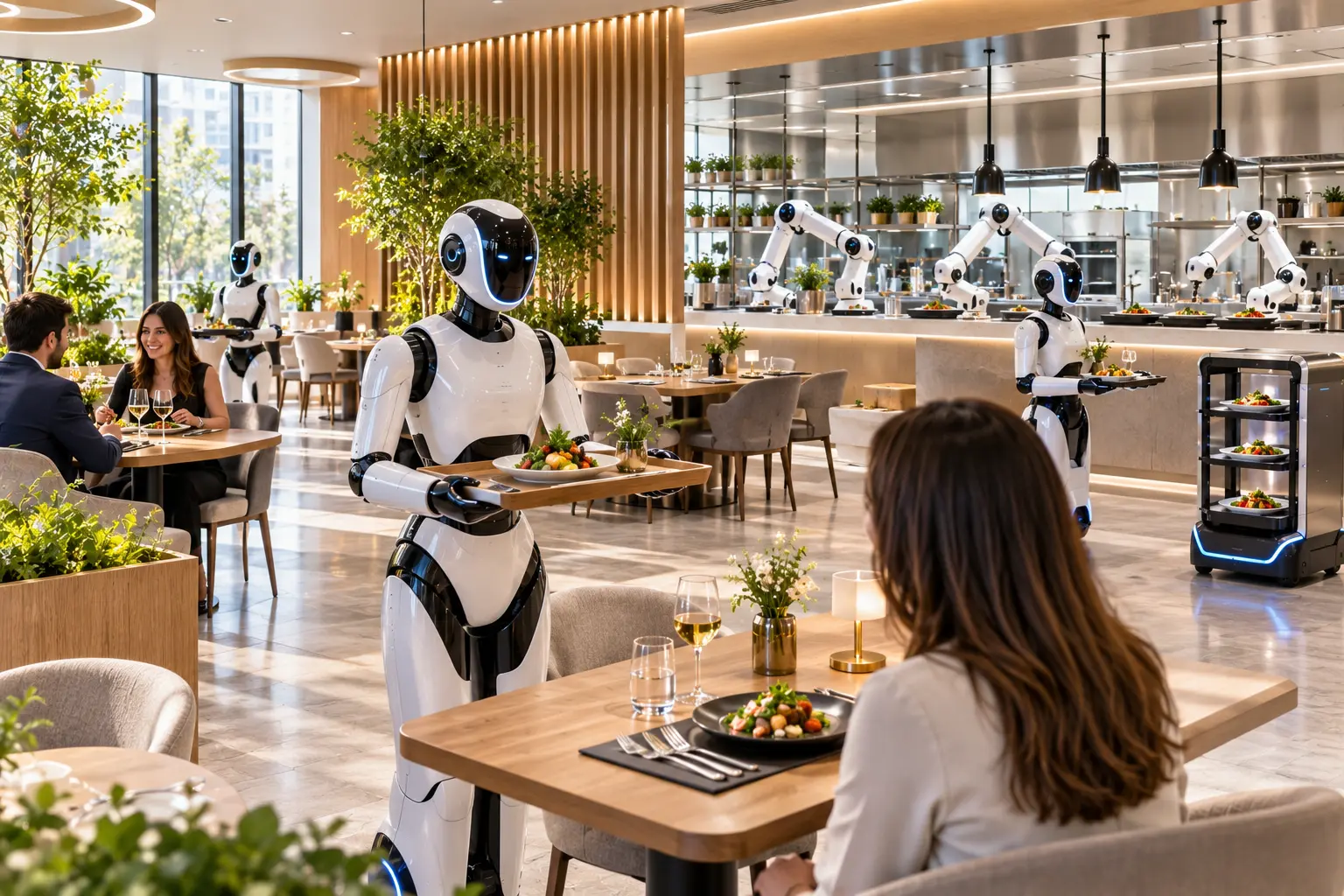
The image that circulates most often in discussions about the future of restaurants is that of a space where robots cook, screens take orders, and no person touches the food from ingredient to customer. It is a spectacular image, well suited to headlines and startup pitch decks. It is also, in large part, misleading when it comes to where the hospitality industry actually stands in 2026.
The autonomous restaurant is not a single concept. It is a spectrum. At one end sits the fully manual restaurant, where every interaction involves a person. At the other end sit fully robotised units with no human staff, which exist, but in small numbers and with mixed results. Between these extremes lies reality: restaurants that are gradually automating certain tasks, reducing dependence on human intervention in repetitive processes and freeing people up for what genuinely matters.
This article discusses what has actually been built so far, why some fully autonomous projects have failed, where the accessible reality lies for an independent restaurant in 2026, and what happens to the traditional restaurant in all of this.
What Has Already Been Built
Restaurants with varying degrees of automation are no longer laboratory demonstrations. They are operational businesses, some with years of activity behind them.
White Castle and Flippy is perhaps the longest-running automation project in the fast food industry. Miso Robotics developed a robot for the fry station, called Flippy 2, capable of lowering baskets into the fryer, monitoring frying times, and managing orders without human intervention at that station. White Castle expanded the partnership to more than 100 locations, with 14 Flippy 2 units confirmed as active at the end of 2025. Buffalo Wild Wings is testing an adapted version designed for high volumes of chicken wings. Jack in the Box is trying both Flippy 2 and Sippy, an automated drinks dispenser.
Sweetgreen and the Infinite Kitchen went further. Sweetgreen acquired Spyce, a startup with a robotic kitchen, and renamed the technology the Infinite Kitchen. The system automatically assembles salad and grain bowls. At the end of 2025, Sweetgreen sold this technology to Wonder for $186.4 million, according to Finitless. Wonder plans to install the robotic line in its Manhattan locations in 2026. This transaction demonstrates something significant: kitchen automation technology has acquired value as a standalone asset, not just as an operational tool.
Service robots are appearing in mainstream chains. Plaza Azteca introduced BellaBot, a robot that carries dishes from the kitchen to the customer's table. Staff load the robot with food, enter the table number, and the robot navigates the route. It does not replace the server but reduces physical trips. Chili's tested service robots from Bear Robotics, although the trial was paused after its initial roll-out.
McDonald's is piloting AI-powered voice ordering at drive-throughs and partially automating the fry station at selected locations in the US. Results are positive in controlled conditions, but global-scale implementation remains under evaluation.
Why Fully Staffless Restaurants Have Failed
Failures are just as instructive as successes, and in 2025 and 2026 the industry received some important lessons.
CaliExpress by Flippy, in Pasadena, California, was presented as the world's first fully autonomous restaurant, with robotic grill and fry stations and zero human interaction in the kitchen. The restaurant is currently temporarily closed. The problems were not with the technology itself but with the economics of operations and the customer experience. The robotically produced food did not justify the price point, and the experience of a “restaurant without people” generated less enthusiasm among consumers and more indifference than expected.
Mezli, a fully autonomous Mediterranean bowl restaurant in San Francisco, followed a similar trajectory: an innovative concept, significant investment, and operations temporarily closed. Bowls started at $6.99, the opening investment was roughly half that of a Chipotle restaurant, but the venue failed to attract the traffic it needed.
The conclusion drawn from these failures is clear: the fully staffless restaurant is not a mature model in 2026. The cost of complete robotisation remains high, flexibility in handling exceptions (a modified order, a customer with an allergy, an unexpected situation) is limited, and the customer experience in a space without people is colder than many anticipated. As SVRC notes in its 2026 assessment, the winners in the automation space are not the restaurants that tried to eliminate staff entirely, but those that automated specific, repetitive tasks and freed people up for what cannot be automated.
The Automation Spectrum: It’s Not All or Nothing
An autonomous restaurant in the most useful sense of the term is not one without people. It is one where people are no longer occupied with tasks that a system can do better.
There are several levels of automation that restaurants can reach, each with different costs and complexity.
Level 1: Digital operations automation. This is the most accessible level with the fastest impact. It includes taking orders through a self-ordering kiosk or QR menu (the customer orders independently), automatically sending orders to the kitchen via the KDS (no paper tickets), synchronising stock management automatically with sales, and managing orders from all channels on a single screen. No physical robots, no investment running into hundreds of thousands of euros. The result is that existing staff handle fewer repetitive tasks and can manage a greater volume.
Level 2: Automation of specific kitchen tasks. Automated fryers, assembly robots, ingredient dosing systems. These exist on the market, but require significant investment and are economically viable mainly at the high volumes typical of fast food.
Level 3: Service robotisation. Robots that transport food from kitchen to table, automated drink dispensers, integrated payment systems at the table. These work well in clearly defined conditions, but require adapted spaces and produce a specific type of experience.
Level 4: Full autonomy. Fully automated kitchen and service, with no human staff. This exists, but results from 2025 and 2026 show that the model is not mature for restaurants with a varied menu and genuine hospitality expectations.
The Tools That Build the Foundation of a More Autonomous Restaurant
If Level 4 is premature and Levels 2 and 3 require major investment, Level 1 is accessible now and builds the foundation for everything that follows.
A restaurant that wants to reduce its dependence on human intervention in repetitive tasks can start with a few concrete tools.
The self-ordering kiosk takes orders from customers without a server. A touch screen installed in the venue, and the customer orders, pays, and the order goes automatically into the system. McDonald's, Burger King, and virtually every major chain in the world has implemented it precisely because it reduces queues, increases average order value, and frees staff from the task of taking orders.
The QR table ordering menu extends the same principle: the customer scans a QR code, orders from their phone, and the order goes to the kitchen with no staff intervention. The server no longer makes trips to take orders but focuses on the customer experience.
The KDS organises the kitchen without verbal communication. The kitchen display screen automatically prioritises orders, distributes them across stations, and notifies staff when they are ready. It is not a robot, but it eliminates one of the most frequent sources of errors and delays.
The TapTasty inventory management software automatically updates the theoretical stock with every sale, generating restocking alerts without the need for continuous manual stock-taking.
The delivery software coordinates drivers without an intermediary employee. It sends orders directly to the driver's app the moment the kitchen marks them as ready, with the route optimised if they have multiple orders.
Together, these tools form a set of specialised technologies, each handling a different layer of the restaurant's operations, without eliminating people but reducing how much they intervene in tasks that can be automated.
The European and Romanian Context
The conversation about autonomous restaurants takes place primarily in the American context, with high minimum wages, a severe staff shortage, and capital markets funding expensive experiments. The European and Romanian context differs across several dimensions.
Labour costs are lower in Romania than in the US, which reduces the economic pressure to robotise the kitchen in the American sense. A fry robot that pays for itself in two years in California might take ten years to do so in Bucharest, making the decision much harder to justify.
But digitalising operations, meaning Level 1 of automation, is just as relevant and accessible regardless of market. Order errors cost the same. The chaos of multiple tablets costs the same. The hours spent manually on stock-taking cost the same. And their effect on the margin is proportional to revenue, not to the minimum wage.
What this means is that the “more autonomous” restaurant in the Romanian context will not look like CaliExpress or Sweetgreen Infinite Kitchen in 2026. It will look like a restaurant that no longer loses time on repetitive manual tasks, because it has the systems to take them over automatically.
Will Traditional Restaurants Still Exist?
Yes, and there is no real risk of them disappearing within the next generation.
Hospitality has a component that cannot be robotised: the human relationship. The moment when a server notices that you are uneasy before you ask for the bill, or when a chef comes out of the kitchen to explain a special dish, or when a restaurant knows your preferences without having been told, these things cannot be replicated by an algorithm in 2026 or in 2036.
What is changing is not whether people exist in restaurants, but what those people do. The autonomous restaurant in its more realistic sense does not eliminate the server; it frees them from logistical tasks so they can be more of a host. It does not eliminate the chef; it takes over the repetitive tasks so they can focus on the dishes that require experience and judgement.
Fully traditional restaurants, with handwritten menus and no screens, will survive as a niche, just as independent bookshops survive in the era of online retail. Not by denying technology, but by positioning the experience itself as the product.
The great majority of restaurants will sit somewhere in the middle: with digital systems that automate what can be automated, and people doing what cannot. This is not a vision of the future. It is the direction already visible in 2026, for anyone who looks at the industry without romanticism and without alarmism.
Conclusion
The fully autonomous restaurant, with no people in the equation, is premature, and the evidence from 2025 and 2026 shows that the model has economic problems and customer experience problems that current technology has not resolved. The semi-autonomous restaurant, which uses digital tools to take over repetitive tasks and free staff for what matters, is an accessible reality right now.
The road to a more autonomous restaurant does not begin with a robot. It begins with a kiosk that takes orders, a KDS that organises the kitchen, a system that manages stock without manual stock-taking, and software that coordinates deliveries without an intermediary employee. These are not technologies of the future. They are available, deployable, and delivering demonstrable impact in tens of thousands of restaurants around the world.