
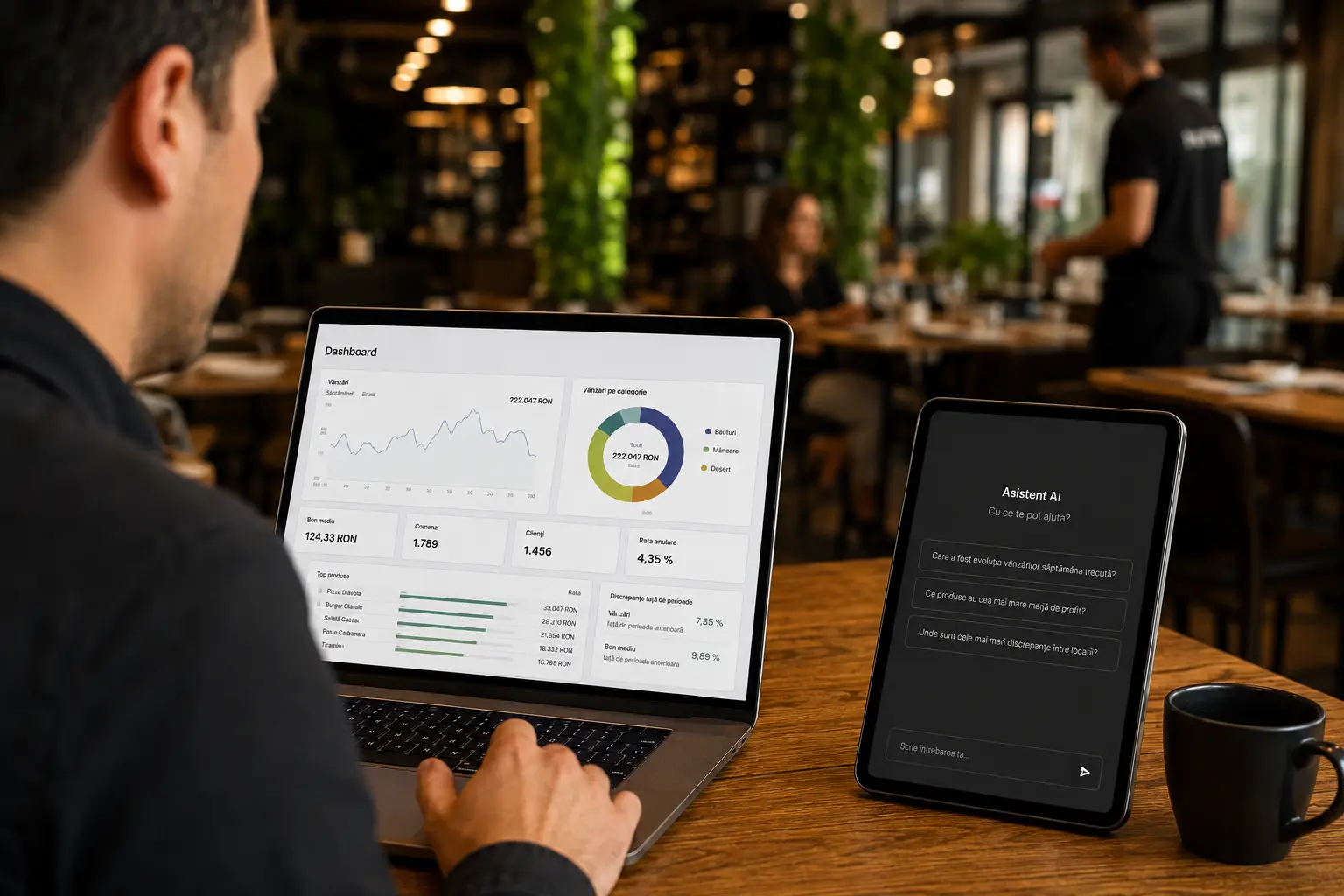
When artificial intelligence in restaurants comes up in conversation, the image that usually appears is either a robot cooking in the kitchen, or a sophisticated system accessible only to international chains with million-dollar budgets. Both images are wrong. Artificial intelligence for restaurants, in its most concrete and most useful form, does not mean automating the kitchen. It means systems that process the data a restaurant already generates every day and transform it into answers, signals, and better decisions.
An average restaurant generates thousands of transactions a month: orders, payments, cancellations, table transfers, product modifications, returned items. Without a system to process this data, it remains in long logs that nobody reads. With an artificial intelligence system, that same data becomes answers to questions the manager never thought to ask: why did sales fall on Wednesdays? Is there an unusual pattern in the cancelled orders from a particular shift?
This article presents the main ways in which artificial intelligence can concretely help restaurants, from data analysis to operational auditing, personalisation, and marketing, and explains what inevitably remains human.
What AI Means in the Context of a Restaurant
Before presenting some concrete examples, it is worth clarifying what artificial intelligence means in the context of a restaurant, because the term is used so broadly that it risks becoming meaningless.
At its simplest, an artificial intelligence-based system for restaurants is a system that learns from data and uses those patterns to support better decisions. It does not replace human judgement; it informs it. An AI system can identify that Friday evening sales have been falling consistently over the past three weeks, and can correlate that drop with a change in a particular server's work schedule or a menu modification. It may not know why something happened, but it can signal that something has changed and that it is worth investigating.
According to a Toast 2025 survey, 81% of restaurant operators believe artificial intelligence will make them more efficient, and 78% consider AI tools to offer real value for money. This is no longer speculative enthusiasm for a future technology, but the lived experience of those already using it.
AI for Data Analysis and Decision-Making
The most practical and most immediate way in which artificial intelligence can help a restaurant is in the analysis of operational data. A restaurant using a modern POS generates data every day about sales, payments, products, servers, and stations. The problem is that this data sits in raw reports that the manager does not have time to analyse systematically.
A business intelligence system with AI components transforms this situation. From the POS's raw data, it extracts the relevant indicators: sales by hour and day, performance per server, the dishes with the highest and lowest contribution to profit, peak kitchen hours, and deviations from previous periods. All available in real time, with no dedicated analyst required.
TapTasty BI is TapTasty's business intelligence platform, built specifically for hospitality operators. It covers seven operational areas simultaneously: sales and revenue, POS control and audit, kitchen and KDS performance, team and individual performance, products and menu, bill management and fiscal data, and multi-location analysis. All reports are built from the same data source, which means that management and operations see the same indicators, with no discrepancies between what one report says and what another says.
The AI Assistant: Ask Questions, Get Answers Grounded in Data
A step beyond classic reports is the AI assistant integrated into TapTasty BI. The difference from a traditional dashboard is that you do not need to know where to look for the information. You can ask a question in natural language directly in the system: “What influenced sales last week?” or “Which products in the pizza category have declined compared to last month?” or “Where are the biggest discrepancies between my locations?”
The AI assistant does not invent answers. It responds on the basis of real data from the platform and opens the relevant report that supports the answer. It does not replace the manager's judgement, but it drastically reduces the time they would otherwise spend navigating reports to reach the same conclusion. The difference between “what happened?” and “where, when, and who can act?” is precisely what a well-integrated AI assistant delivers.
This is the area where artificial intelligence for restaurants provides real value: not in making decisions in place of the manager, but in reducing informational noise and bringing to the surface the signals that matter.
Operational Audit and Control: Exceptions Become Visible Signals
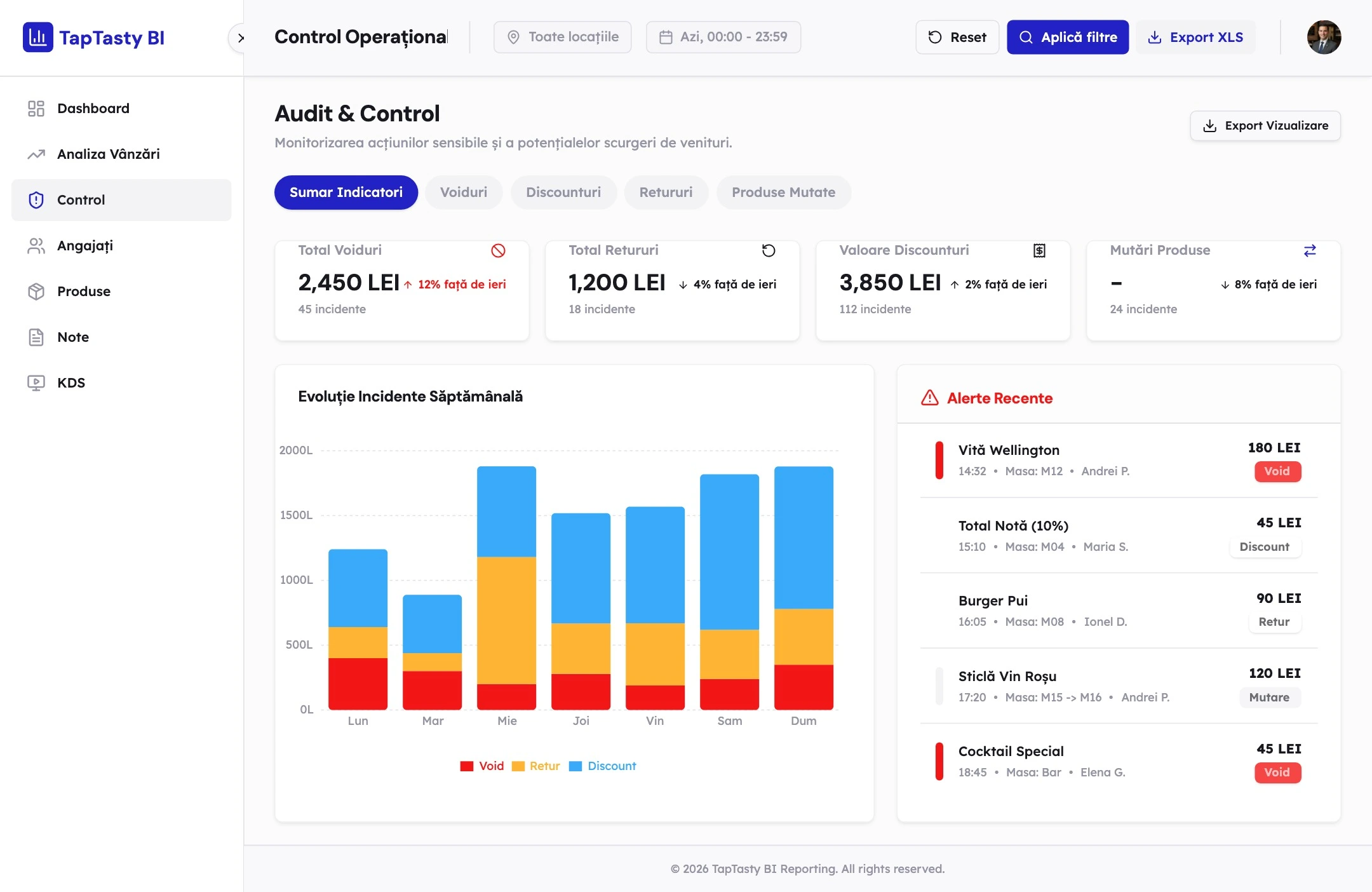
One of the recurring problems in high-volume restaurants is operational control: order cancellations, returns, discounts given for no apparent reason, table transfers at unusual times. Each of these can be legitimate. Together, they can form a pattern worth investigating.
An AI-based audit system analyses these signals in a correlated way. TapTasty BI includes a risk scoring feature that correlates unusual sequences of operations, differences from the average behaviour of colleagues in the same role, repeated transfers, and end-of-shift actions. From this correlation, an explainable score per employee emerges, not an accusation, but a signal that there are situations the manager should review.
The score factors are transparently weighted: unusual sequences contribute 35%, possible impact 25%, differences from colleagues 20%, and timing combinations 20%. The decision of whether to act or not remains entirely with the manager. The system identifies; the person decides.
TapTasty BI also provides complete traceability of a bill from opening to payment: which products were added, when they reached the KDS, when they were marked as ready, how payment was finalised, and whether there were any transfers or modifications. This level of traceability has not existed in traditional restaurants, where a cancellation was simply a deleted line in the system. It now becomes an event with context.
Kitchen Performance Through Data
Another area where artificial intelligence for restaurants brings clarity is kitchen performance. Preparation times, order distribution across stations, peak hours, and the moments when the kitchen falls behind estimated times are all data that exists in the KDS system, but which is rarely analysed systematically.
TapTasty BI extracts this data and transforms it into indicators: which stations have the longest preparation times, at what hours estimated time overruns occur most frequently, which products create bottlenecks in the kitchen. The manager can use this information to redistribute tasks, adjust recipes, or reconfigure workstations. Not intuition, but data. According to Incentivio, restaurants that implement comprehensive digital strategies report a 65% increase in order processing speed and a 60% improvement in operational efficiency. Analysis of kitchen data is one of the drivers of this improvement.
AI for Personalising the Customer Experience
Beyond operations, artificial intelligence for restaurants also helps build better relationships with customers. Not through chatbots or virtual assistants at the counter, but through the use of behavioural data to make communication more relevant.
An AI system can identify that a particular customer usually orders on Thursday evenings, prefers vegetarian dishes, and has not ordered for 28 days. Based on this data, it can automatically trigger a reactivation message with an offer relevant to their profile, sent at the moment they are most likely to order. Not a generic newsletter for all customers, but personalised communication for this specific customer, at the right moment.
This is the essential difference that artificial intelligence introduces into restaurant marketing: from mass communication based on a calendar, to personalised communication based on behaviour. The restaurant no longer sends 500 identical messages and hopes some will react. It sends relevant messages to the customers who have the highest potential to respond.
AI for Menu Optimisation
Another way artificial intelligence can help restaurants is in analysing menu performance. Not all dishes contribute equally to profit. Some sell well but with a thin margin. Others have a good margin but are rarely ordered.
An AI system can classify dishes by sales volume and profit margin, clearly showing which ones deserve to be promoted, which need price or recipe adjustments, and which should be removed from the menu. TapTasty BI includes this analysis in the products and menu module: category rankings, slow-moving products, incidence of products in the average order, and an opportunity matrix. The manager can see at a glance what needs to be optimised, without manually building tables or working with exports from the POS.
What Remains Human
Artificial intelligence for restaurants has clear limits, and it is important to understand them before deciding what to expect from it.
AI can process large volumes of data, identify patterns, and generate signals. It cannot understand the human context behind the data: that the server with the lowest average order value on the shift worked during the most difficult event of the evening, or that the order cancellations came from a communication error resolved on the spot. It cannot assess a customer's satisfaction from a glance, cannot manage a conflict within the team, and cannot create that moment of genuine hospitality that makes a restaurant memorable.
The value of artificial intelligence for restaurants is not in replacing human judgement, but in informing it better. The manager who understands what the data has told them can make better decisions than one who works on instinct. But the decision, the context, and the relationship with people remain profoundly human.
Conclusion
Artificial intelligence for restaurants is not a promise for the future. It is already present in concrete and accessible forms: operational data analysis, POS auditing, kitchen performance tracking, personalised customer communication, and menu optimisation. What makes AI useful in a restaurant is not the sophistication of the technology, but the fact that it transforms data the restaurant is already generating into answers to the questions the manager faces every day.
Platforms such as TapTasty BI integrate these capabilities directly into the restaurant's operational ecosystem, without requiring a dedicated data analyst or a separate infrastructure. The AI assistant, operational audit, and real-time reports are all available from the same system that manages orders, stock, and marketing.