
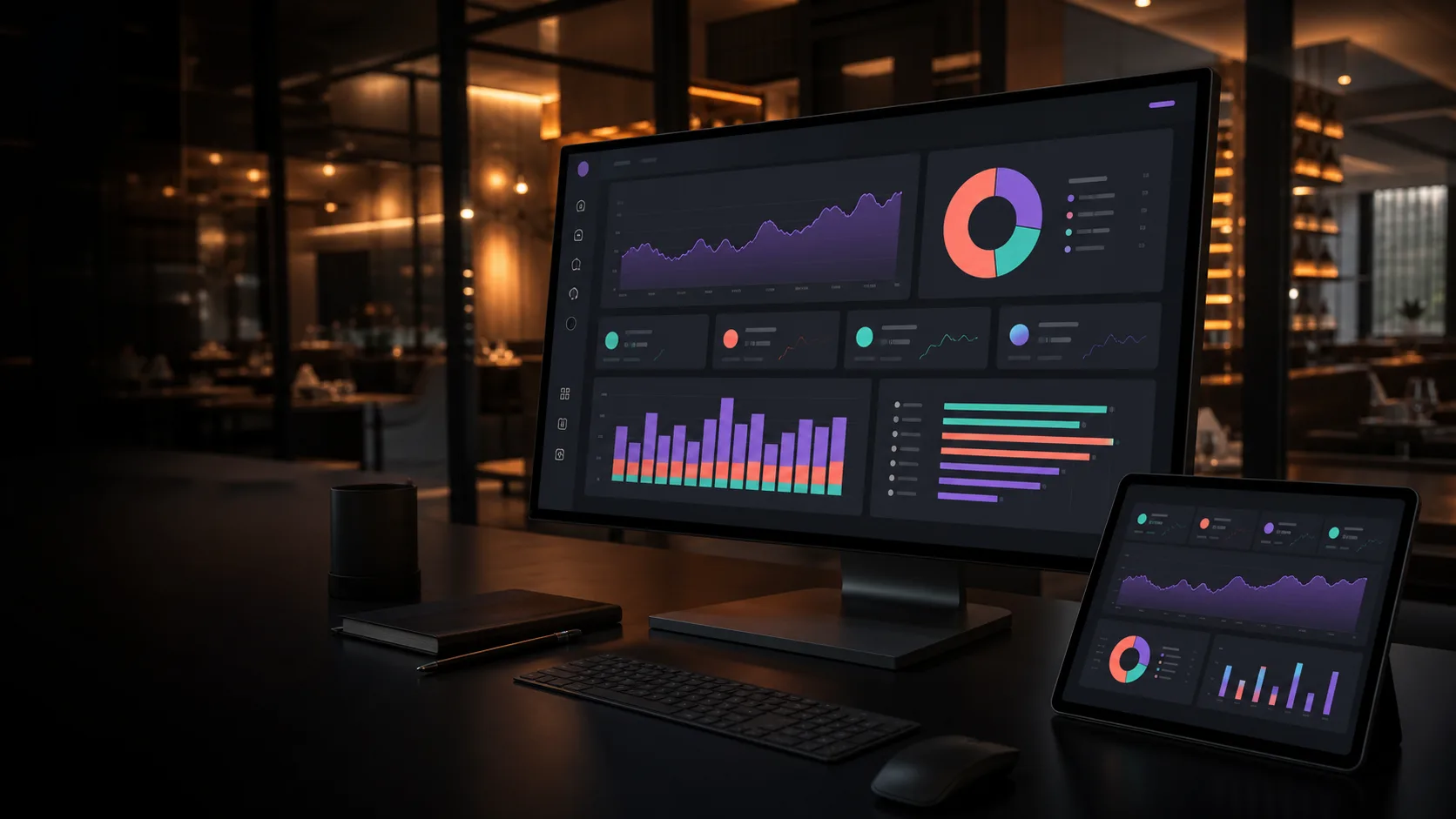
A digital system for restaurants no longer means just a cash register connected to a computer. The market has evolved rapidly, and restaurants that fully digitalize their operations now have access to integrated ecosystems that cover the entire operational cycle: from the moment the customer places an order, to the analysis of the data that guides decisions about the menu, staffing, and marketing.
The problem is that not all solutions available on the market are the same. Some cover only one or two features, others are complete packages. And a restaurant owner who does not know what a modern platform should include risks choosing a solution that will leave them needing to purchase additional, disconnected systems in a few years.
This article is intended to help owners understand which features a modern digital system for restaurants should include, what each one does, and why the absence of any of them creates operational problems.
Centralising Orders from All Channels
The first thing a digital system for restaurants must do is centralise orders. A modern restaurant receives orders from multiple sources: at the counter, at the table through a server, through its own app, through its website, through QR menus, or through third-party delivery platforms. If each channel ends up on a separate device or requires separate manual entry into the system, operational complexity grows rapidly, and along with it so do errors.
A modern POS is the core of this centralisation. It takes in orders from the venue, automatically sends them to the kitchen, and handles payments. Complemented by a mobile POS, servers take orders directly at the table without making repeated trips to a fixed terminal. Alongside these, a modern POS also centralises orders placed through QR table ordering menus or through the self-ordering kiosk, covering all in-venue ordering scenarios.
Orders coming from outside, through aggregators or through the restaurant's own online channels, must pass through the same system as in-venue orders. A system that fragments this flow and requires managing multiple tablets depending on the source of the order will inevitably generate errors and delays. Centralisation is not a luxury, but a basic condition for a coherent operational flow.
Inventory Management and Recipe Costing
A digital system for restaurants that does not manage stock leaves the manager responsible for one of the most time-consuming administrative tasks: manually calculating what should be in stock based on sales. And, beyond the issue of time and complexity, without a clear picture of the real cost per dish, pricing decisions are made on estimates rather than data.
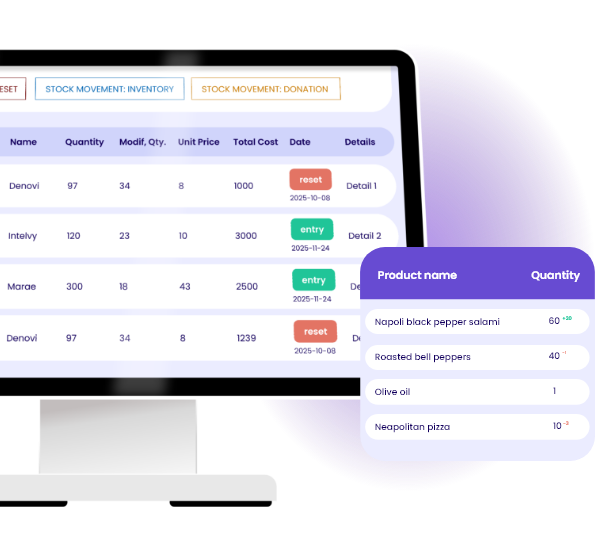
The inventory management module must synchronise automatically with sales. Every time a dish is sold, the ingredients in the recipe are automatically deducted from the theoretical stock. Low-stock alerts appear automatically, without the manager needing to check daily. Discrepancies between theoretical and actual stock, visible at periodic stock-takes, flag waste, portioning errors, or other variables that do not appear in the data.
The TapTasty inventory management software works on exactly this principle: automatic synchronisation with sales, a real-time picture of stock levels, and tools for quickly identifying discrepancies. The recipe module connected to the stock also makes it possible to calculate the real cost per dish, essential information for a sound pricing strategy.
The Kitchen Order Display Screen
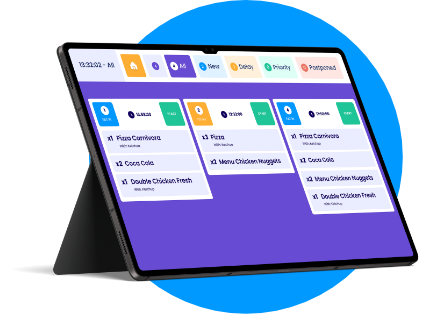
Communication between the dining room and the kitchen is one of the main friction points in a restaurant's operations. Paper tickets get lost, called-out orders can be misheard, and last-minute modifications never reach the cook. The result is errors, dishes that have to be remade, and tension between teams.
A kitchen order display screen, or Kitchen Display System (KDS), should receive orders directly from the POS that centralises them all, and display them by station. The cook can clearly see what needs to be prepared, in what order, and with what specifications, without depending on verbal communication. Orders are automatically prioritised, and modifications arrive on screen in real time. When a dish is ready, the cook marks the order complete, and the server or delivery driver is automatically notified.
The TapTasty KDS communicates in real time with the entire platform ecosystem: it receives orders from the POS, the app, the website, the kiosk, and aggregators, all on the same screen, organised by department. The order status screen (OSD) completes the picture: it displays in real time which orders are being prepared and which are ready for collection, eliminating verbal announcements and the repeated questions of customers on the premises.
The Restaurant's Own Online Ordering Channels
A digital system for restaurants must also include the tools through which the restaurant attracts direct orders, without the commissions charged by third-party platforms. These are, in practice, the channels through which the restaurant's own customer database is built.
The restaurant's mobile app allows customers to order with an account, accumulate loyalty points, view their order history, and recommend the restaurant through the referral programme. It stays on the customer's phone and can send relevant push notifications. The online ordering website covers occasional orders without requiring an app download, and can attract organic traffic through local search optimisation.
Every customer who orders with an account through these channels creates a profile: what they ordered, when, how much they spent, how often they return. This data is the foundation of any marketing and loyalty strategy. Without direct channels, any customer who orders exclusively through aggregators remains anonymous.
Delivery Management
Restaurants with their own delivery fleet need a dedicated tool for coordinating their drivers. Without one, coordination happens in a fragmented way, without a clear collection sequence and without an overview of orders in progress.
The TapTasty delivery management software sends orders directly to the driver's app the moment the kitchen marks them as ready. The driver sees the address, any special instructions, and, if they have multiple orders, the suggested optimal delivery sequence by zone. The manager has a real-time picture of all orders in progress, without managing anything verbally. The customer automatically receives a notification when their order has left.
Loyalty, Marketing and Campaigns
A complete digital system for restaurants does not stop at operations. It also includes the tools through which the restaurant builds relationships with existing customers and motivates them to return.
Loyalty programmes can take several forms: points awarded per dollar spent, redeemable for discounts on future orders; digital stamp cards of the “order N times and get something free” type; gift cards that can be purchased and given as gifts, or converted into loyalty points; and referral programmes with personalised links per customer and recurring rewards for those who bring in new customers. The TapTasty loyalty module includes all of these mechanisms, available across all of the restaurant's ordering channels.
Customer segmentation allows thresholds to be defined based on the number of orders or the total amount spent. When a customer reaches a threshold, they automatically unlock a reward configured by the manager. The targeted marketing module sends personalised push notifications and emails, with configurable days and times for sending, so the right message reaches the right customer at the right moment. Campaigns and promotions cover coupons, buy-one-get-one-free offers, special combo deals, and gift cards for special occasions. Contests and the prize wheel can be activated from the app or website to increase customer engagement.
Reservations
Managing reservations by phone is time-consuming and leaves room for error: overlaps, tables already occupied, details noted incorrectly. A digital system for restaurants must include a reservations module that automates this process.
The TapTasty reservations module allows customers to book directly from the app or website, with availability updated in real time. The manager configures the rules: reservation duration, available tables, or any applicable fees. The reservation arrives automatically in the system, and the table plan in the POS shows in real time who is coming and where they are seated. The team manages everything centrally, without phone calls for confirmation.
Reports and Data Analysis
A digital system for restaurants that does not generate usable reports delivers only half its value. Data from the system must be accessible and structured in a way that guides concrete decisions.
Reports from the TapTasty POS allow sales to be analysed by payment method or server, the best-selling products to be viewed, and the performance of each station or product category to be tracked, all in real time. The manager accesses this data from the management dashboard without manually building any report.
Beyond operational data, integration with Google Analytics 4 and Meta Pixel connects the restaurant's mobile app and website to Google's analytics platform and to Meta. From Google Analytics, the restaurant can track where customers who reach the direct channels come from, which products they view, where they abandon the order, and what the conversion rate is per channel. Through Meta Pixel, it can measure the conversions generated by Facebook and Instagram ads, create personalised audiences for retargeting, and optimise paid campaigns based on the real behaviour of website visitors.
Integrations with External Systems
A digital system for restaurants does not operate in complete isolation. It must integrate with the other tools the restaurant uses or with the platforms from which it receives orders.
The TapTasty integrations cover delivery platforms (Glovo, Bolt Food, Wolt), so orders from these platforms arrive automatically in the same system and on the same KDS as direct orders, with no manual input. The POS can also send the restaurant's orders to Glovo and Wolt for restaurants that do not have their own delivery fleet. Integrations with payment processors, accounting systems, and other specific tools may vary by provider and should be verified explicitly before choosing a platform.
What to Check Before Choosing
Two systems with similar descriptions can be fundamentally different in practice. A few questions that help with a proper evaluation:
Do all modules communicate natively with each other, or do separate integrations need to be configured? An ecosystem with natively connected modules is more stable and easier to manage than a collection of separate applications that need to be synchronised.
Does data from all sales channels end up in the same reports? If sales from the app and those from aggregators are in separate systems, the overall picture is missing.
Can modules be activated gradually, or does everything need to be purchased at once? The flexibility to start with what you need now and add features over time reduces financial risk and allows adaptation at the restaurant's own pace.
Are there hidden costs per transaction, per integration, or per update? The total cost over two or three years is more relevant than the monthly price advertised.
Conclusion
A modern digital system for restaurants is not a single product, but an ecosystem: order management from all channels, automatically synchronised stock, digital communication between the dining room and the kitchen, direct ordering channels, delivery management, loyalty programmes, marketing, reservations, reports, and integrations. The absence of any component from this list means either a manual process to replace it, or a separate system that cannot talk to the rest.
TapTasty covers all of these features in a single ecosystem, with a modular model that allows starting with the tools you need now and completing the ecosystem over time. If you would like to understand which modules suit your restaurant, you can explore TapTasty's modules and request a personalised quote.